The Supreme Court of British Columbia has dismissed a challenge to conditional approval for a tree-services business to use part of agricultural land in Summerland, leaving the Agricultural Land Commission’s decision in place.
In Besler v. British Columbia (Agricultural Land Commission), 2026 BCSC 2038, released October 22, 2026, Justice Gibb-Carsley found that neighbouring residents Vicki and Bradley Besler lacked standing to seek judicial review. He also examined their objections in the alternative and found no basis to overturn the commission’s decision for unreasonableness, unfairness or bias.
The result is not an unrestricted permission for commercial operations on farmland. The approval remains tied to mushroom farming, limits the tree business’s footprint and activities, and requires a District of Summerland temporary use permit. Its maximum six-year duration runs from issuance of that permit, not from the court judgment.
An expanded business sought authorization
The property is within the Agricultural Land Reserve, which restricts non-farm uses to protect agricultural land. It is also subject to Summerland’s zoning and bylaws. A commission approval does not remove those separate local requirements or take the property out of the reserve.
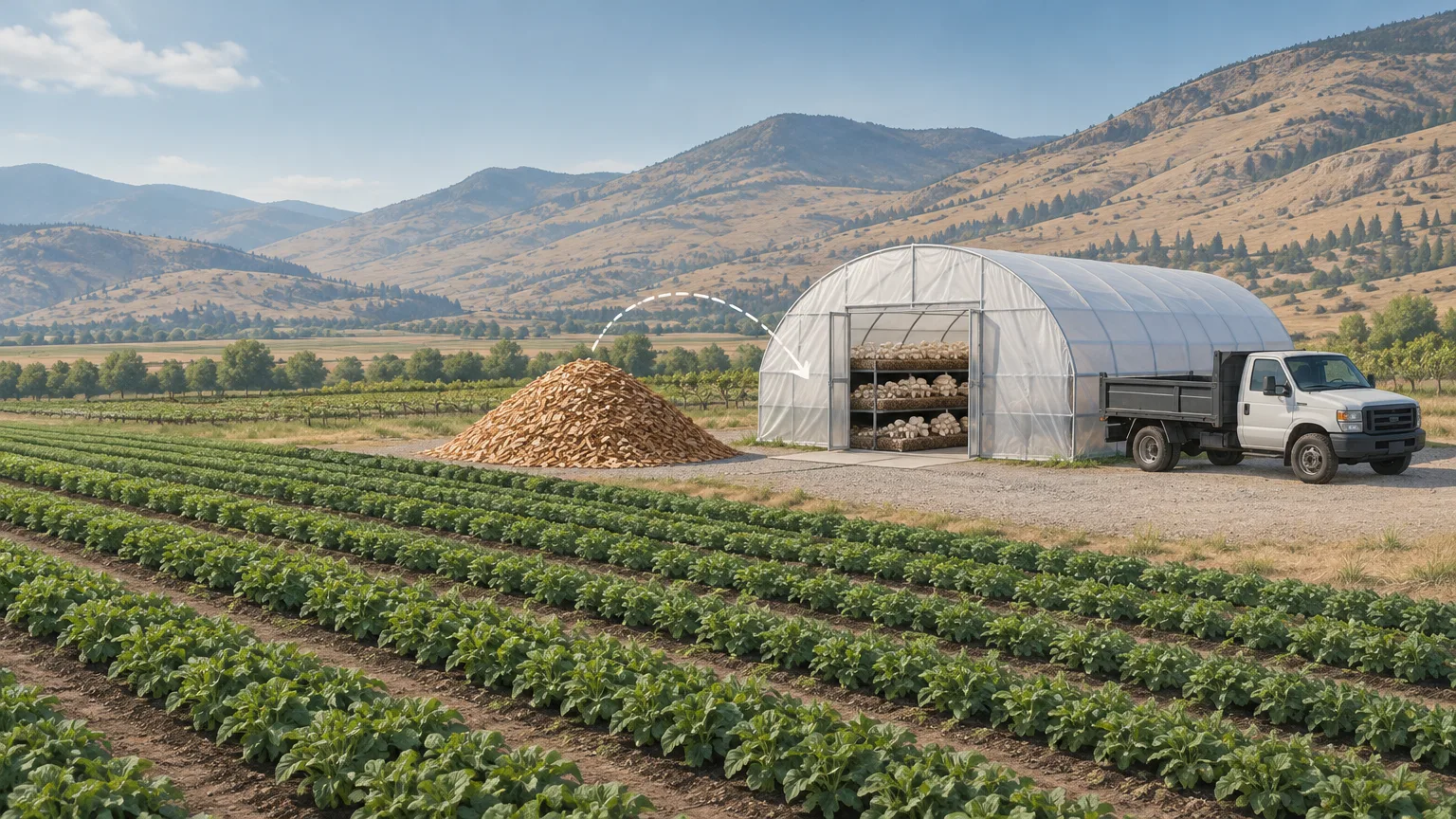
Owner Thorsten Clausen operates a tree-care and removal business and, with others, a mushroom farm on the property. The tree business uses space for trucks, equipment and an office. Its wood chips are supplied to the mushroom farm as growing material and to other local agricultural producers.
The judge accepted that the tree business had expanded beyond its permitted footprint without authorization. Enforcement steps by the commission and the district eventually led Clausen to seek permission for non-farm use. The application proposed 500 square metres for the business’s office, crew area and equipment parking.
Summerland council allowed the application to proceed to the commission in April 2024. That was not itself final land-use approval: the application still had to be decided by the commission, and a district temporary use permit would also be required.
After reviewing staff reports, submissions and a site visit, a three-member commission panel unanimously approved a conditional non-farm-use area in March 2025. It allowed 0.23 hectares, or 2,300 square metres, of the 1.6-hectare property to be used for the tree business.
The conditions remain central
The commission’s approval was limited to the mapped area and made non-transferable, for Clausen’s sole benefit. Among its requirements:
- The mushroom farm must continue operating, and the property must maintain its farm classification for assessment purposes.
- The tree business must continue making wood chips available to the mushroom farm and other local agricultural operators.
- No more than 10 tree-business trucks may be parked in the approved area at one time, and truck maintenance is prohibited on the property.
- No new tree-business infrastructure may be constructed or developed in the non-farm-use area, and the area may not expand without commission approval.
- A district temporary use permit was required within one year of the commission’s March 27, 2025 decision.
- A status report on continued mushroom farming is required within three years of the temporary use permit. The approval lasts a maximum of six years from that permit’s issuance.
The judicial-review decision does not establish that the district permit was obtained or that all conditions have been fulfilled. It upholds the commission’s conditional decision, rather than making a fresh finding about present-day compliance.
Why these neighbours lacked standing
Standing concerns whether a person is entitled to ask the court to review an administrative decision. The Beslers argued both that their own interests were directly affected and that the case should proceed in the public interest.
On private-interest standing, the judge found that they had not identified an infringed private right or supplied sufficient evidence showing that the approved land use affected them in a particular legally relevant way. Living next door and disagreeing with the application were not enough on the record before him.
Their objections focused on the accuracy of the owner’s submissions, his previous non-compliance and the panel’s treatment of their comments. The judge distinguished those concerns from evidence of an actual impact on their specific legal interests. Disliking a tribunal’s assessment of someone’s submissions did not, by itself, create standing.
The statutory framework also mattered. The court found that neighbouring residents had no express or implied participatory rights of the kind they claimed in this non-farm-use application. They could submit letters of comment, but doing so did not give them the full procedural rights of a party. The reasons distinguished this process from other types of land-reserve applications that carry particular public-notice requirements.
For public-interest standing, the court considered whether there was a genuine interest, a serious issue suitable for judicial determination, and a reasonable and effective way to bring that issue before the court. Those considerations are assessed together, rather than as a rigid checklist.
The judge accepted that judicial review presents an issue courts can decide, but found that these petitioners had not demonstrated a genuine public interest sufficiently connected to the commission’s farmland-preservation mandate. Nor had they shown that their proposed review was a reasonable and effective means of bringing the challenge. The ruling was based on their case and evidence; it was not a declaration that neighbours can never challenge commission decisions.
The agricultural connection supported the decision
Although lack of standing was sufficient to dispose of the petition, the judge also addressed the merits because they had been fully argued. His task was to review whether the commission’s reasoning was justified, coherent and supported by the record, not to decide the land-use application anew.
The Beslers argued that the mushroom farm could use other growing material or obtain wood chips without having the tree business based on the property. They also challenged the size of the approved area and the weight given to the owner’s past conduct.
The court found that the commission had considered those concerns. It knew the mushroom farm sometimes used grain-based material instead of wood chips. Nevertheless, it could reasonably accept the detailed explanation gathered during the site visit about the business’s contribution to the mushroom farm and other farms nearby.
The panel did not have to examine every possible alternative source of growing material so long as its overall decision advanced the legislation’s agricultural purposes. The judge treated some uncertainty in the reported wood-chip percentages as minor: the important connection was that the chips supported farming on the property and in the area.
Why the approved area exceeded the application
The 2,300-square-metre approval was substantially larger than the requested 500 square metres. The court found that the commission had a rational explanation for the difference.
Mapping and site information showed that the business used not only the shop, office, parking and storage areas, but also the surrounding driveway for moving trucks, equipment and staff vehicles. The commission assessed that fuller operational footprint rather than accepting the applicant’s smaller figure.
The judge found it reasonable to determine the actual area used and then decide whether conditional non-farm use would be compatible with the commission’s mandate. The continued-farming requirement, limits on trucks and infrastructure, maintenance prohibition and time limit helped explain why the panel found the arrangement acceptable.
Past unauthorized expansion did not disappear from the analysis. But the court held that the application still had to be assessed on its merits. Compliance history could bear on credibility and the risk of future problems; it was not necessarily the sole or governing factor that determined whether permission should be refused.
No basis to overturn the process
The judge also rejected the remaining fairness and bias arguments. Preferring the owner’s explanation over the neighbours’ position was not, on its own, evidence of an unfair process. The court found that the panel had gathered relevant information, considered the objections and reached conclusions supported by its record.
The petition was dismissed, and each party was left to bear its own costs because the commission did not seek a costs award. No damages were awarded. The decision leaves a specific, conditional land-use approval intact; it does not grant general permission to expand commercial businesses throughout the Agricultural Land Reserve.