The Ontario Court of Appeal has ordered that an undeveloped road allowance be registered in the Town of Essex’s name, overturning a ruling that treated the lack of public use or municipal acceptance as a barrier to its legal status as a highway.
In Lecuyer v. Essex (Town), 2026 ONCA 729, decided October 13, 2026, the court held that the Municipal Act, 2001 makes road allowances shown on a registered subdivision plan highways unless they have been closed. The decision distinguishes ownership of such land from a municipality’s responsibility to maintain a road.
The successful appellant, Jodi Lynn Lecuyer, owns two properties separated by the disputed parcel. She wanted to buy that land from the Town but discovered that a numbered company operating a golf course, 11662724 Canada Ltd., held registered title.
Her application sought to amend the Land Titles Register to confirm municipal ownership. Although the Town had earlier said it owned the parcel, it ultimately did not support her application and did not seek ownership itself.
A road on a plan can be a statutory highway
Superior Court Justice Barbara A. MacFarlane dismissed the application in May 2025. She found that the land had neither been dedicated for public use as a highway nor accepted for that purpose by the Town.
The lower court rejected two possible routes under section 26 of the Municipal Act, 2001. Lecuyer did not appeal the finding that the parcel was not a highway that existed on December 31, 2002. Her successful appeal concerned a separate provision, paragraph 5, covering road allowances, highways, streets and lanes shown on a registered plan of subdivision.
The application judge had reasoned that identifying land as a road on a plan was insufficient without evidence of an intention to dedicate it for public use and municipal acceptance.
Justices Huscroft, George and Wilson concluded that this added common-law requirements to clear statutory language. Paragraph 5 does not make a planned road allowance’s highway status depend on its having been developed or assumed for public use.
The court traced the provision to earlier legislation and decisions recognizing that road allowances could become public highways through the subdivision-plan process without municipal assumption. Changes in statutory wording over time had not displaced that principle.
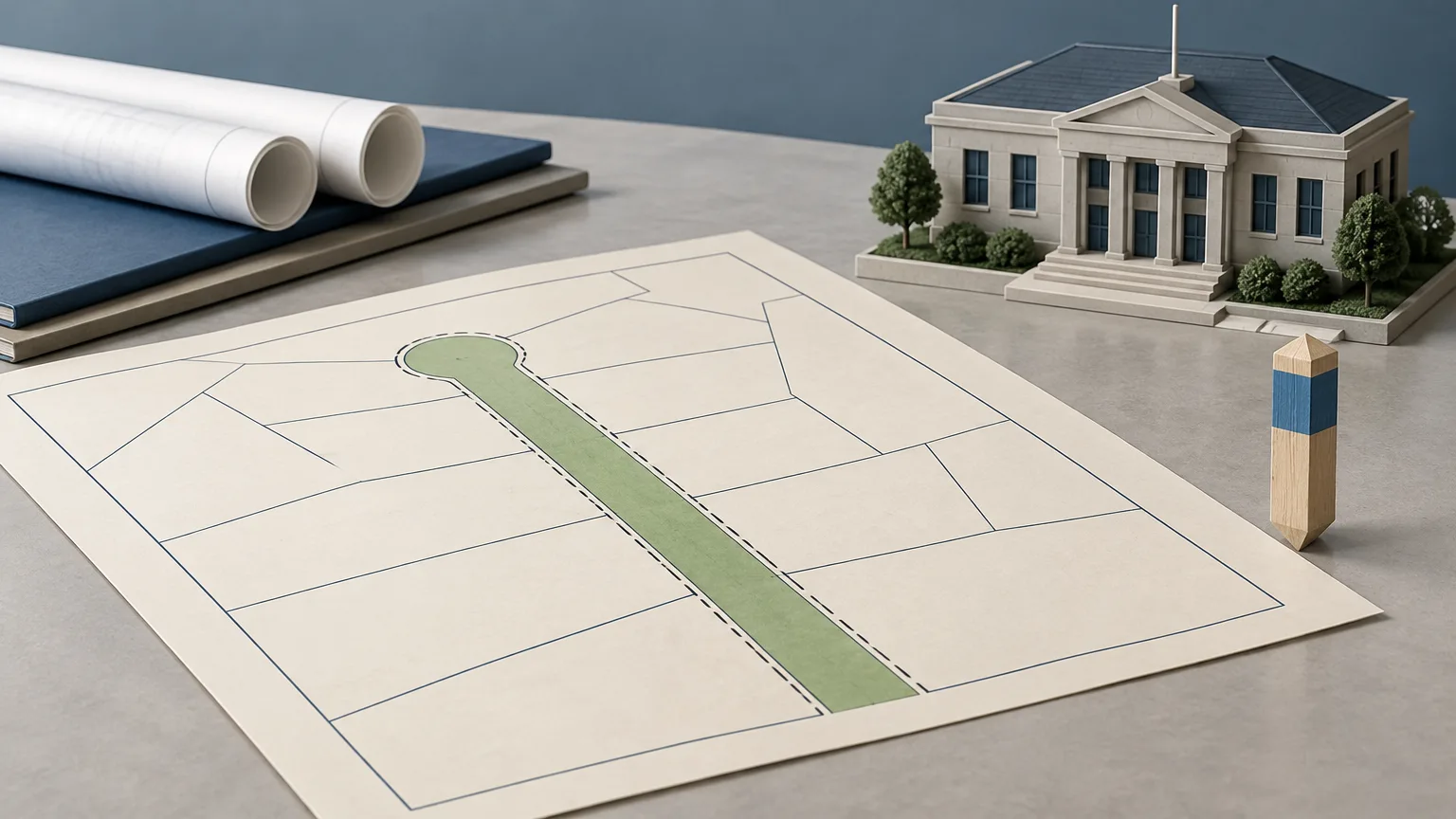
Here, the registered plan showed the disputed parcel as a continuation of the road allowance labelled Lakeview Drive. The parties proceeded on the basis that Lakeview Drive was a planned road on Plan 1598, and no other statutory requirement was disputed.
Ownership and maintenance are different questions
The appeal court distinguished an earlier case relied on below because it concerned whether a municipality had assumed liability to repair a public street. That was a different issue from whether the street had become a statutory highway.
The ruling therefore does not order Essex to build, open or maintain a road on the parcel. It resolves the land’s legal classification and ownership, rather than establishing a general rule about municipal repair liability.
Section 30 provides for municipal ownership of a highway, subject to reserved rights or another person’s interest in the land. The golf course argued that its registered title was such an interest.
The court rejected that argument on this record. The company acknowledged that it did not know how its predecessors came to be on title to Lakeview Drive. The parcel description also made the property subject to the municipality’s interest. In those circumstances, the company had not established an interest that qualified the Town’s ownership.
Town to be entered as owner
The court allowed the appeal, declared the disputed parcel a highway and ordered the Land Titles Register amended to list the Town as its registered owner.
Lecuyer was awarded agreed, all-inclusive costs of $7,500 for the appeal and $11,000 for the application, totalling $18,500. Those are litigation costs, not compensation for the land.
The judgment does not transfer the property to Lecuyer, direct the Town to sell it or give her a right to purchase it. Her wish to buy the parcel explains why the ownership question arose; the order resolves that question in the Town’s favour despite its decision not to seek ownership.