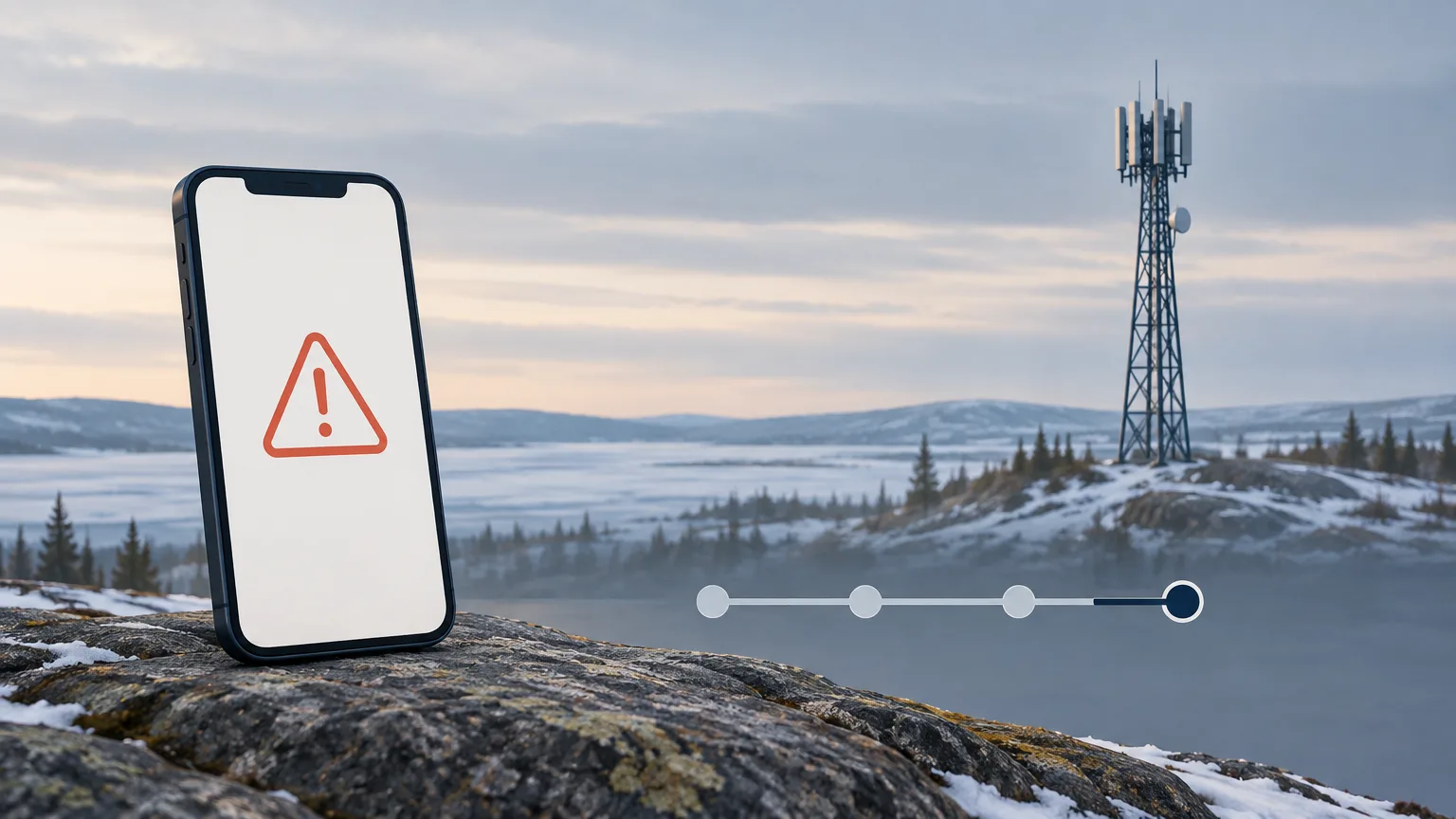
The CRTC has adopted a national standard for reporting mobile coverage that will require wireless providers to distinguish between three levels of outdoor signal strength, starting with the lowest level in the next annual survey in early 2027.
In Telecom Decision CRTC 2026-258, issued October 2, 2026, the commission said inconsistent definitions of coverage have made maps difficult to compare and have left Canadians uncertain about the service they can expect. The standard is intended to improve information used for investment and policy decisions, rather than directly improve service or guarantee a connection.
Providers will submit coverage predictions at a resolution of 50 metres or finer. Public information will be presented at the less detailed 250-metre road-segment level, while the finer data will remain confidential.
Signal strength, not a service guarantee
The three levels use progressively stronger signal thresholds. For 4G and 5G networks, they are minus 110, minus 105 and minus 100 decibel-milliwatts. Separate thresholds apply to older technologies still in service.
The lowest level is associated with signal strength that could support emergency voice calls and public alerts. Level 2 could also support voice or video calls with high voice quality and data speeds of at least three megabits per second downloading and one uploading. Level 3 could support at least 10 megabits per second downloading and two uploading. These are predicted capabilities, not promised speeds.
The commission rejected the proposed labels Emergency, Basic and Advanced in favour of Level 1, Level 2 and Level 3, partly to avoid suggesting that emergency calls are guaranteed.
Only Level 1 reporting will be required for the early-2027 survey. Levels 2 and 3 will follow in later surveys; the decision does not assign them a specific implementation year.
The standard applies to outdoor coverage and not to users in motion. It excludes indoor coverage and, for now, low Earth orbit satellite-to-mobile services. Providers must continue reporting on deployed terrestrial technologies, including older networks that still serve communities.
Some providers disputed the need for a new standard, while governments and consumer groups sought maps that better reflected real-world experience. Indigenous and accessibility organizations pressed for indoor coverage reporting, and municipal and accessibility groups supported quality-of-service metrics. The commission found that standardizing existing signal-strength models would improve comparisons with limited additional burden, while phasing implementation would ease the immediate adjustment.
The commission declined to add measures such as latency, packet loss or dropped-call rates, citing the reporting burden and differences in providers’ capabilities. Coverage will continue to be predicted through models rather than measured at every location.
Validation and consumer challenges
The regulator plans to strengthen its checks using several sources, including drive tests, crowdsourced data and transmitter-site information. Sampling will include rural, remote and Indigenous communities. Providers will have an opportunity to address discrepancies rather than having their submissions routinely overridden.
A planned feature in the next version of the National Broadband Map will let Canadians challenge reported coverage. It is also intended to let Deaf, Deaf-Blind and Hard-of-Hearing users flag places where reported service does not support their video communications needs. The decision describes a feature to be developed, not a verified current service.
Annual reporting will remain, with providers able to submit corrections or updates between surveys. The commission will retain flexible mapping-file formats and provide guidance, sample files and direct assistance, including engagement with Indigenous providers through its Indigenous Relations Team.
The CRTC’s Annual Facilities Survey guidance now flags the new reporting standard. The decision’s phased timetable remains important: adoption of the standard does not mean that maps based on all three levels are already available.