The Alberta Utilities Commission has refused a proposed 1,400-megawatt gas-fired power plant and 1,800 megawatts of backup diesel generation in Olds, finding that potential engineering solutions did not answer the more basic question of whether a development of that scale belonged beside an established community.
In Decision 30732-D01-2026, dated August 17, 2026, the commission found that Synapse Real Estate Corp. had not supplied a compelling justification for its chosen location. It denied the power-plant application without requiring a further full hearing process, concluding that the existing record was sufficient.
The decision does not reject a data centre as such. The commission emphasized that it regulates power plants, not data centres, and was not deciding whether a data centre would be suitable at the site.
Size and proximity drove the assessment
The proposed plant would supply electricity exclusively to a co-located data centre, without connecting to Alberta’s electricity grid. Its gas and steam generating equipment would provide 1,400 megawatts of capacity, supported by 600 emergency diesel generators with a combined capacity of 1,800 megawatts. The latter figure described backup capacity, not continuous generation.
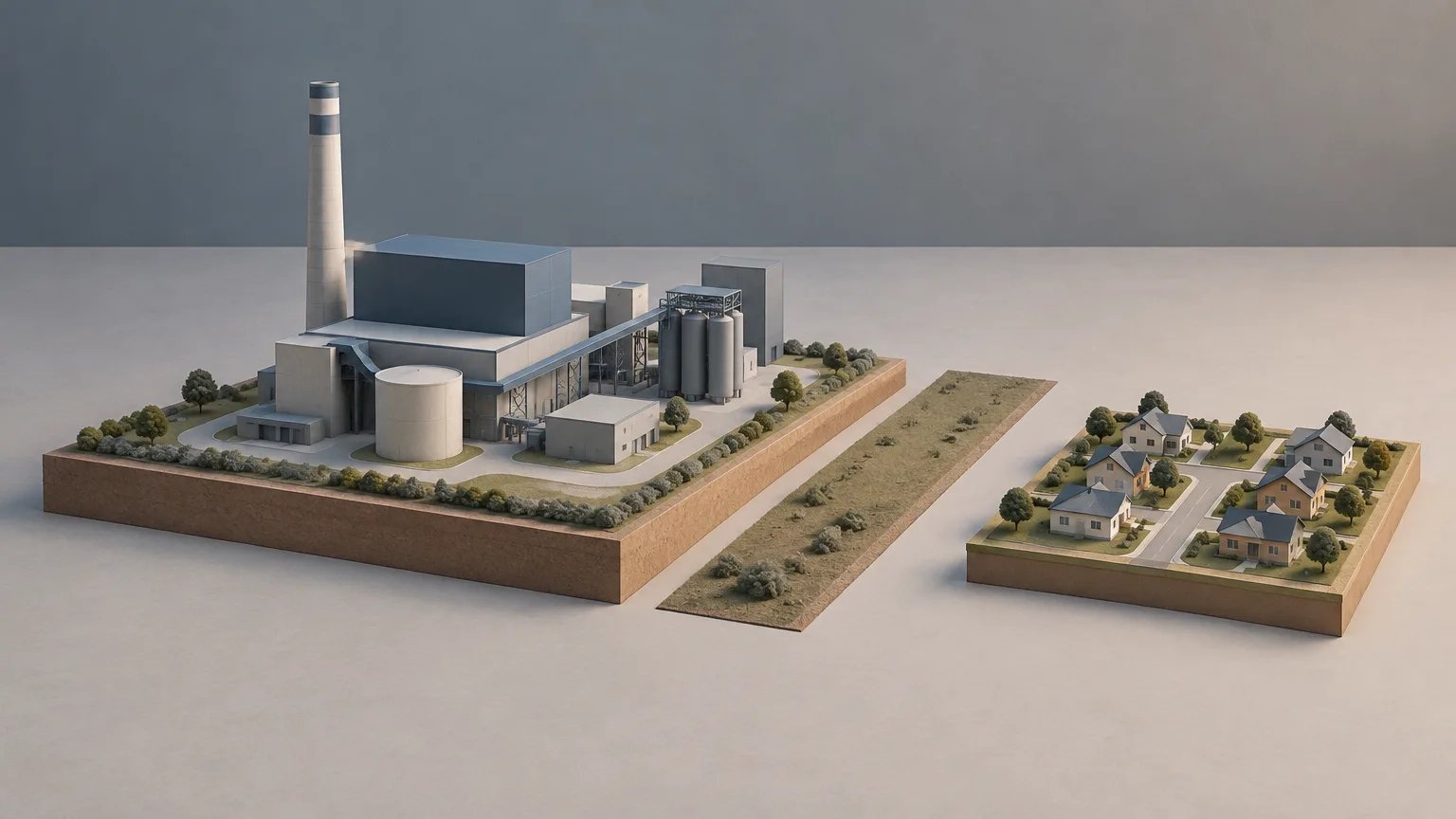
Together, the power plant, backup generators and data-centre infrastructure would occupy approximately 273 acres—about a tenth of the town’s area. Although the site was zoned light industrial, it was across from residential neighbourhoods and near shops, restaurants and hotels. The site boundary was approximately 30 metres from the edge of the first row of residential properties; the reasons did not say the generating units themselves would be that close. More than 700 residences were within 800 metres of the project lands.
Under section 17 of the Alberta Utilities Commission Act, the commission had to weigh the project’s social, economic, environmental and other effects. Synapse bore the burden of establishing that approval was in the public interest. Meeting the information requirements in the commission’s facility-application and noise rules would not automatically secure approval.
Zoning and investment benefits did not establish suitability
Synapse argued that data centres were a discretionary use in the light-industrial district and that the power plant would be accessory to the principal data-centre use, requiring no bylaw amendment. It also said it had considered alternatives in Rocky View, Mountain View and Ponoka counties, but preferred Olds for its infrastructure, workforce, land-use compatibility and reduced agricultural impacts.
The commission treated potential municipal permissibility as relevant, not conclusive. Its public-interest responsibility was provincial in scope. It considered the town’s support in principle and the potential for investment, employment and tax revenue, but found those benefits insufficient to justify this location.
Crucially, Synapse had not shown that the plant needed to be beside the town’s existing development. Unlike a facility tied to a particular resource, grid connection or industrial complex, this off-grid project would require a new gas pipeline. That weakened the case for a location-specific constraint.
Identifying reasons to prefer Olds was not the same as demonstrating that more separated alternatives were unavailable or infeasible. Nor had Synapse established that the proposed benefits could not be achieved elsewhere with fewer land-use conflicts.
The commission accepted that noise, air emissions and other technical effects might be mitigated through design, operating restrictions or approval conditions. But those possibilities did not resolve the incompatibility between a facility of this scale and its immediate surroundings.
A sufficient record, not a vote on the project
An earlier application had been closed for errors, incomplete information and other deficiencies, without a decision on the public interest. Synapse filed the present application on April 3, 2026. The commission then put siting questions to the company in two rounds of information requests.
Approximately 1,500 interested parties submitted statements of intent to participate, and 919 interveners received standing. The commission stressed that the number of participants did not determine the public interest. Their submissions nevertheless showed persistent concerns about the development’s scale and relationship to the surrounding community, beyond individual technical effects.
Synapse had undertaken mailouts, meetings, open houses and other consultation. The commission noted questions about whether all affected residents had been properly notified, but expressly said consultation deficiencies were not the reason for denying this application.
Having reviewed the application, the responses to its questions and participation statements, the commission found it had enough information to decide. Synapse had received several opportunities to address proximity and siting. Requiring a full hearing process would impose further time and expense without being necessary to resolve the application.
The refusal therefore rests on a site-specific failure to establish the public interest—not a blanket prohibition on gas generation, data centres or development within municipal boundaries. Technical feasibility and possible mitigation did not discharge the applicant’s separate burden of justifying this unusually large plant at this location.