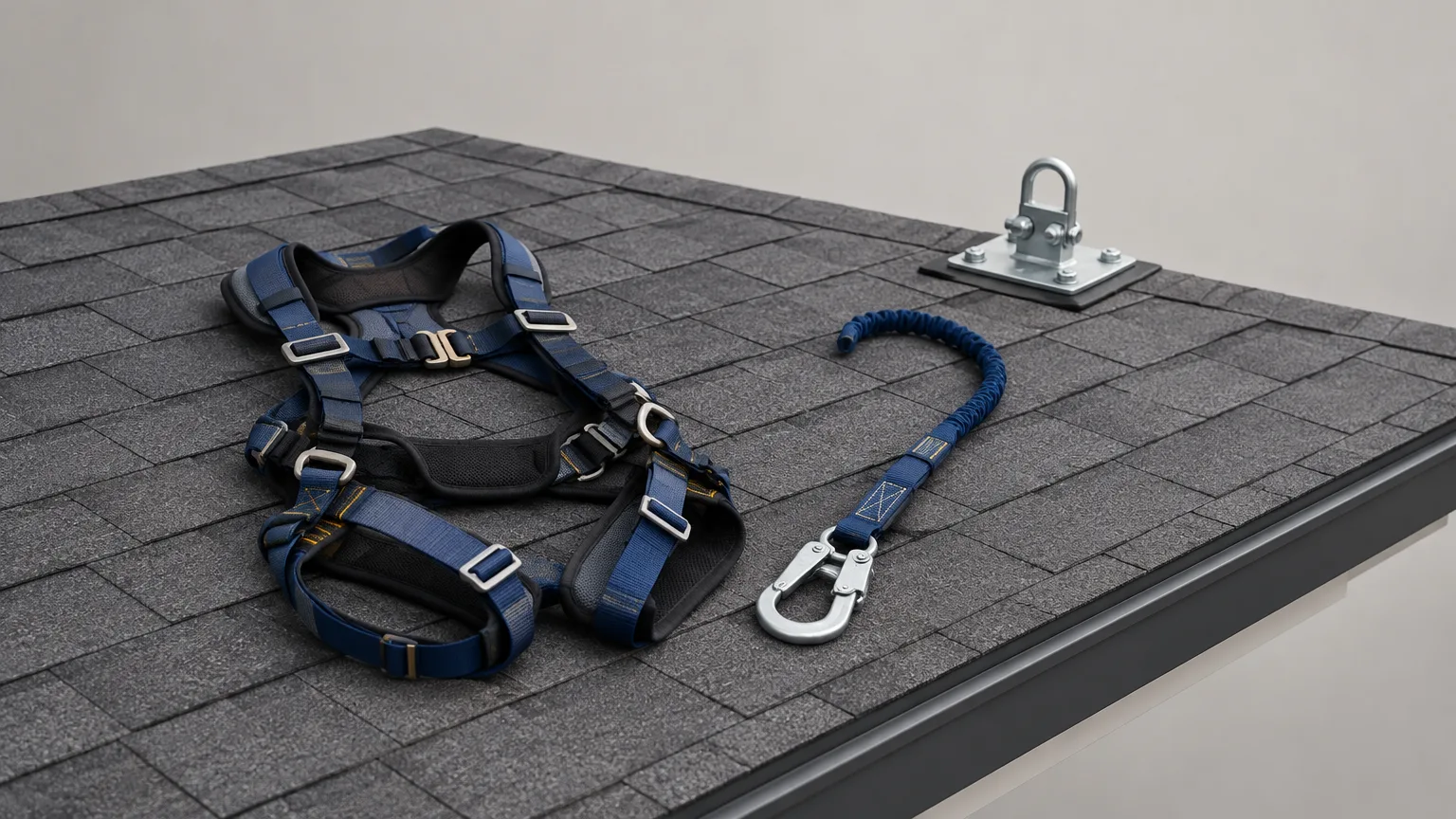
A Manitoba roofing company lost its challenge to fall-protection orders after a labour board panel found that workers on a bungalow roof had been wearing harnesses without connecting them to the installed safety system.
In Above All Roofing & Exteriors Inc. and the Director of Workplace Safety and Health, Order No. 141, case 18/25/WSH, issued April 14, 2026, the Manitoba Labour Board upheld a stop-work and improvement order concerning a November 15, 2024 job.
The decision was not a finding that Above All was generally an unsafe company. The board expressly confined its conclusion to non-compliance at the particular property on that date. Nor did it impose a continuing shutdown: the officer had allowed work to resume minutes after the workers tied off.
Harnesses were not enough
A safety officer attended after a report of roof work without proper fall protection. He saw three workers wearing harnesses and lanyards but not attached to anchor points. According to his evidence, they hurried to connect themselves when he approached.
The site foreman was among the three workers. After inspecting the installed system and receiving an assurance that they would remain tied off, the officer recorded compliance and permitted work to continue.
The company appealed first to the workplace safety director, who upheld the order in January 2025, and then to the board. It disputed the height requiring protection, the officer's authority to stop work and the decision to issue an order against the employer rather than individual workers.
A lower roof did not necessarily remove the duty
The parties agreed one roof edge was at least three metres above the ground. Above All maintained the other was only eight feet high, below that threshold.
The board described both sides' height evidence as weak. Each relied partly on information from the foreman, who was not called as a witness. It preferred the officer's visual assessment that both edges were about three metres high over the company's consultant's account of a measurement made by someone else.
The panel also gave an alternative reason. Manitoba's regulation requires protection for a fall of less than three metres where the landing surface or another feature increases the risk of injury. The concrete driveway beneath the disputed side met that concern on the accepted evidence.
No need to wait for a worker to slip
Above All argued that there had been no imminent risk: the roof was gently sloped and the officer had not seen anyone leaning over an edge, losing balance or slipping. It also questioned whether a genuine imminent risk was consistent with allowing work to restart so quickly.
The board rejected both arguments. It accepted that the unprotected roof work created imminent risk and that promptly correcting the problem did not undermine the original order. The equipment was already present; the missing step was using it.
The company also argued that a stop-work order required an earlier improvement order and warning at that particular property. The board rejected such a narrow approach to transient roofing jobs, reasoning that a job could be finished before that sequence was completed. In these circumstances, the concept of a workplace extended broadly enough to include the employer as a whole. Independently, the imminent-risk finding supported the order regardless of the company's compliance history.
Employee duties did not displace employer duties
Above All pointed to its safety training, equipment and certification, and argued that workers should bear responsibility for failing to use their protective equipment.
The board found that workers' obligations did not replace the employer's. The foreman represented the employer at the site and was responsible both for tying off himself and ensuring that the other workers did so.
The company further argued that the fall-arrest equipment could not effectively catch someone at the available height. That submission did not excuse the situation: the board said an effective alternative system should have been used if the installed arrangement would not protect the workers. Its reasons distinguished systems designed to prevent a fall from those intended to arrest one.
The appeal was dismissed and the historical orders stood. The board applied the existing regulation to the worksite; it did not create an exemption for low-sloped bungalow roofs or impose a monetary penalty in this decision.