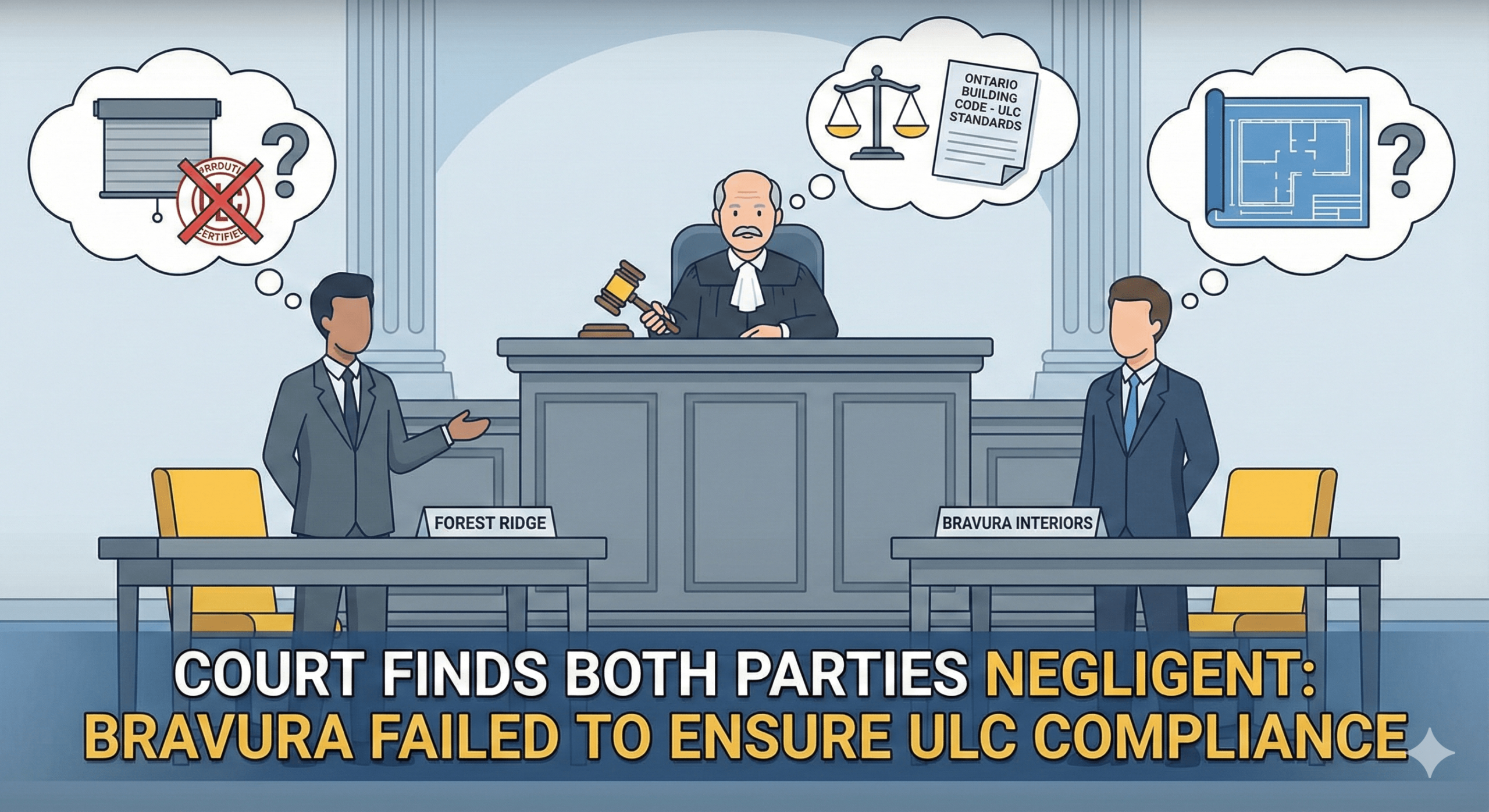
The Ontario Superior Court of Justice has recently waded into a complex commercial dispute involving the sale of fire safety equipment that ultimately failed to meet the requirements of the Ontario Building Code. In a decision arising from the Oshawa Small Claims Court, Deputy Judge David M. José was tasked with determining who should bear the financial burden when a specialized product, despite being manufactured to specification, is rejected by municipal inspectors. The case of Forest Ridge Inc. v Bravura Interiors Ltd., 2025 CanLII 110484 (ON SCSM) serves as a reminder for both suppliers and purchasers in the construction industry regarding their shared responsibilities for regulatory compliance.
The conflict began in December 2021 during a substantial renovation project of a commercial building located in Toronto. Forest Ridge Inc., the purchaser and owner of the project, was represented by its project manager, Stefan Kojic of Prism Partners Inc. Seeking to secure necessary fire safety components for the building, Kojic contacted Michael Vetzal, the Director of Business Management at Bravura Interiors Ltd. Bravura, operating under the name Bravura Group, is a company known for selling interior architectural products, including specialized smoke and fire mitigation systems.
According to the evidence presented at trial, the initial communication between the two parties was a telephone call that became a central point of contention during the litigation. Kojic testified that he originally reached out to Bravura to inquire about purchasing fire shutters, which were the components originally specified in the project's architectural drawings. However, Kojic claimed that Vetzal suggested fire curtains as a superior alternative. These fabric curtains, specifically the Smoke Guard Models 2100 and 2500, were marketed as being more cost-effective and aesthetically pleasing than traditional shutters, as they could be more easily concealed within the building's architecture.
Vetzal provided a different account of this initial interaction, asserting that Kojic had asked for fire curtains from the very beginning. However, after reviewing the architectural plans that existed at the time of the call, Deputy Judge José found that Kojic’s version of events was more probable. The judge noted that the drawings dated December 16, 2021, clearly incorporated fire shutters rather than curtains. It was only after this initial conversation and the subsequent receipt of Bravura’s product specifications that the architectural plans were modified to replace the shutters with the Smoke Guard curtain system.
Following that first call, the relationship proceeded with a series of technical exchanges. In late December 2021, Vetzal sent brochures and specification sheets for the fire curtains to Kojic. While the judge noted that the actual attachments were not reproduced for the court, it was established that Bravura only sold and installed one type of fire curtain manufactured in the United States. Throughout January 2022, several quotes were exchanged as the parties refined the design and installation details. On January 21, 2022, a final quote of $85,089, including taxes, was provided, and Forest Ridge issued a formal purchase order on February 8, 2022.
The project appeared to be moving forward successfully through the early months of 2022. On March 1, the architect for Forest Ridge returned marked-up drawings to Bravura, showing a high level of professional oversight and control by the purchaser’s design team. Manufacturing and installation milestones were met, and Forest Ridge made interim payments totaling more than $68,000. The momentum was halted abruptly when an inspector from the City of Toronto arrived for a site visit. The inspector refused to sign off on the building permit because the Smoke Guard fire curtains were not certified by the Underwriters Laboratories of Canada, commonly known as ULC.
The product provided by Bravura carried a UL certification, which is the standard American safety certification. While the standards may be similar, the Ontario Building Code specifically required fire curtains to be compliant with the CAN/ULC-S104 standard. Despite efforts by both Forest Ridge and Bravura to convince the inspector to accept the American certification, or to acknowledge that similar curtains had been installed in other Toronto buildings without issue, the inspector remained firm. Without the ULC certification, the curtains were deemed unusable for the project, and Forest Ridge was forced to source a different, compliant product to meet its looming occupancy deadlines.
In the ensuing legal battle, Forest Ridge sought a full refund of the $68,922.09 it had paid to Bravura, though it capped its claim at the 35,000 dollar limit of the Small Claims Court. Forest Ridge argued that Bravura was negligent for selling a product that it knew, or ought to have known, would not pass a Canadian inspection. In response, Bravura filed a counterclaim for the remaining balance of the contract, approximately $16,166. Bravura argued that it had provided all the technical specifications to Forest Ridge months before the purchase was finalized. The supplier contended that it was the responsibility of Forest Ridge and its team of architects and fire code consultants to ensure the product met the local regulatory requirements.
In his analysis, Deputy Judge José described the dispute as a classic case where both parties were effectively pointing the finger at the other for a shared failure. To resolve the impasse, the judge looked to the legal principle of contributory fault. He cited a recent Ontario Court of Appeal decision, Arcamm Electrical Services Ltd. v. Avison Young Real Estate Management Services LP, which confirmed that damages in contract cases can be apportioned based on the degree of fault of both the plaintiff and the defendant. The judge explained that while the Negligence Act does not strictly apply to contract law, the principles of fairness, equity, and justice allow a court to reduce a claim if the claimant's own actions contributed to the loss.
The court found that both Forest Ridge and Bravura had been negligent in their dealings. Regarding Bravura, the judge determined that as a specialized seller of fire safety products in Ontario, the company should have been aware that its products were not ULC certified in accordance with the Ontario Building Code. The judge noted that the seller seemed to have been oblivious to the issue because previous installations in Toronto had seemingly passed inspection without being challenged. However, this history of success did not excuse the failure to ensure the product met the literal requirements of the law. The judge characterized Bravura’s omission not as fraudulent, but as a negligent lack of awareness.
Conversely, the court found that Forest Ridge was also at fault. The purchaser was not an unsophisticated individual but a commercial entity supported by a flank of professional experts, including architects, engineers, and fire code consultants. The judge noted that the specification sheets, which clearly identified the UL certification, had been in the purchaser’s possession for a considerable amount of time before the contract was signed. It was the job of these professionals to ensure that the materials being sourced were compliant with the building code. The judge remarked that if the purchaser’s team had looked at the documents more carefully instead of simply assuming that any fire curtain would suffice, the problem could have been avoided.
Ultimately, the court determined that the most equitable solution was to split the responsibility equally between the two parties. Because both sides had failed to have a heart-to-heart discussion about the specific certification requirements, the judge ordered that the total contract cost be divided 50/50. The total value of the contract, including taxes, was $85,089. Under the judge’s ruling, Forest Ridge was responsible for $42,544.50, representing half of the total price. Since Forest Ridge had already paid $68,922.09 to Bravura, the supplier was ordered to return the difference.
As a result of this calculation, Bravura was ordered to pay Forest Ridge $26,377.50 in damages. The judge also awarded prejudgment interest at a rate of 1.8 percent, totaling $1,528.45, calculated from the date of the last payment in July 2022. The counterclaim filed by Bravura was dismissed in its entirety, and the court specifically noted that no personal liability was found against the individuals involved in the project. The parties were given a period of fourteen days to attempt to resolve the issue of legal costs before the court would intervene to make a final determination on that matter.
The decision highlights the risks inherent in the construction and renovation industry when participants rely on assumptions rather than verified compliance. For suppliers, the ruling suggests a duty to ensure that products marketed for use in a specific jurisdiction meet that jurisdiction's regulatory standards. For purchasers and project managers, it serves as a warning that employing professionals does not insulate a company from the consequences of failing to perform due diligence on technical specifications. In the eyes of the court, when two sophisticated parties fail to address a fundamental regulatory requirement, they may find themselves sharing the cost of the resulting failure.
Read more Ontario legal news here.