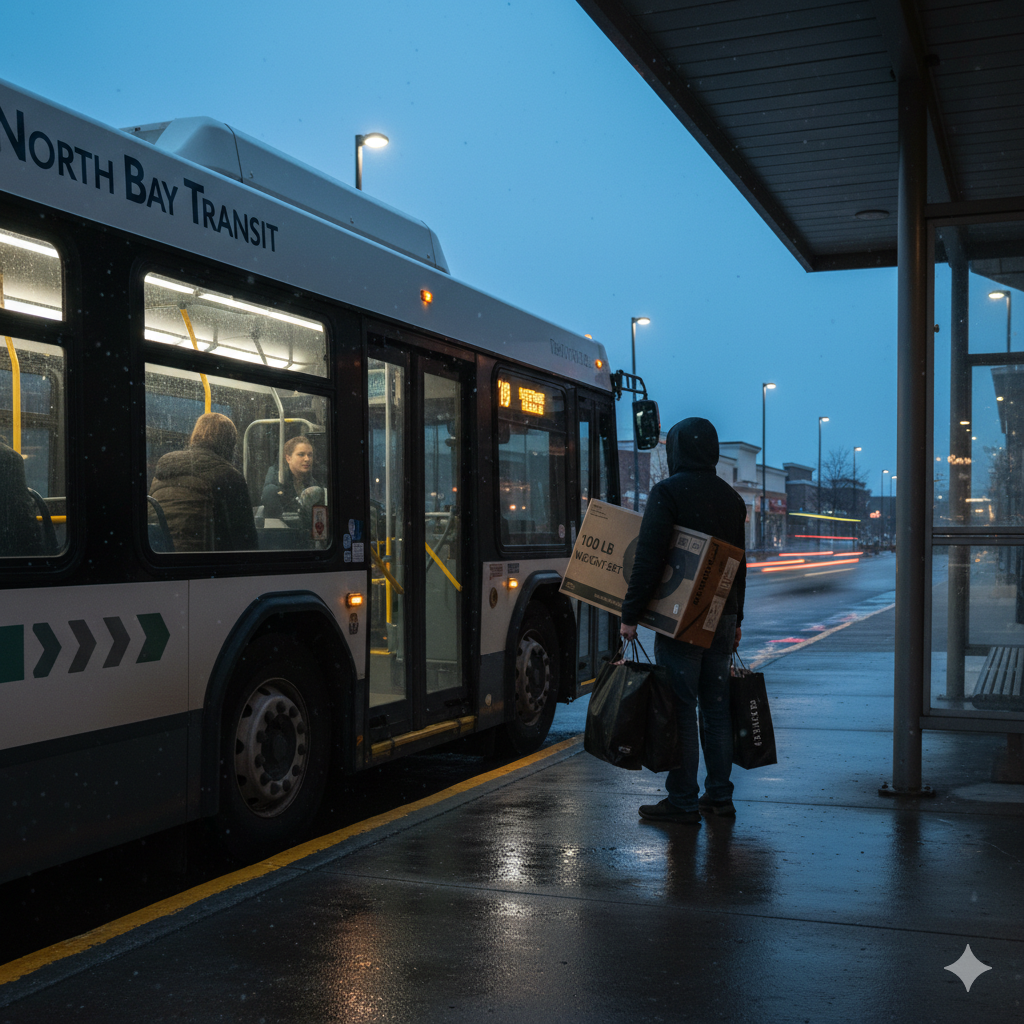
The Human Rights Tribunal of Ontario has ordered the City of North Bay to pay $45,000 to an Indigenous mother and her two sons after finding a North Bay Transit operator discriminated against them based on their race1. In a decision dated December 18, 2024, Adjudicator Karen Mason found that the driver refused to let the family board a bus and repeatedly told them to “get out,” and also found that the transit service failed in its duty to properly investigate the subsequent complaint.
The applications were brought by Paula Nakogee and her sons, Kendall and Austin Nakogee, who self-identify as Indigenous, First Nations, and Cree. They alleged discrimination in services contrary to the Human Rights Code. The incident occurred when the family, who lived downtown and relied on public transportation, attempted to board a bus at the Northgate Shopping Centre. The Corporation of the City of North Bay denied the allegations, submitting that the interaction was a “misunderstanding” and that the driver had a history of poor customer interactions that were not related to race. The city also argued that it had investigated the matter appropriately.
The tribunal heard evidence detailing the events of the day, which occurred prior to the applications being filed in March 2018. The Nakogee family was at the mall and had purchased numerous heavy items, including groceries, personal hygiene products, and a 100-pound set of exercise weights. They waited for the 5:45 pm Ski Club Route bus, which they specifically chose because, while slower, it offered a direct route to their home and avoided a transfer with their heavy packages.
The applicants testified that they were in a line with approximately 15 to 20 other people, whom they described as Caucasian and East Indian. The Nakogee family members were the only visibly Indigenous people waiting to board. They testified that several other passengers boarded the bus ahead of them without any issue, and the Transit Operator did not question any of these other passengers about their routes.
When Kendall Nakogee, holding a multiple-trip bus pass, stepped onto the bus first, followed closely by his mother and brother, the operator’s conduct allegedly changed. Ms. Nakogee and Austin Nakogee both testified that the driver looked at the pass and gave them a “dirty look.” Austin Nakogee described their appearance in his testimony, stating, “We are very tall, the way we dress too. We dress very Rez-y, jeans, typical of how Native Canadians from remote reserves wear jeans, hoody, boots.” The adjudicator noted that while the respondent suggested in its submissions that all youth dress this way, it did not question the applicants on this point during cross-examination. Adjudicator Mason found that the driver observed the applicants and could identify them as Indigenous based on their physical appearance.
The applicants testified that they did not ask the driver for directions. Despite this, the operator confronted them. The family’s evidence was that the driver did not suggest an alternative, faster route, but instead “forced the applicants to leave the bus telling them repeatedly to ‘get out’.”
In contrast, the Transit Operator testified that he did not remember the incident at all. He suggested that passengers sometimes find his manner abrasive because of his “French-Canadian background” and claimed that he does not speak to customers unless they speak to him first. Given the operator’s lack of memory, the adjudicator relied solely on the evidence of the applicants to determine the facts of the interaction, finding their testimony sufficiently congruent and reliable despite the five and a half years that had passed.
The tribunal also admitted into evidence six disciplinary records for the operator from the nine years preceding the incident. These records detailed coaching or suspensions for “inappropriate interactions with the public” and “poor customer service,” including previous incidents where the operator had prevented passengers from boarding buses or asked them to leave in conflict with North Bay Transit’s protocols.
Adjudicator Mason found, on a balance of probabilities, that the driver prevented the family from boarding in an aggressive manner and challenged them about their destination. She found that he “treated the applicants differently than he treated the other passengers on the bus” and provided no explanation for his actions. Both the current and retired Transit Managers testified that while an operator might suggest a more efficient route, there was no policy that allowed an operator to remove a passenger for not taking one. The tribunal concluded that the respondent had “not provided any reason to explain why the Transit Operator refused to allow the applicants to board the bus.” Weighing all the evidence, the adjudicator found that the refusal was discriminatory and based, at least in part, on the applicants’ race, colour, and ancestry.
The decision also heavily scrutinized North Bay Transit’s failure to adequately investigate the complaint Ms. Nakogee filed on the day of the incident. Ms. Nakogee testified she called the after-hours complaint line and identified herself as Indigenous to the Public Works Dispatcher. The dispatcher, however, did not note this fact on the “Public Works and Services Division Request for Assistance Form,” although she did note that the sons lived with disabilities.
The complaint was forwarded to the Transit Supervisor. The Supervisor testified that he spoke to Ms. Nakogee and told her it was “probably a misunderstanding.” He then spoke to the Transit Operator. The Supervisor admitted that he never interviewed Kendall or Austin Nakogee, despite knowing they were part of the complaint. He made no notes of his investigation or its outcome on the official form and did not sign it. He concluded the matter was a “misunderstanding.” The Transit Manager testified that there was no tracking mechanism for complaint outcomes and that he could not tell from the complaint form what steps had been taken.
The adjudicator found that North Bay Transit had a duty to investigate complaints of discrimination and failed to do so. The investigation was deemed not to be serious, as the Supervisor had pre-judged the outcome. The tribunal found the complaint mechanism was not “sufficiently robust,” noting a lack of formal investigation training for supervisors, who learned “on the job.” There was also no managerial oversight of investigations and no tracking of data to identify trends of discrimination. Testimony from transit managers revealed that while the city had policies referencing the Human Rights Code, staff received no specific training on racial discrimination or racial profiling; training was focused on providing services to individuals with disabilities.
In determining the remedy, the applicants each requested $15,000 for injury to their dignity, feelings, and self-respect. They stated the incident had a lasting emotional impact and made them fearful of using public transit. The respondent argued for a much lower amount, claiming the incident was “transitory, brief, and outside of an existing relationship.” Adjudicator Mason rejected this position, stating that public transit is an “essential service” provided by a municipality and, unlike a retail outlet, has “no direct competitor.” The applicants testified that after the incident, they were forced to use costly taxis, providing receipts as evidence, or walk long distances in inclement weather. The adjudicator also found that the “failure to properly investigate the incident,” including the failure to include two of the three applicants in the process, impacted the remedy.
The tribunal ordered the respondent to pay $15,000 to each of the three applicants, for a total of $45,000, plus pre-judgment interest calculated from March 21, 2018.
In addition to the monetary compensation, the tribunal issued significant public interest remedies. Within 12 months, North Bay Transit must develop and implement a formal policy and procedure for the investigation of customer complaints. This new policy must address data collection, service standards for investigation timelines, standard protocols, a method for documenting and tracking complaints to identify discrimination, and a process for ensuring management oversight.
Finally, the tribunal ordered that within 12 months, all of the respondent’s staff must receive training, developed and delivered by an expert, on racial discrimination, racial profiling, and Indigenous cultural competence.