
A Nanaimo man has been found guilty on a raft of drug trafficking and firearms charges after a complex police investigation that began with a single fingerprint discovered on a drug-filled package bound for New Zealand1. Justice Baird of the Supreme Court of British Columbia convicted Kien Trung Pham on ten counts, concluding he was the “driving force” behind a sophisticated operation that shipped kilograms of methamphetamine internationally while also dealing fentanyl and cocaine locally. The verdict came after a 25-day trial that pieced together evidence from police surveillance, a sparsely furnished apartment used as a drug-packaging site, and a trove of incriminating data extracted from four cell phones.
The investigation was set in motion on May 7, 2019, when officers with the Canadian Border Security Agency at Vancouver International Airport intercepted two suspicious packages. The parcels, sent from a Loomis Express branch in Nanaimo a day earlier, were destined for New Zealand. Inside, officers discovered over three kilograms of methamphetamine and nearly 400 grams of MDMA concealed within plastic containers crudely disguised as muscle and tissue supplements. During a forensic examination of the contents, investigators lifted a fingerprint from one of the containers. It belonged to Kien Trung Pham.
The sender was listed as a fictitious company called “Essential Nutrition Wholesale.” Inquiries by the RCMP revealed that a man later identified as William Laurence McGuire had previously shipped similar packages from the same Loomis location, also to New Zealand, always paying cash. Alerted to the criminal activity, the RCMP instructed Loomis staff to contact them if McGuire returned. He did so on two more occasions. On May 15, McGuire arrived and shipped another package which was later seized by police and found to contain methamphetamine. After leaving the courier office, Loomis staff saw him get into the passenger seat of a silver Mercedes coupe registered to Pham. Two days later, on May 17, McGuire returned to ship a fourth parcel, also containing methamphetamine. This time, an employee photographed a Ford F150 pickup truck, similar to one owned by Pham, waiting nearby while McGuire was inside.
With evidence mounting, the RCMP initiated physical surveillance on Pham. Officers observed him driving both the silver Mercedes and a silver Ford F150 registered in his name. They tracked his movements, noting he frequently came and went from a residence on Kiara Place, where he appeared to live with his mother and brother, Le Tran. The police operation culminated on May 23, 2019. Surveillance officers watched as Pham left his residence in the F150, drove to the Nanaimo Loomis branch to pick up unrelated packages, and then proceeded to an address on 12th Street, where he picked up William McGuire. Together, they drove to an apartment building at 1805 Summerhill Place. Pham entered the building alone and emerged minutes later carrying a white box with blue lettering.
Less than ten minutes later, McGuire walked into the Loomis office and attempted to ship the same white box. It, too, was destined for New Zealand and later found to contain almost two kilograms of methamphetamine. As McGuire walked away from the courier with a receipt, Pham was waiting for him in the F150 on a nearby street. Once McGuire was in the passenger seat, a police tactical team moved in, blocked the truck, and arrested both men. A search of Pham at the scene uncovered $4,750 in cash, while the commercial invoice for the package McGuire had just shipped was found in his suit jacket pocket.
A subsequent search of the F150 yielded a wealth of evidence. Police seized four mobile phones from the front cabin. In the centre console, next to Pham’s wallet containing his driver’s licence, officers found waybills and receipts for the drug packages shipped on May 6 and May 17. Crucially, they also found a key and an electronic fob for suite 203 at 1805 Summerhill Place, the same building Pham had entered just before the arrest. The vehicle also contained utility bills and a business licence reminder addressed to Pham at that suite, along with a notice of rent increase for the unit. About thirty minutes after the arrest, police located the Mercedes in the parking lot of the Summerhill Place building. Pham’s brother, Le Tran, was arrested after he came out of the building and drove away in it. He was also in possession of a key and fob for suite 203.
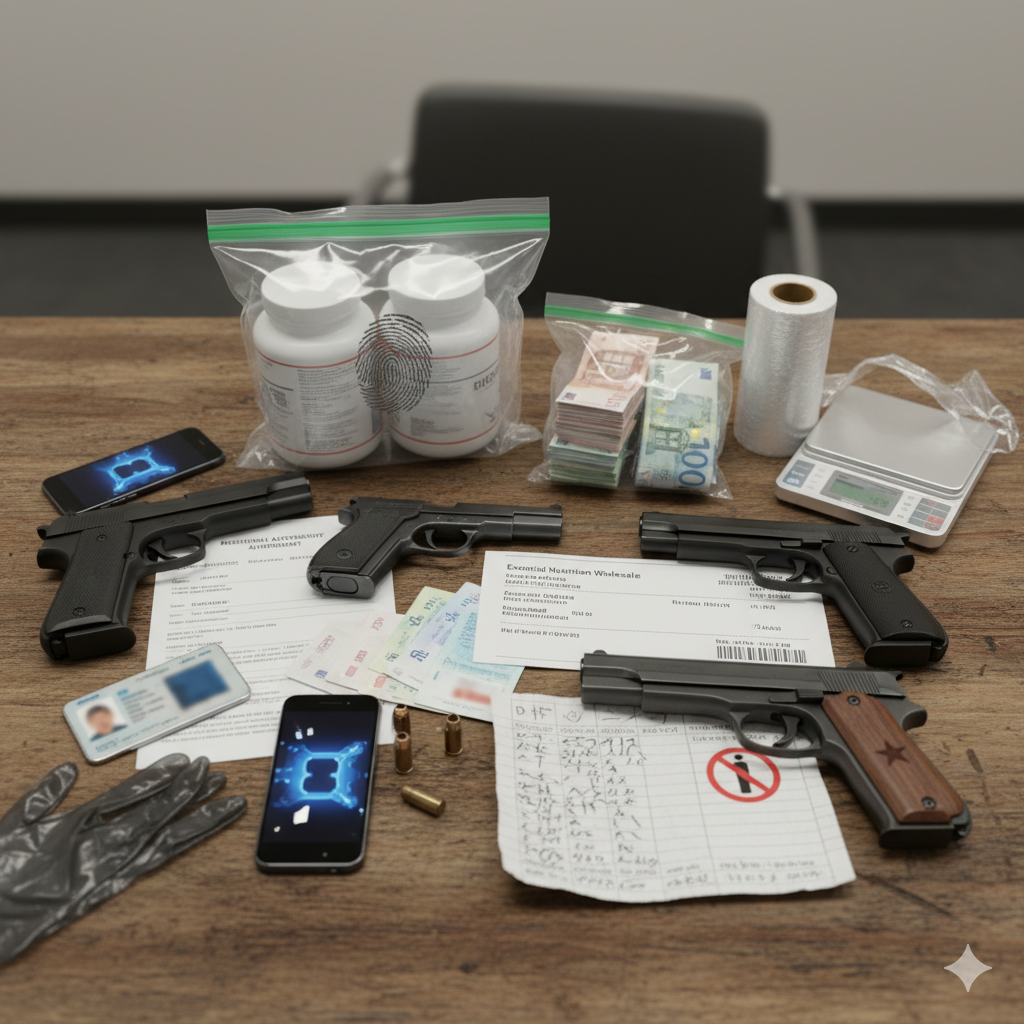
Investigators executed a search warrant on suite 203 the following day. The court heard testimony from the building manager, who confirmed Pham was the sole tenant, paid rent for the unit and for two parking stalls assigned to his Mercedes and F150, and was the only person she dealt with concerning the suite. The apartment was not set up as a residence. It had a sofa and desks but no bed, no clothes in the closets, and no food in the kitchen. Instead, it appeared to be a dedicated drug processing and packaging lab. Police found rolls of plastic wrap, gloves, an electronic scale, a coffee grinder with white residue, and other paraphernalia. In a hidden compartment of a desk, officers located a brown envelope containing 177 grams of fentanyl and 28 grams of cocaine. Pham’s fingerprint was found on this envelope. Garbage bags in the apartment contained discarded packaging with drug residue and sticky notes with slang terms for cocaine.
The search also uncovered a significant cache of firearms. A Walther semi-automatic handgun was in a kitchen drawer with loose ammunition. On top of the kitchen cupboards, police found a Norinco Tokarev semi-automatic handgun and a 9mm Luger semi-automatic handgun. The only item in a bedroom closet, other than a chair box, was a cloth case containing a Mossberg pump action shotgun. Ammunition for the handguns was found nearby, making it “readily accessible.”
The most conclusive evidence came from the four cell phones seized from Pham’s truck. Justice Baird noted that the extracted data comprised “strong circumstantial evidence” that decisively closed off any possibility of Pham’s innocence. One phone, Exhibit E-3, used a number that matched the contact information on Pham’s tenancy agreement for suite 203. It contained numerous selfies of Pham, photos of his vehicles, and pictures of personal documents. More critically, it held photographs of the same type of supplement containers used to hide the methamphetamine, commercial invoices for the fictitious company Essential Nutrition Wholesale, and screenshots of maps of Auckland, New Zealand. Short video clips showed someone heat-sealing lids onto the supplement containers in a kitchen that matched the one in suite 203.
Another phone, Exhibit E-4, contained extensive text message conversations detailing drug transactions. In the messages, the user identified himself as “Kenny,” a known alias for Pham, and used the online handle “bcpremo,” a name also found on a note in the apartment’s garbage. The texts discussed deals for “pants” (fentanyl), “glass” (methamphetamine), and “soft” (cocaine). Two messages, sent to contacts named “Skip” and “Ace,” referenced debts of $17,700 and $17,200, figures that precisely matched notations on a scoresheet found on a calendar page in the suite’s trash. Another text exchange, consistent with a travel itinerary also found on his phone, showed “Kenny” complaining about a failed trip to Montreal to source 190 kilograms of methamphetamine. The remaining two phones contained further evidence, including more drug-related texts, screenshots of online drug sales by “bcpremo,” and a photograph of the distinctive Norinco Tokarev handgun that police found on top of the kitchen cabinets in suite 203.
During the trial, Pham’s defence counsel argued that other plausible theories existed, suggesting that Pham’s brother, Le Tran, or others could have been responsible for the criminal activity without Pham’s knowledge. Justice Baird rejected this submission entirely. Calling the evidence against Pham “overwhelming,” the judge concluded he was “in charge of it all.” Justice Baird found that Pham rented suite 203 for the sole purpose of preparing drugs for distribution and that he was intimately involved in every one of the methamphetamine shipments to New Zealand. The judge further found that Pham possessed the fentanyl and cocaine for trafficking and acquired the firearms to protect his lucrative criminal enterprise.
In his final judgment, Justice Baird stated, “On the basis of this significant body of evidence, I am left with no doubt whatsoever that Mr. Pham was running a mid to high level volume drug trafficking business.” He found Pham guilty on all charges, including four counts of trafficking methamphetamine, one count of possession of fentanyl for the purpose of trafficking, one count of possession of cocaine for the purpose of trafficking, two counts of possessing a prohibited firearm with readily accessible ammunition, and two counts of possessing a firearm without a licence.
Read more crime stories here.



One thought on “Fingerprint on seized package unravels Nanaimo-to-New Zealand methamphetamine scheme, leading to conviction”
Comments are closed.