An Ontario court has ordered a real estate development corporation to pay its former joint venture partner more than $400,000 in profits from a housing project, finding the corporation had improperly calculated the venture’s earnings by deducting the value of its own land contribution and inflating construction costs1. The ruling brings a close to a complex, decade-long legal battle that intertwined the failed partnership with a mortgage enforcement action between the parties’ affiliated companies.
The dispute began in late 2013 when Orren Louch, the principal of the construction company 2264052 Ontario Inc., connected with Larry Dunn, the head of HarbourEdge Realty Administration Corporation (HRAC) and HarbourEdge Mortgage Investment Corporation (HMIC). Their discussions led to a proposal for a 50/50 joint venture to build 14 new homes in the Brockwoods subdivision in Brockville, Ontario. A Letter of Intent was signed on February 10, 2014, outlining the basic terms. Under the agreement, HRAC would contribute the 14 vacant building lots to acquire its 50 percent stake, while Mr. Louch’s company would manage the complete construction of the homes to acquire its 50 percent share.
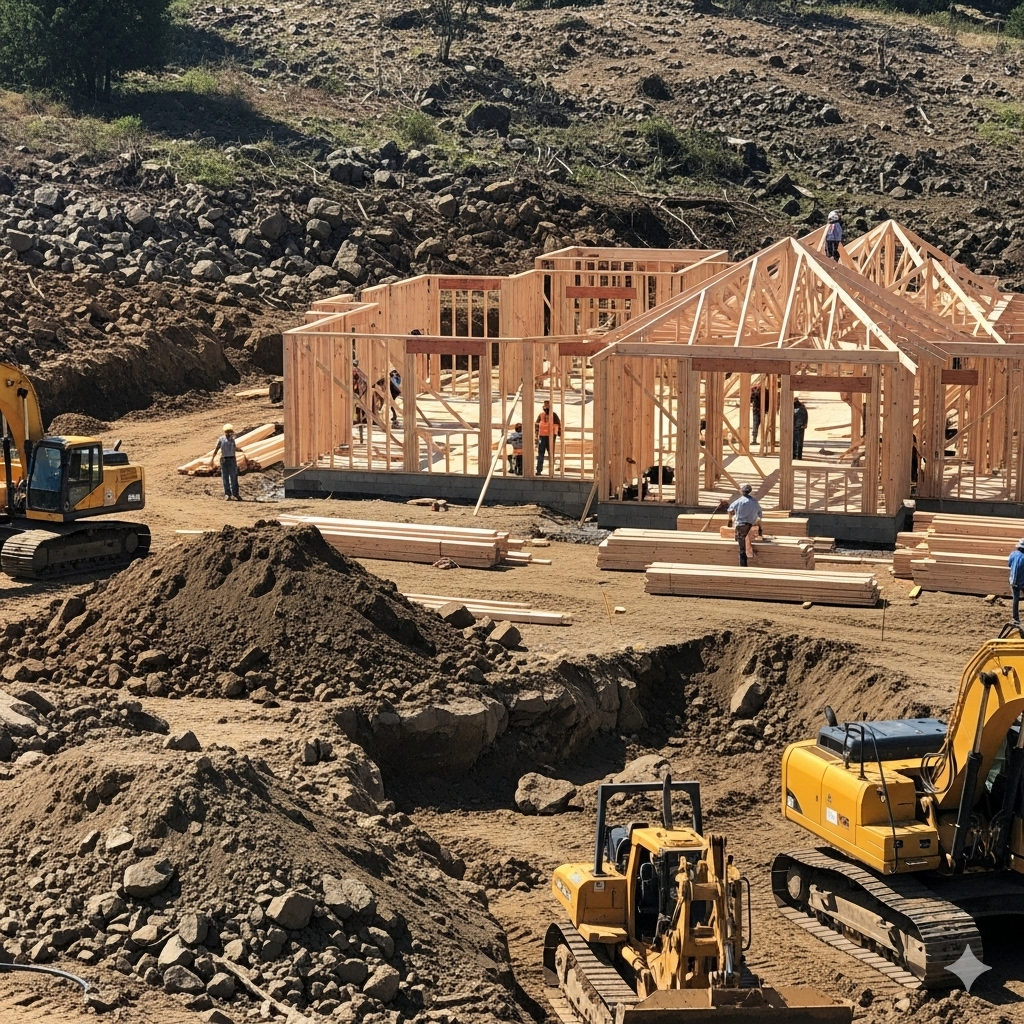
Although the partners began work, a formal joint venture agreement was never finalized. When the snow melted in the spring of 2014, Mr. Louch discovered the 14 lots were in poor condition. Evidence presented in court, including photographs, showed the land was partially covered by a swamp and littered with excess fill, large rocks, and boulders left by a previous builder. Mr. Louch testified that significant remediation was required, including pumping out the swamp and removing between 1,000 and 1,200 truckloads of fill. During this period, Mr. Louch’s company also undertook the construction of an extension to Adley Street and a berm at the rear of the development. This work, while making practical use of the excess fill from the joint venture lots, was intended to benefit the entire Brockwoods subdivision, which HRAC was developing.
The relationship between the partners deteriorated over the next year and a half. HRAC cited disputes over the pace of construction and Mr. Louch’s ongoing default on a separate mortgage as reasons for the breakdown. Mr. Louch maintained that HRAC forced his company off the project after he pressed Mr. Dunn for a written joint venture agreement and a proper accounting of the home sales. On August 16, 2015, HRAC formally terminated the joint venture. The very next day, HMIC, HRAC’s lending arm, demanded immediate and full payment of a $370,000 blanket mortgage it had provided to Mr. Louch’s companies in December 2014.
Despite the termination in 2015, HRAC did not provide a profit statement for the joint venture until 2022. That statement calculated the total profit from the 14-home project to be only about $5,500. Mr. Louch’s company subsequently sued for its unpaid share of the profits, launching one of three interconnected legal actions that were tried together before Justice Ryan Bell of the Ontario Superior Court of Justice.
At the heart of the trial was the question of how the joint venture’s profits should have been calculated. HRAC argued it was entitled to deduct the $561,270 value of the 14 lots it contributed before profits were split. It also included certain construction costs which 226 Ontario claimed were never supposed to be borne by the joint venture. Expert witnesses for each side presented vastly different profit calculations. HRAC’s expert calculated a net profit of between roughly $12,000 and $42,000. In stark contrast, the expert for Mr. Louch’s company calculated the profit to be between approximately $277,000 and $838,000. The highest calculation was based on the premise that neither the land value nor certain disputed construction costs should have been deducted from the revenues.
Justice Bell sided with Mr. Louch’s company on all key points regarding the profit calculation. In his reasons for judgment, the judge found that an objective review of the parties’ arrangement did not support HRAC’s claim to deduct its land contribution. He noted that the Letter of Intent framed the land as HRAC’s contribution to acquire its 50 percent interest, just as 226 Ontario’s construction management was its contribution. To then deduct the land’s value as a cost would create a result inconsistent with a 50/50 partnership. Justice Bell also pointed to draft joint venture agreements prepared by HRAC itself, which contained formulas for calculating profit that did not include a deduction for land costs. The judge found Mr. Dunn’s testimony that this omission was a mistake to be “not credible.”
The court also agreed that HRAC had overstated construction costs by $235,902. Justice Bell found there was a verbal agreement that the $61,030 in costs for the Adley Street extension and berm would not be charged to the joint venture, as the work benefited the entire subdivision. He also accepted Mr. Louch’s evidence that the parties had agreed that unexpected excavation and remediation costs above the budgeted amount of $17,400 per lot would not be a joint venture expense. The judge found Mr. Louch’s testimony on the poor condition of the lots, supported by photographs and the evidence of the site excavator, to be more convincing than that of Mr. Dunn, whose evidence on the matter the judge rejected as not credible. Based on these findings, Justice Bell accepted the calculation of 226 Ontario’s expert, concluding the joint venture’s true net profit was $838,865. He awarded 226 Ontario its 50 percent share, amounting to $419,432.50.
In the parallel mortgage action, the court addressed HMIC’s claim for repayment. While the $370,000 principal was not in dispute, HMIC also sought an additional $154,552 in expenses and $118,100 in fees. Justice Bell disallowed these extra charges entirely. He found there was “no evidentiary basis” for the expenses, noting that HMIC failed to provide supporting documentation until the day before the trial began, ten years after commencing the action. He also rejected the fees, which were claimed as a monthly “late fee,” finding no such term in the mortgage agreement. The judge added that even if there had been such an agreement, the charge would constitute an illegal penalty under Canada’s Interest Act. Consequently, HMIC was awarded only the outstanding principal of $370,000.
In a final crucial determination, Justice Bell ruled on the rate of prejudgment interest. He exercised his judicial discretion to apply the mortgage’s contractual rate of 10 percent per annum, compounding semi-annually, to both the award for 226 Ontario and the award for HMIC. The judge reasoned that the joint venture and the mortgage were clearly related, with both of the HarbourEdge companies being run by Mr. Dunn. He accepted that HRAC and HMIC were aware that Mr. Louch was relying on his share of the joint venture profits to pay the mortgage. The judge found Mr. Dunn’s claim that the termination of the joint venture and the decision to call the mortgage were unrelated to be not credible, stating it “runs counter to logic and common sense.” He concluded it would be unjust to allow HRAC to benefit from withholding the profits while the related mortgage accrued interest at a much higher rate.
The court ordered that the damages and interest awarded to HMIC in the mortgage action be set off against the larger amount awarded to 226 Ontario in the joint venture action, resulting in a net payment to 226 Ontario. The judge also ordered that the mortgage registered against Mr. Louch’s properties be discharged.