TORONTO – A young Toronto man who jumped from a second-storey balcony with two loaded handguns during a police raid has been sentenced to a global term of three and a half years in prison. After receiving significant credit for his time in pre-trial custody, harsh jail conditions, and restrictive bail, 21-year-old Ade Munda has six months of his sentence left to serve. The sentence, delivered by Ontario Superior Court Justice R. Maxwell, took into account Mr. Munda’s difficult upbringing, his exposure to community violence, and the impact of systemic anti-Black racism on his life1.
The events leading to the sentence began on the evening of July 20, 2022. Officers from the Toronto Police Emergency Task Force arrived at an apartment unit at 2500 Hill Rise Court to execute a search warrant. Inside, Mr. Munda, then 19, was gathered with several other people following a funeral for a friend who had been a victim of gun violence. As police breached the apartment’s doors, announcing their presence, Mr. Munda moved quickly to the balcony. He then jumped into a laneway below. An officer stationed in the laneway saw Mr. Munda come over the railing and heard a clattering sound he believed was a gun hitting the ground. Officers found two firearms in the immediate area where Mr. Munda landed. Perceiving that Mr. Munda was reaching for one of the guns, the officer shot him twice, striking him once in the leg before arresting him.
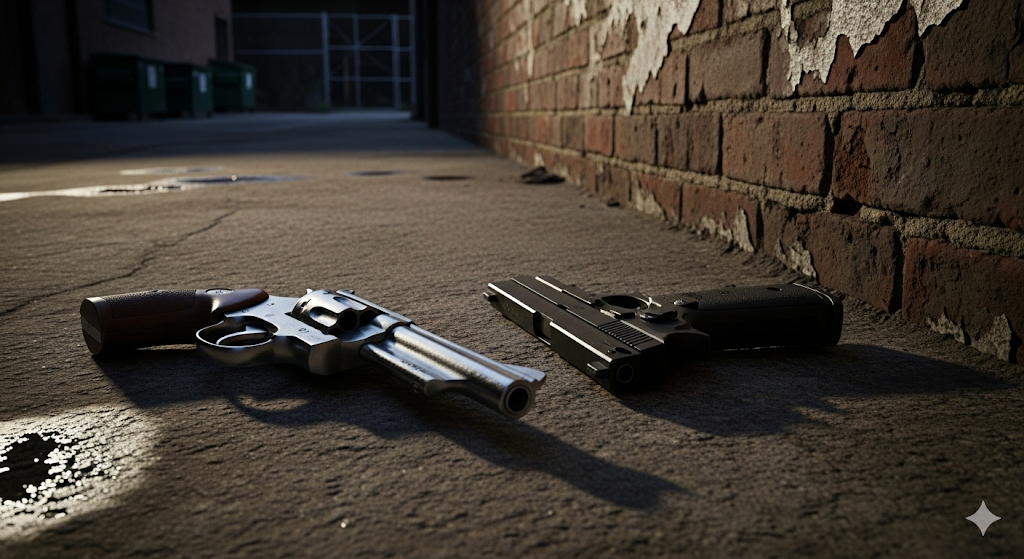
Police recovered two prohibited Glock handguns from the laneway. One was loaded with 16 rounds of 9mm ammunition and equipped with an over-capacity magazine, which is a prohibited device. The other was loaded with 10 rounds of 9mm ammunition. Mr. Munda did not have a licence for the firearms or the prohibited device. A jury found him guilty on December 18, 2024, on five counts: two counts of possessing a loaded, restricted firearm, two counts of careless storage of ammunition, and one count of possessing a prohibited device.
During the sentencing hearing on August 1, 2025, the Crown prosecutor, M. Mandel, argued for a penitentiary sentence of four and a half to five years. The Crown noted that Mr. Munda had already served 487 days in pre-sentence custody, which, with standard enhanced credit, was equivalent to approximately two years. This would have left Mr. Munda with another two and a half to three years to serve. In contrast, Mr. Munda’s lawyer, M. Mistry, proposed a three-year sentence. He argued that after applying credit for pre-sentence custody and additional credit for the harsh conditions Mr. Munda endured in jail and the strict terms of his bail, the sentence should be considered “time served.” The defence emphasized that the court should consider Mr. Munda’s circumstances as a young Black man impacted by systemic racism and disadvantage.
In his decision released on September 5, 2025, Justice Maxwell detailed the complex personal history that shaped Mr. Munda’s life. Mr. Munda, who is now 21, is a Black man of Congolese background who was born in Toronto. He grew up witnessing domestic violence perpetrated by his father against his mother, and he was also the subject of his father’s physical and emotional abuse. After his parents divorced when he was 12, the family lived in the Lawrence Heights neighbourhood, which Mr. Munda described as violent. He witnessed a shooting outside his home at age eight and lost several friends to gun violence, including two just a month before his arrest.
Mr. Munda struggled in school, where he was bullied before becoming a bully himself. He left high school in grade 12, just three credits short of his diploma. He developed a substance use habit involving marijuana, alcohol, and Percocets, which he reported worsened after the deaths of his friends. At the time of the firearm offences, he was a first-time offender.
Justice Maxwell acknowledged the extreme gravity of Mr. Munda’s offences. He noted that possessing two loaded firearms, ready to be fired, posed a real and immediate danger to the public. The judge stated that the dangerousness was compounded when Mr. Munda jumped from the balcony with the unsecured weapons, creating an obvious risk to the officers and anyone else in the laneway. “A person who carries a concealed, loaded handgun in public undermines the community’s sense of safety and security,” Justice Maxwell wrote, quoting a previous Court of Appeal decision. He affirmed that denunciation and deterrence must be paramount considerations for such serious gun crimes.
However, the judge also carefully weighed Mr. Munda’s moral blameworthiness in the context of his life experiences. While his background did not excuse his criminal conduct, Justice Maxwell found that it mitigated his degree of responsibility. The judge accepted that factors such as growing up without a positive father figure, witnessing and experiencing violence from a young age, and living in a dangerous environment where he feared for his own life provided critical context. Mr. Munda had told the author of a pre-sentence report that he possessed the firearms for “self-protection.” Justice Maxwell concluded that these systemic and background factors reduced Mr. Munda’s moral culpability compared to what it would have been otherwise.
The final sentence was the result of a detailed calculation of credit. Justice Maxwell determined that a fit global sentence was three and a half years, or 42 months. From this, he granted substantial credit. First, he awarded 12 months of credit for two specific mitigating factors. This included credit for the harsh conditions Mr. Munda faced while in pre-trial custody at three separate detention centres, where he experienced numerous lockdowns, was exposed to violence, and perceived that Black inmates were treated differently and more punitively than white inmates. This credit also accounted for the 15 months he spent on highly restrictive bail, which included a term of house arrest. Next, the judge applied the standard credit for the 487 days he spent in pre-sentence custody, which was calculated as 24 months.
Subtracting the total of 36 months of credit from the 42-month global sentence left a remainder of six months to be served. Justice Maxwell explained that while the usual sentencing range for these offences is three to five years, a sentence at the lower end was appropriate. He distinguished Mr. Munda’s case because the firearms were not possessed in connection with another specific criminal activity. He also gave significant weight to Mr. Munda’s youth, his status as a first-time offender for these crimes, and the harshness of his pre-sentence experience.
In addition to the remaining six months of jail time, Mr. Munda is subject to a lifetime prohibition from possessing firearms and other weapons. He must also submit a sample of his DNA to the national databank, and the firearms he possessed will be forfeited. In concluding his reasons, Justice Maxwell thanked both counsel for their advocacy and wished Mr. Munda good luck.
Read more crime stories here.