A recent decision from the Ontario Superior Court of Justice has resolved a legal battle over a workplace accident that occurred on school property in Southwestern Ontario1. The case centered on a routine inspection that took an unexpected and injurious turn, eventually leading to a full week of trial before a jury. The legal proceedings reached a critical milestone on December 29, 2025, when Justice M.D. McArthur issued an endorsement detailing the liability and the substantial legal costs resulting from the board’s failure to maintain a safe environment for those performing work on its premises.
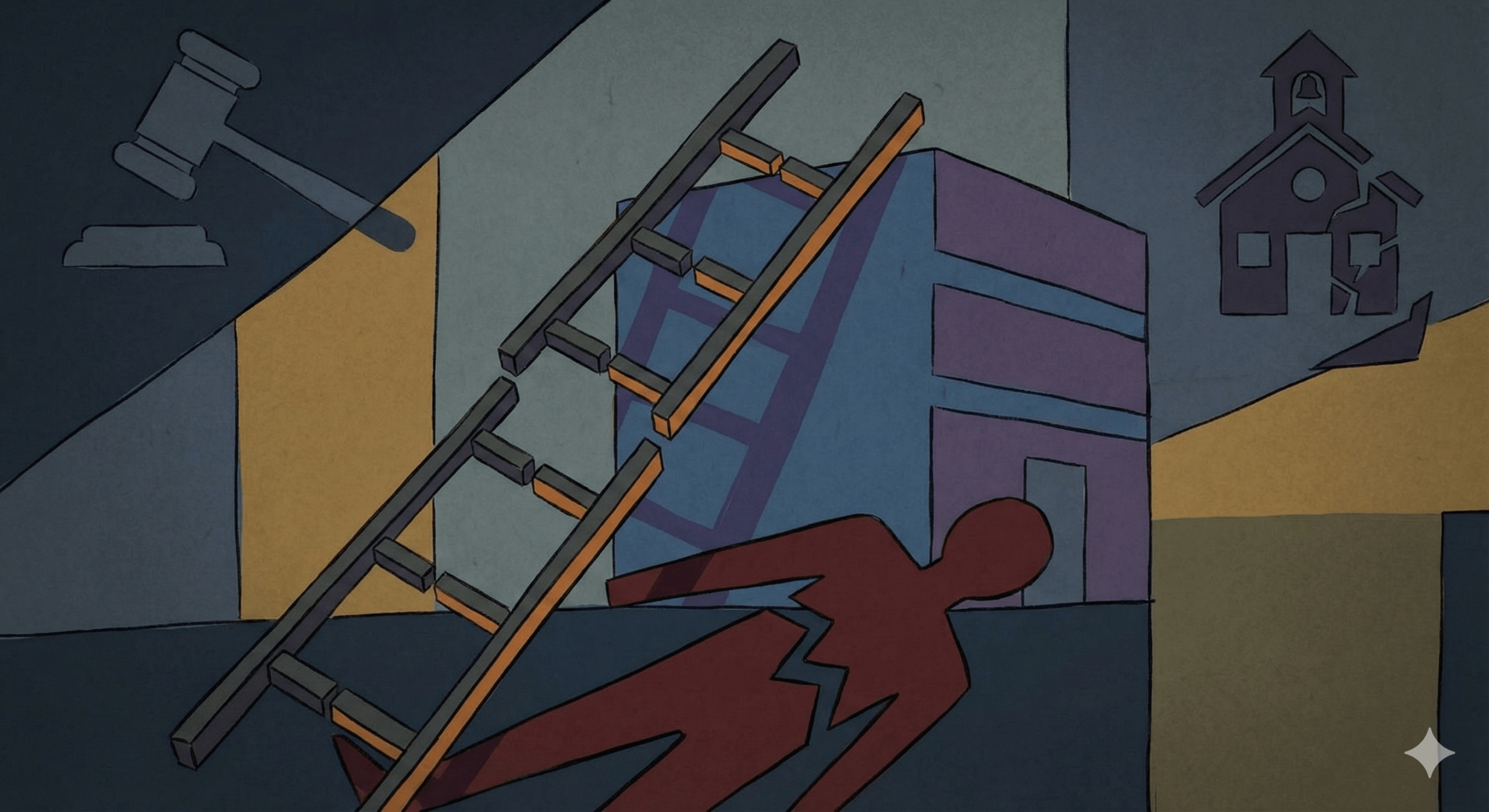
The incident began when Matthew Morrison arrived at a school operated by the Lambton Kent District School Board to conduct an inspection of an exterior ladder. He was accompanied by a co-worker who was tasked with gaining access to a higher level of the building to reach the equipment in question. To reach that elevated area, the co-worker had to climb an initial exterior ladder. As the co-worker ascended, he lost his footing and fell from the ladder. In the descent, he struck Mr. Morrison, who was standing below, causing injuries that would eventually lead to a long-running lawsuit against the school board.
The litigation that followed was structured through a process known as bifurcation. This means the court separated the legal issues into two distinct phases. The first phase, which was the focus of the recent trial, was dedicated solely to determining liability, or who was legally at fault for the accident. The second phase, which remains for a future date, will determine the specific amount of money, or damages, that Mr. Morrison should receive for his injuries. By focusing first on liability, the court and the parties involved could establish whether the school board was responsible before spending more time and resources on the complex calculations of medical costs and lost wages.
During the trial, the courtroom became a theater for detailed factual and expert testimony. The school board sought to defend itself by raising potential exclusions under the Workplace Safety and Insurance Board (WSIB) framework. Their primary defense was the argument that if the employer or the co-worker were found to be the negligent parties, the school board should not be held responsible for the entirety of the claim. In Ontario law, claims against employers and co-workers are often barred by the statutory insurance scheme, meaning if the fault lay with them, Mr. Morrison’s ability to recover from the school board would be significantly reduced or eliminated.
To navigate these complexities, both sides relied heavily on professional witnesses. These experts provided the jury with technical insights into safety standards and the mechanics of the fall. The trial was described by the presiding judge as exceptionally efficient, noting that both the plaintiff’s counsel, Mr. Fife, and the defense counsel, Mr. Brimblecomb, conducted themselves with exemplary professionalism. The cross-examination of these experts was a central feature of the week-long proceeding, as the jury was tasked with deciding whether the school board’s maintenance of its premises or its safety protocols fell below the required legal standard.
A pivotal moment in the timeline of the case occurred on February 14, 2025. On that date, Mr. Morrison made a formal offer to settle the liability portion of the case. He proposed a deal where the school board would be found only 49 percent responsible, with the case then moving directly to a trial on damages. This was a strategic move under the Rules of Civil Procedure. If a plaintiff makes a settlement offer that is rejected and then goes on to win a better result at trial, the defendant can be ordered to pay a much higher portion of the plaintiff’s legal fees as a penalty for not settling. The Lambton Kent District School Board chose not to accept this offer, opting instead to let a jury of peers decide the outcome.
The jury’s decision was a total victory for Mr. Morrison. After deliberating on the evidence and the testimony of the competing experts, the jury returned a verdict finding the Lambton Kent District School Board 100 percent liable for the injuries sustained. This verdict completely rejected the board’s attempts to shift blame onto other parties or to invoke WSIB-related exclusions. With 100 percent liability established, the board became responsible for the entirety of the damages to be determined in the next phase of the litigation, as well as the substantial legal costs incurred by Mr. Morrison to bring the case to trial.
Following the jury’s verdict, the focus shifted to the calculation of legal costs. In Ontario, the winning party in a lawsuit is typically entitled to have a portion of their legal fees paid by the losing party. This is governed by the principle of indemnity, which aims to fairly compensate the successful litigant for the expense of asserting their rights. The determination of these costs is at the discretion of the judge, who must consider factors such as the complexity of the case, the importance of the issues, and the conduct of the parties.
The school board did not contest the amount of time the lawyers spent on the case or the out-of-pocket expenses, known as disbursements. However, they did raise an objection regarding the hourly rates being claimed. Specifically, they questioned the rate of Mr. Fife, a veteran lawyer and Certified Specialist in Civil Litigation with over 35 years of experience. While Mr. Fife’s standard rate for firm work was approximately $500 per hour, the plaintiff sought a rate of $800 per hour for his work as lead trial counsel. The school board argued that this was a significant increase and that they had no prior notice that such high rates would be sought.
In his analysis, Justice McArthur noted that the actual rates charged by a lawyer are a relevant consideration but not the only factor. The court must fix an amount that is fair and reasonable for the losing party to pay. The judge highlighted that this was a particularly complex situation involving difficult factual and expert challenges. He observed that understanding and presenting complex scientific or technical material, especially before a jury, requires a high level of skill. The judge remarked that the trial was conducted as efficiently as any he had presided over, whether in civil or criminal court.
Because the trial had been bifurcated, the judge had to determine which portion of the legal work was related to the liability phase and which was related to the future damages phase. He applied a general rule of thumb, attributing 70 percent of the general legal work to the negligence aspect of the case. For the trial-specific work performed by various lawyers at the firm, including Gordon Harris, Randy F. Knight, and Shania Robinson, the court calculated specific amounts that the school board would be required to pay.
Regarding Mr. Fife’s specific role, Justice McArthur found that a cost premium was warranted. Given his status as a specialist and the exceptional result he achieved at trial, especially in light of the rejected settlement offer, the court set a reasonable indemnity rate of $725 per hour. This resulted in a total fee award for the trial counsel alone of over $46,000, plus HST. When combined with the fees for the other lawyers involved, the school board was ordered to pay a significant sum to cover the plaintiff’s legal expenses for this stage of the litigation.
The ruling serves as a final resolution to the question of fault in the ladder accident. The Lambton Kent District School Board now stands fully responsible for the incident that occurred on its property. The case will eventually proceed to determine the financial compensation Mr. Morrison will receive for his injuries, but the hurdle of proving negligence has been cleared. The decision underscores the risks public institutions face when maintenance and safety issues lead to litigation, particularly when strategic settlement offers are declined and the matter is left in the hands of a jury.
Read about more personal injury cases here.