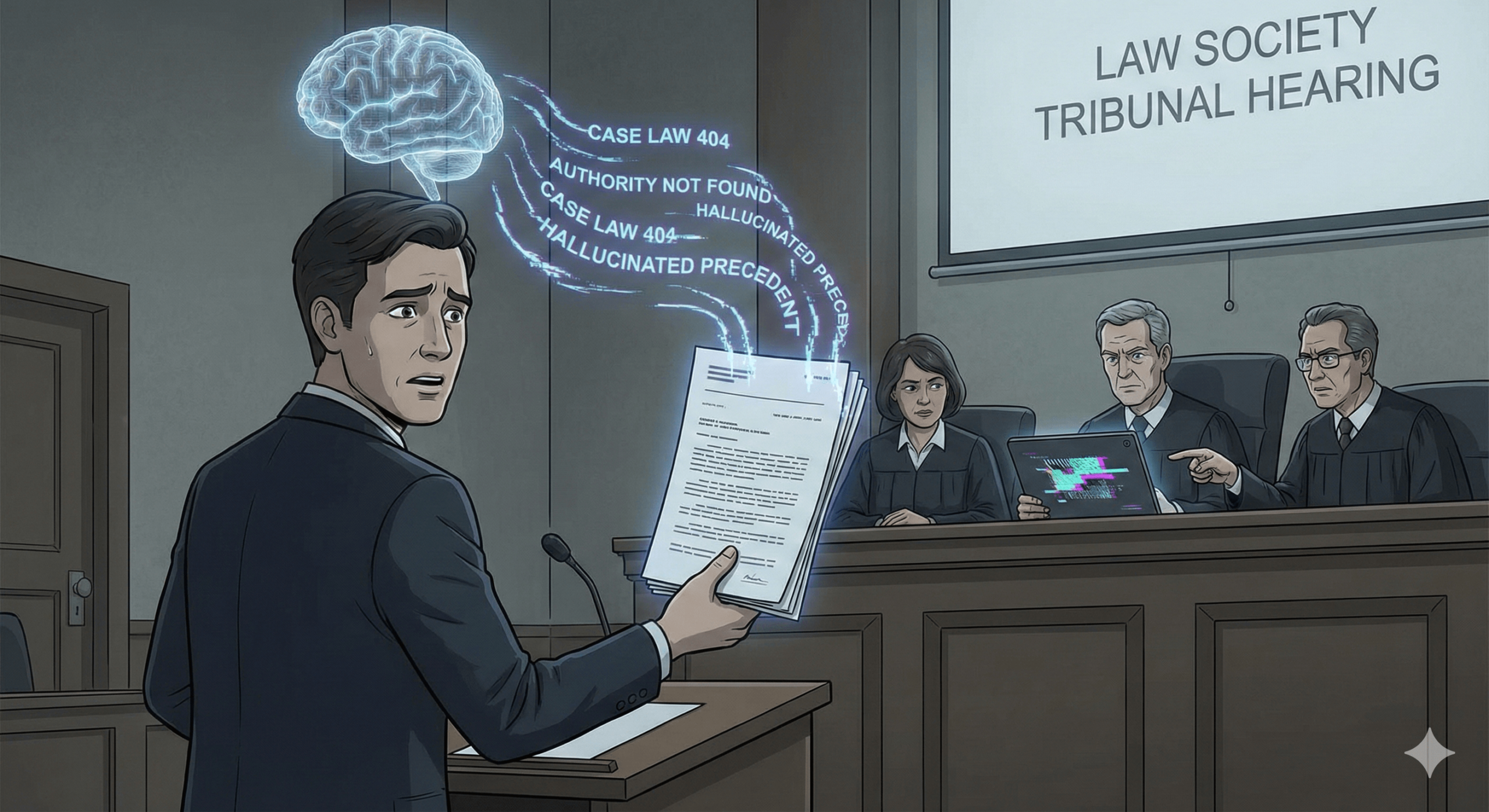
The Law Society Tribunal has dismissed a series of motions brought by an Ontario lawyer who sought to remove his suspension while simultaneously attempting to disqualify the adjudicators overseeing his case1. The decision, released on December 30, 2025, centers on Shahryar Mazaheri, a lawyer whose license was suspended on an interlocutory basis in late 2024. The proceedings took an unusual turn when it was revealed that Mr. Mazaheri’s legal filings were riddled with non-existent case law and “hallucinated” authorities generated by artificial intelligence.
The conflict began in the fall of 2025, nearly a year after the Tribunal originally imposed an interlocutory suspension on Mr. Mazaheri’s license. Under the Law Society Act, such suspensions are temporary measures intended to protect the public while a full conduct investigation or hearing is pending. On September 23, 2025, Mr. Mazaheri moved to vary or remove this suspension, arguing that material changes in his circumstances warranted his return to practice.
During the lead-up to the hearing for that request, a significant procedural issue emerged. Mr. Mazaheri filed a series of documents, including affidavits and factums, to support his position. Upon review, the Tribunal panel—chaired by Paul Aterman and including Lubomir Poliacik and Michelle Richards—noticed that substantial portions of the materials were unintelligible. The legal propositions cited in the documents were not supported by any reliable or recognized legal authorities.
Following this discovery, the Tribunal took the step of issuing a detailed 15-page chart to the parties, highlighting numerous examples of non-existent and misleading citations found within Mr. Mazaheri’s filings. This prompted a case management conference where the origins of these documents were addressed. Mr. Mazaheri eventually admitted in writing that he had relied heavily on generative artificial intelligence, specifically a tool called Grok, to research and draft his materials.
In his correspondence with the Tribunal, Mr. Mazaheri explained that he had turned to AI because he was unable to retain a lawyer to assist him and was attempting to manage the complex filings on his own. He admitted to the Tribunal that he failed to verify the accuracy of the output before submission. While he apologized for the errors and maintained that he did not intend to mislead the panel, he took full responsibility for the inaccuracies, which included fake hyperlinks and fictional applications of Tribunal rules.
Despite these admissions, the procedural path forward became further complicated when Mr. Mazaheri launched a secondary motion. He argued that the Law Society of Ontario had filed evidence that should be excluded from his suspension review. Furthermore, he claimed that the Tribunal panel was now biased against him and should recuse itself. His argument for bias was twofold: first, that the panel had already looked at the evidence he wanted excluded, and second, that the panel had improperly criticized his conduct regarding the AI-generated filings during a case management hearing.
The Tribunal’s recent reasons for decision address these preliminary hurdles before the actual motion to lift the suspension can proceed. Regarding the admissibility of evidence, the panel ruled that the Law Society was entitled to submit the record from the original 2024 suspension hearing. The Tribunal noted that it would be impossible to determine if a “material change in circumstances” had occurred without first reviewing the original facts and evidence that led to the suspension in the first place.
Mr. Mazaheri had also objected to fresh evidence filed by the Law Society, which included transcripts of interviews with investigators, documents from a Superior Court trusteeship application, and records of litigation involving one of Mr. Mazaheri’s former clients. He argued that the Law Society’s investigation should have been considered closed and that continuing to gather or use this evidence was an abuse of process.
The panel disagreed, noting that the Law Society’s authority to investigate is ongoing. In the context of interlocutory proceedings—which are not final trials—the rules for admitting evidence are generally more flexible. The panel found that the documents were relevant to the issues at hand, particularly regarding whether Mr. Mazaheri was aware of certain allegations of fraud involving a client he represented and whether certain custodian agreements existed. The Tribunal clarified that while the evidence is admissible, the weight or importance given to it would be determined at the final hearing.
The most contentious part of the ruling dealt with the allegations of bias and the request for the panel to step down. Mr. Mazaheri argued that because the adjudicators had already read the Law Society’s evidence, they could no longer be impartial when deciding whether that same evidence should be excluded. The Tribunal dismissed this logic, citing established law that there is a strong presumption of impartiality for adjudicators. Simply reviewing materials to rule on their admissibility is a standard part of a judge’s or tribunal member’s job and does not equate to bias.
The panel also addressed Mr. Mazaheri’s claim that they had shown bias by “criticizing” his use of AI and interrupting his submissions. Mr. Mazaheri alleged that the chair had erroneously attempted to adjudicate professional conduct rules during a case management conference when the Tribunal lacked the jurisdiction to do so at that stage. He claimed the panel only backed down after being challenged.
The Tribunal provided a different account of those interactions. According to the reasons for decision, the transcript of the hearing showed that the panel was fulfilling its duty to protect the integrity of its own processes. The panel noted that it has an independent interest in ensuring that materials filed by lawyers are accurate and not fabricated by AI. They clarified that while they had not yet made any formal findings of misconduct regarding the AI filings, they were entitled to put Mr. Mazaheri on notice that his actions might be considered when the Tribunal eventually decides on the merits of his case or the issue of legal costs.
The ruling emphasized that a “reasonable and right-minded person” would not view the panel’s focus on the AI-generated “hallucinations” as a sign of bias. Instead, the Tribunal framed its response as a necessary reaction to a lawyer submitting non-existent law to a judicial body. The panel noted that even though Mr. Mazaheri was permitted to file a new, corrected factum, he again failed to follow directions by filing unauthorized supplementary affidavits and factums, which the Tribunal subsequently refused to consider.
With the dismissal of these preliminary motions, the stay of Mr. Mazaheri’s license remains in effect. The Tribunal concluded that the Law Society’s evidence will be included in the upcoming hearing to determine if Mr. Mazaheri’s suspension should be varied or lifted. The question of who will pay for the legal costs associated with these specific motions regarding bias and evidence has been deferred until the conclusion of the broader suspension review.
This case serves as a notable entry in the evolving intersection of the legal profession and generative artificial intelligence in Ontario. It highlights the strict expectations placed on legal professionals to verify all research, regardless of the tools used. The Tribunal’s decision reaffirms that while AI can assist in drafting, the ultimate responsibility for the veracity of legal submissions rests solely with the lawyer whose name appears on the record.
The matter will now proceed to a hearing on the merits of the suspension. At that stage, the Tribunal will decide if the “material changes” cited by Mr. Mazaheri are sufficient to allow him to return to the practice of law, or if the concerns raised by the Law Society necessitate a continued suspension to protect the public interest.
Read more cases about proceedings in regulated professions here.