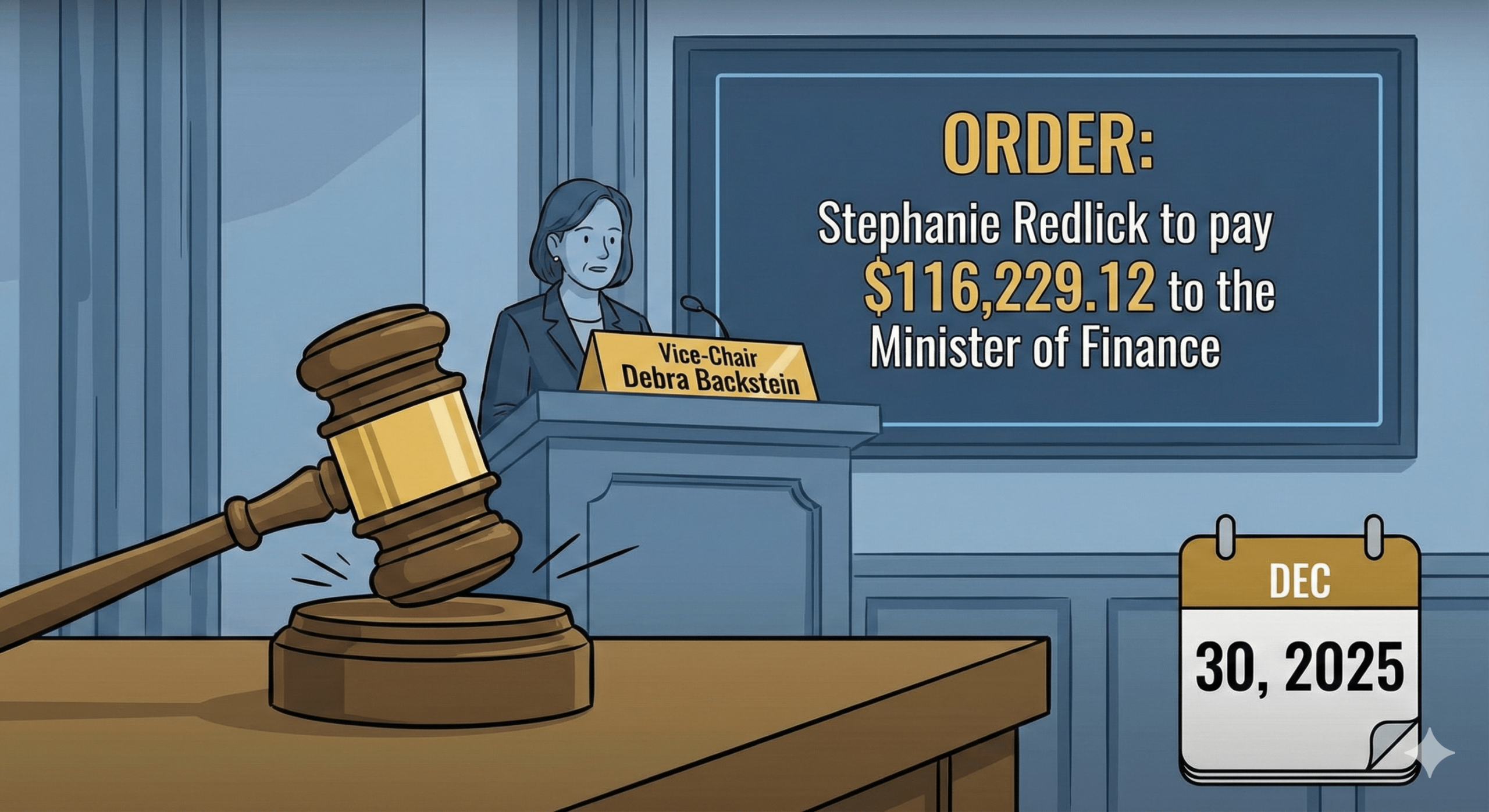
The Animal Care Review Board has released a decision concerning the financial responsibilities of animal owners when the province intervenes to provide care for livestock1. In a ruling dated December 30, 2025, Vice-Chair Debra Backstein ordered Stephanie Redlick to pay $116,229.12 to the Minister of Finance. This sum represents the costs incurred by Animal Welfare Services for the transportation, boarding, and medical treatment of sixteen horses seized from a rented property earlier that year. The case provides a detailed look at the high costs associated with large scale animal seizures and the strict legal framework governing how those costs are assessed and challenged in Ontario.
The conflict began on February 20, 2025, when Animal Welfare Services investigators removed sixteen horses from a property where Ms. Redlick was keeping them. This removal was not an isolated event but rather the culmination of a process that started with compliance orders issued on February 12, 2025. When those orders were not met to the satisfaction of the Chief Animal Welfare Inspector, the horses were taken into provincial care under the Provincial Animal Welfare Services Act. While Ms. Redlick later disputed the legality of this seizure, she did not successfully appeal the initial Notice of Removal or the subsequent Notice of Decision to Keep the Animals in Care. This procedural history proved to be a critical factor in the eventual financial ruling.
By August 2025, the horses had been in the care of the province for approximately six months. During this period, the province issued two separate statements of account. The first statement led to the eventual forfeiture of the horses to the Crown on August 26, 2025, after the required payments were not made. The second statement of account, which is the subject of this specific appeal, totaled $118,831.19. This bill covered the period from the initial removal in February through to the date of forfeiture in late August. Ms. Redlick challenged this amount, arguing that the removal was illegal, that the horses were healthy at the time of seizure, and that any health issues they developed were the fault of the province’s chosen caretakers.
The hearing for this appeal took place via videoconference on November 5, 2025, and was marked by several procedural disputes. Ms. Redlick, representing herself, raised multiple motions for the adjudicator to recuse herself, alleging bias. These allegations were based on several factors, including the adjudicator’s insistence that Ms. Redlick follow hearing decorum and questions regarding Ms. Redlick’s decision to participate by telephone without a camera despite the agreed upon videoconference format. The adjudicator denied these motions, noting that enforcing rules of order and making procedural rulings do not constitute bias. The decision cited Supreme Court of Canada precedents which establish a high threshold for proving bias, requiring substantial grounds that an informed person would view as a lack of impartiality.
Throughout the hearing, the province bore the initial burden of proving that the costs listed in the statement of account were both actually incurred and reasonable. To meet this burden, the Respondent produced a series of witnesses and a large volume of documentary evidence, including invoices from specialized vendors. Senior Investigator Alison Green provided testimony regarding the logistical challenges of moving sixteen horses. She explained that the province used approved equine transport vendors to safely relocate the animals to multiple boarding facilities. The transportation costs alone totaled more than $12,000, a figure that included a separate, specialized transport for a pregnant mare that required a specific facility for foaling while in the province’s care.
The most substantial portion of the bill involved boarding costs, which amounted to $83,648.92. These costs covered daily housing, food, water, and supervision for the sixteen horses over a span of nearly half a year. Investigator Green testified that the animals were distributed across three different equine boarding facilities. These locations were selected based on their ability to meet the specific medical and dietary needs of the horses. The evidence presented indicated that the daily rate per horse broke down to approximately $28.00 to $30.00, which the board found was consistent with standard market rates for equine care in Ontario. The province also noted that it had absorbed some miscellaneous costs, such as blankets and halters, rather than passing those expenses on to Ms. Redlick.
In addition to housing and transport, the horses required significant veterinary and animal care services, totaling nearly $34,000. These services included dental procedures, sedation, medications, and regular health monitoring. To justify these expenses, the province called upon Dr. Kyle Goldie, a licensed veterinarian, as an expert witness. While Dr. Goldie was not the treating veterinarian, he conducted a comprehensive, line by line review of all medical invoices and records. He compared the charges against the Ontario Veterinary Medical Association fee guide, which serves as an industry benchmark. Dr. Goldie’s analysis found that while most charges were reasonable, certain markups on prescription medications and professional fees were slightly higher than the guide suggested. Based on his expert recommendation, the province agreed to reduce the total claim by approximately $2,600.
Ms. Redlick’s defense focused heavily on the circumstances of the initial seizure. She argued that the horses were receiving regular veterinary care while in her possession and that the Animal Welfare Services investigators had no right to remove them. She further alleged that any medical issues found by the province were either non-existent at the time of removal or were caused by the custodians appointed by the Chief Animal Welfare Inspector. However, the Board found that these arguments were largely irrelevant to the specific matter of the statement of account. Because the removal itself had not been successfully appealed in the proper timeframe, the legality of the seizure was already an established fact for the purposes of the financial hearing.
The legal standard applied by the Board required that once the province proved the costs were real and reasonable, the onus shifted to the appellant to prove they should be revoked or varied. The adjudicator found that Ms. Redlick failed to meet this requirement. According to the decision, Ms. Redlick did not provide evidence of alternative, lower cost boarding options or expert testimony to challenge the necessity of the veterinary treatments. She also did not cross examine the province’s witnesses on the specific details of the invoices. Instead, her testimony and that of her father, Sammy Redlick, focused on why the horses should not have been taken in the first place, an issue that was beyond the scope of the Board’s review of the statement of account.
The Board also addressed the conduct of the hearing itself, noting that Ms. Redlick had disconnected from the videoconference multiple times following procedural rulings she disliked. Despite these interruptions and the repeated motions for recusal, the Board maintained that the process remained fair. The adjudicator emphasized that the Board has the authority to control its own process to ensure efficiency and proportionality. This included denying a motion by Ms. Redlick to exclude the province’s documents, which had been filed a few hours past a set deadline. The Board ruled that the brief delay did not prejudice Ms. Redlick’s ability to prepare for the case.
In the final analysis, the Board concluded that the province had successfully demonstrated that the $116,229.12 in costs were necessary and reasonably priced according to industry standards. The final order varied the original statement of account only to reflect the small reductions suggested by the province’s own expert veterinarian. The ruling confirms that under the Provincial Animal Welfare Services Act, owners are held strictly liable for the costs of care when their animals are removed due to non-compliance with welfare orders. The decision serves as a reminder of the significant financial implications that can arise from provincial animal welfare interventions, particularly involving livestock that require long term boarding and specialized medical attention.
The ordered amount is now payable to the Minister of Finance. This concludes a lengthy legal process that saw multiple motions, appeals, and a significant amount of expert testimony regarding the standards of equine care in Ontario. The horses remain forfeited to the Crown, a status that was finalized in August 2025 prior to this final financial determination. The Board’s decision emphasizes that while owners have the right to challenge the reasonableness of provincial bills, those challenges must be supported by evidence related to the costs themselves rather than a re-litigation of the original seizure.
Read more Ontario legal news here.