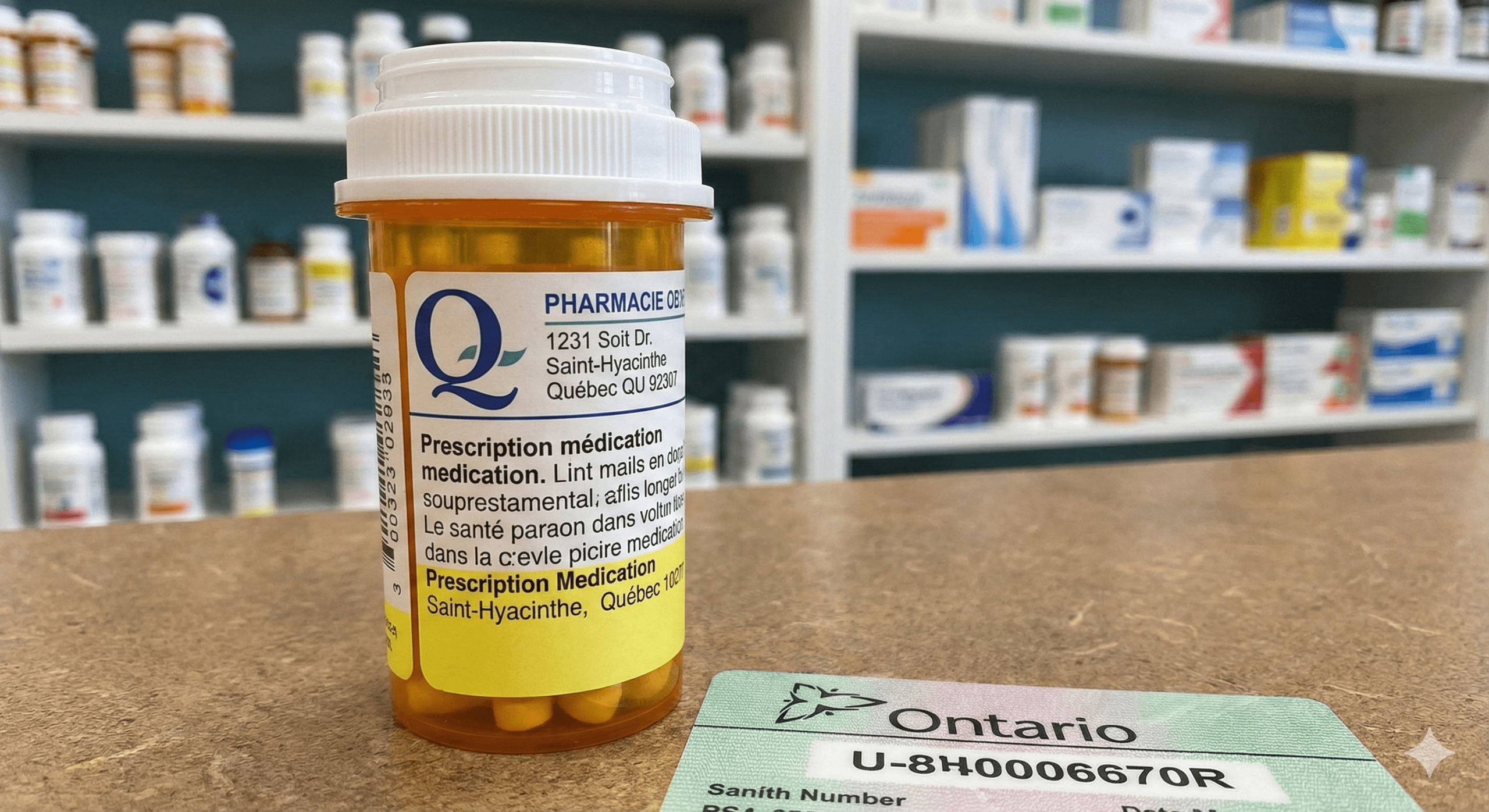
The Health Services Appeal and Review Board has dismissed an application from an Ontario resident seeking reimbursement for nearly $10,000 in prescription medication costs1. The case, involving Denzil Spence and the General Manager of the Ontario Health Insurance Plan (OHIP), centered on whether Ontario’s public drug programs could cover medications dispensed by a pharmacy located in Quebec, even when the treatment was administered at an Ontario hospital. The decision reinforces the strict geographic limitations governing provincial health insurance and drug benefit programs, even in situations where administrative confusion or interprovincial transitions occur.
The narrative began in early 2021 when Mr. Spence, a Canadian citizen over the age of 65, resided in Quebec. As a senior in Quebec, he was covered by the Régie de l’assurance maladie du Québec (RAMQ), the province’s public health insurance plan. During this time, Mr. Spence was receiving regular medical treatment at the Ottawa Hospital Eye Institute for an ongoing condition that required monthly eye injections. The logistical arrangement for these treatments was specific and largely automated from the patient’s perspective. The Ottawa Hospital would send the prescriptions to a pharmacy located in St. Hyacinthe, Quebec. That pharmacy would then dispense the medication and deliver it directly to the hospital in Ottawa for administration. Because Mr. Spence was a Quebec resident at the time, the pharmacy billed RAMQ directly for the cost of the drugs.
In March 2021, Mr. Spence relocated his primary residence from Quebec to Ontario. On March 23, 2021, he attended a ServiceOntario office to begin the process of establishing his residency in the province. During this visit, he applied for an Ontario driver’s license, which was subsequently issued with a start date reflecting his move. A point of contention later arose between the parties regarding the timing of his health card application. Mr. Spence maintained that he applied for his Ontario health card on the same day he applied for his driver’s license. In contrast, records from the Ministry of Health suggested that the health card application was not processed until September 3, 2021, nearly six months later. Regardless of this discrepancy, OHIP did not dispute that Mr. Spence became an eligible Ontario resident effective March 23, 2021.
Following his move, Mr. Spence continued his monthly appointments at the Ottawa Hospital Eye Institute. Between April and October 2021, he received six additional eye injections. However, the administrative machinery behind his prescriptions did not immediately update to reflect his change in provincial residency. The Ottawa Hospital continued to send his prescriptions to the same Quebec pharmacy in St. Hyacinthe, and that pharmacy continued to deliver the medication to the hospital and bill RAMQ for the costs. Mr. Spence noted that he never handled the prescriptions or the medication directly, as the process was managed between the medical facility and the pharmacy.
The issue came to a head in September 2021 when RAMQ realized that Mr. Spence was no longer a resident of Quebec and had been an Ontario resident since March. Consequently, RAMQ determined that he was no longer eligible for Quebec’s public drug coverage during the period in question. The Quebec agency then issued a demand to Mr. Spence for the reimbursement of $9,737.67, representing the total cost of the medications billed to RAMQ after his move to Ontario.
Seeking to resolve the debt, Mr. Spence turned to the Ontario Ministry of Health. In March 2024, he requested that Ontario reimburse him for the costs being reclaimed by Quebec. He argued that since he was a legal resident of Ontario and over the age of 65 during the period between April and October 2021, he was entitled to coverage under the Ontario Drug Benefit (ODB) Program. The ODB Program is designed to cover the majority of prescription drug costs for Ontario seniors. Mr. Spence contended that the continued billing of the Quebec pharmacy was an administrative error. He argued that if the Ministry of Health had correctly recorded his OHIP application in March 2021, the Ottawa Hospital and the pharmacy would have been alerted to bill the Ontario program instead of the Quebec one.
The OHIP Eligibility Review Committee (OERC) denied his request in May 2024. The committee explained that while Ontario provides coverage for physician and hospital services for residents traveling or moving within Canada, this coverage does not extend to prescription drugs dispensed outside of the province. The OERC noted that the ODB Program is legislatively restricted to reimbursing for drugs dispensed by an Ontario pharmacy. Because the receipts provided by Mr. Spence were from a Quebec pharmacy, the committee found no legal basis to provide payment.
Mr. Spence subsequently appealed this denial to the Health Services Appeal and Review Board. During the teleconference hearing, he reiterated his position that he was an insured person as of March 23, 2021, and that the medications administered at the Ottawa Hospital should be considered insured services. He further argued that the financial burden he now faced was the result of the Ministry’s failure to properly record his registration, which led to the incorrect billing of the Quebec pharmacy.
The General Manager of OHIP responded by confirming that while Mr. Spence was indeed an insured person effective March 2021, the law did not allow for the requested reimbursement. The Respondent argued that neither the Ontario Drug Benefit Act nor its associated regulations authorize the Ministry to fund drugs dispensed outside of Ontario. They maintained that the provincial health insurance scheme is a creature of statute and that the Ministry cannot bypass the specific geographic requirements set out in the legislation.
In its deliberations, the Appeal Board reviewed the statutory framework governing health insurance in Ontario. They noted that Section 10 of the Health Insurance Act defines the purpose of OHIP as providing insurance for the costs of “insured services” on uniform terms for all residents. However, the Board emphasized that the definition of what constitutes an “insured service” is strictly controlled by Regulation 552. While hospital and physician services are covered across provincial borders under certain conditions, prescription drugs fall under a different regulatory regime.
The Board looked specifically at the Ontario Drug Benefit Act and Ontario Regulation 201/96. These laws establish the framework for the ODB Program, which serves residents aged 65 and older. The Board found that these regulations do not provide any authority for the Ministry of Health to pay for or reimburse the costs of drug products that are dispensed by a pharmacy located outside the province of Ontario. This geographic restriction is a fundamental component of the program’s administration.
The Board also addressed its own jurisdictional limits. Under Section 21 of the Health Insurance Act, the Appeal Board only has the power to order the General Manager of OHIP to take actions that are authorized by the law. The Board noted that it cannot grant “equitable” relief, meaning it cannot ignore the law to reach a “fair” outcome if the law itself does not allow for it. Even if the Board felt sympathy for Mr. Spence’s situation, it lacked the legal authority to waive the requirement that drugs must be dispensed in Ontario to be eligible for provincial funding.
In its final analysis, the Board determined that the dispute over exactly when Mr. Spence applied for his health card was ultimately irrelevant to the legal outcome. Even if the Ministry had recorded his application on the very day he moved, the fact remained that the medications were dispensed by a pharmacy in Quebec. Under the current legislative scheme, that fact alone disqualified the costs from being covered by the Ontario Drug Benefit Program.
The Board acknowledged that the outcome was “unfortunate” for Mr. Spence, who now remains responsible for the nearly $10,000 debt to RAMQ. However, the Board concluded that the General Manager had correctly applied the law. Because the Eye Institute’s medications were filled by a Quebec-based pharmacy, they did not meet the definition of insured services under the Ontario Act or the ODB Program. As a result, the application for reimbursement was dismissed, and the original decision of the OHIP Eligibility Review Committee was upheld. The decision serves as a significant reminder of the administrative complexities and strict jurisdictional boundaries that govern provincial healthcare coverage for Canadians moving between provinces.
Read more Ontario legal news here.