The Ontario Superior Court of Justice has entered acquittals for a Toronto man facing serious drug trafficking charges after a judge determined that his detention and the subsequent search of his vehicle were the products of racial profiling1. Justice A. J. Ohler ruled that the evidence seized during a 2023 traffic stop, including quantities of fentanyl and cocaine, must be excluded from the trial because the police conduct breached the fundamental rights of the accused under the Canadian Charter of Rights and Freedoms. The decision marks a significant finding regarding the use of “high crime area” designations and rental vehicle status as justifications for police stops.
The incident began on the evening of September 15, 2023, in St. Catharines, Ontario. Two members of the Niagara Regional Police Service, P.C. Adam Molnar and P.C. James D’Annunzio, were on general patrol in an area defined by police as a high drug populated part of the city, specifically near Shakespeare Avenue and Carlton Street. Around 8:25 p.m., the officers observed a grey silver Toyota Camry. After running a query on the license plate, they discovered the vehicle was registered to an Ontario numbered company. Based on this information, the officers assumed the car was a rental vehicle.
According to the testimony of the officers, they decided to conduct a traffic stop under the Highway Traffic Act to ensure the driver was properly licensed. P.C. Molnar testified that in his experience, rental vehicles are often at the center of criminal activity involving firearms, drugs, or stolen property. He stated that the combination of the vehicle being a suspected rental and its presence in a high crime area raised his suspicions. The officers followed the vehicle for approximately one kilometer before initiating the stop. Both officers maintained during their testimony that they could not see the race or gender of the driver while following the car and that the decision to stop the Camry had nothing to do with any personal characteristics of the occupant.
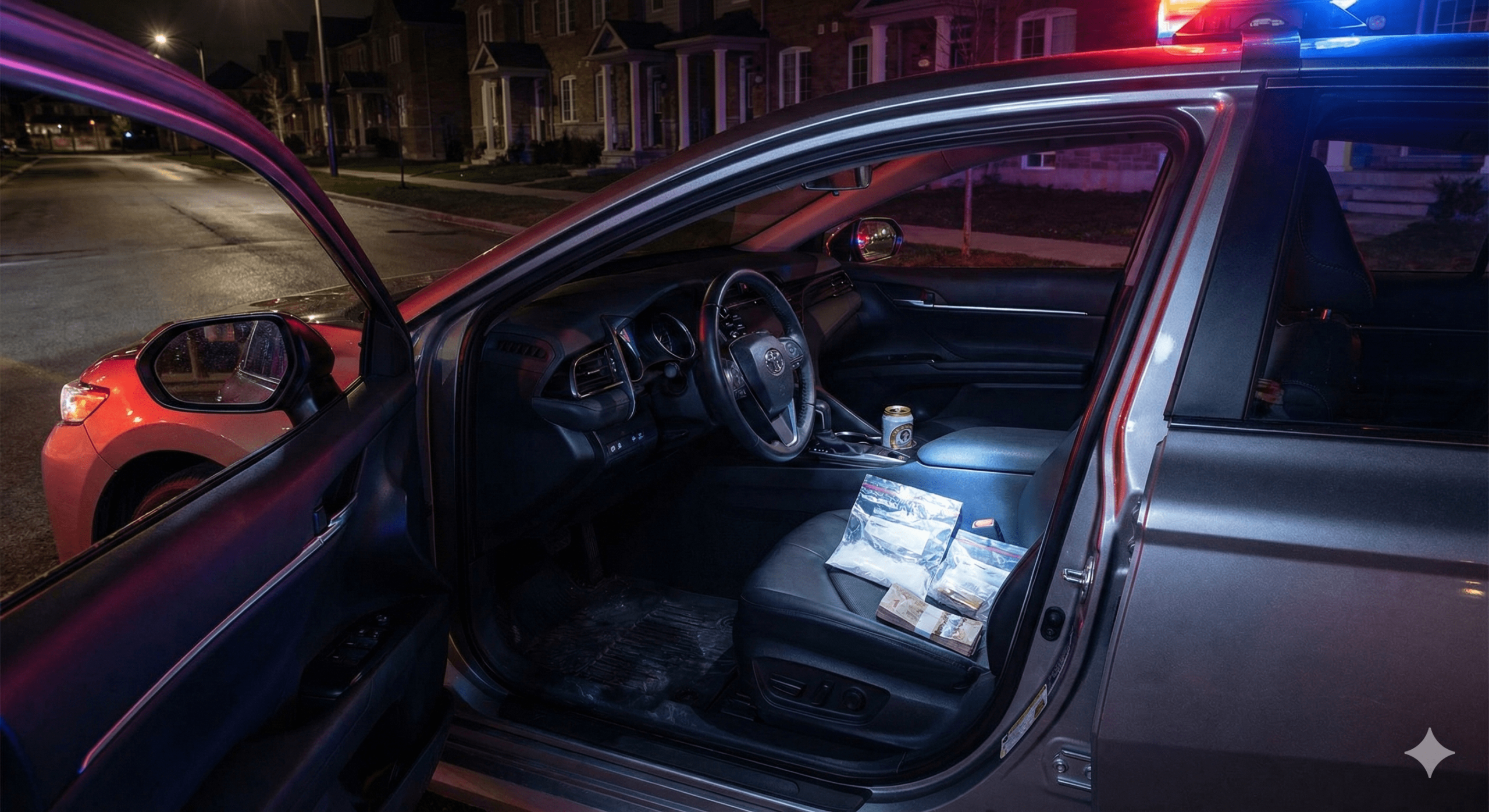
Upon stopping the vehicle, the interaction quickly escalated. P.C. Molnar approached the driver’s side while P.C. D’Annunzio approached the passenger side. P.C. Molnar reported seeing an open can of Corona beer in the center console cupholder. He testified that this observation immediately created a concern regarding the driver’s sobriety and the potential for more alcohol to be inside the vehicle. Under the authority of the Liquor Licence and Control Act, the officers ordered the driver, Roshawn Palmer, to exit the vehicle so a search could be conducted.
The accounts of what happened next diverged significantly between the police and the accused. The officers testified that Mr. Palmer refused to exit the car and attempted to pull the driver’s door shut after P.C. Molnar opened it. They claimed it was necessary to physically pull Mr. Palmer from the vehicle. Once the door was open, the officers observed plastic bags containing suspected narcotics in the door console and on the floorboard. The search ultimately yielded 36.5 grams of fentanyl, 18.4 grams of cocaine, and $1,245 in Canadian currency. Mr. Palmer was arrested and charged with possession for the purpose of trafficking, possession of proceeds of crime, and failing to comply with a release order.
During the trial and the accompanying Charter challenge, several inconsistencies in the police testimony were brought to light. Neither P.C. Molnar nor P.C. D’Annunzio had made any notes regarding Mr. Palmer’s alleged resistance or the claim that he tried to hold the door shut. Furthermore, both officers had failed to mention these specific details during their testimony at a preliminary inquiry held earlier in the legal process. P.C. Molnar also admitted that he did not observe any signs of impairment, such as bloodshot eyes or the smell of alcohol, and conceded that the driver had no opportunity to produce his license or registration before being ordered out of the car.
Mr. Palmer provided a different version of the initial encounter. He testified that he was in St. Catharines to sell drugs and had just met with a client. He claimed that while stopped at an intersection, he made direct eye contact with the two officers while they were parked in their cruiser. He argued that the officers followed him through several turns specifically because they had seen he was a Black man. Mr. Palmer testified that upon being pulled over, P.C. Molnar immediately shouted about a beer can and drew his firearm, ordering him out of the car with profanity. He denied resisting and claimed he was thrown to the ground, resulting in a shoulder injury that was later noted during his booking at the police station.
Justice Ohler evaluated whether the traffic stop was a legitimate exercise of road safety power or a ruse for a criminal investigation. The court noted that while the Highway Traffic Act allows for random stops to check documents, a stop used as a pretext to investigate crime without reasonable grounds is a breach of the Section 9 right against arbitrary detention. The judge found it telling that the officers had no clear recollection of how the Camry first came to their attention or why they chose to run the plates of that specific vehicle among all others on the road.
The court accepted Mr. Palmer’s evidence that he had made eye contact with the officers at an intersection. Justice Ohler found it more likely than not that the officers saw the driver was a Black man and that this observation played a role, whether conscious or unconscious, in the decision to run the plates and subsequently stop the car. The judge emphasized that the presence of a vehicle in a high crime area is not an objectively reasonable indicator of criminal activity. The court concluded that the stop was a pretext for a criminal investigation motivated at least in part by racial profiling.
Regarding the search of the vehicle under the Liquor Licence and Control Act, the court found further breaches. Justice Ohler noted that an open beer can in a cupholder can lead to various inferences and does not automatically provide reasonable grounds for a full vehicle search without further inquiry. The judge pointed out that the officers asked no questions about the can, did not check if it contained liquid, and did not observe any signs of alcohol consumption. The court ruled that the decision to order Mr. Palmer out of the car immediately was influenced by race based stereotypes regarding dangerousness or criminality. Because the initial detention was unlawful, the officers were not in a lawful position to observe the beer can, making the subsequent search of the car unreasonable under Section 8 of the Charter.
The final stage of the court’s analysis involved determining whether the evidence should be excluded under Section 24(2) of the Charter. This requires balancing the seriousness of the state misconduct, the impact on the accused’s rights, and society’s interest in adjudicating the case on its merits. Justice Ohler acknowledged that trafficking in fentanyl is an extremely serious offense that causes immense harm to the community. However, the judge found that the police conduct fell at the serious end of the spectrum.
The court stated that race based decision making in policing, whether conscious or unconscious, undermines the integrity of the justice system. The judge determined that admitting evidence obtained through racial profiling would signal to the public that Charter rights are of little actual value, thereby bringing the long term reputation of the administration of justice into disrepute. Justice Ohler concluded that the breaches of Mr. Palmer’s rights were significant and that the court must dissociate itself from such conduct.
As a result of the exclusion of the fentanyl, cocaine, and cash, the Crown was left with no evidence to support the charges. Following the court’s ruling on the Charter application, acquittals were entered on all counts against Mr. Palmer. The decision serves as a reminder of the rigorous standards required for police interactions and the judiciary’s role in addressing the impact of racial bias in the exercise of police powers.
Read more crime stories here.