The Ontario Superior Court of Justice has released a decision regarding the long term impacts of motor vehicle accidents on vulnerable individuals, awarding Douglas West more than $1.3 million in damages1. The ruling, delivered by Justice S.E. Fraser on December 17, 2025, follows a lengthy trial centered on the life altering injuries Mr. West sustained when he was rear ended by a cube van in 2017. While the defendants admitted liability for the collision itself, the core of the dispute rested on whether the accident was the primary cause of Mr. West’s subsequent physical and psychological decline, or if his pre-existing health challenges would have led to a similar outcome regardless of the crash.
The story begins on January 16, 2017, a day that Mr. West later described as the day he died. He was a belted passenger in a Jeep Cherokee that was struck from behind with significant force by a Canpar cube van driven by Alex Hanna. The impact was severe enough to shatter the rear window of the Jeep, dent the bumper, and trigger the headrest airbags. Mr. West testified to a terrifying experience, recalling a vision of blackness and a moment where he repeatedly told himself he was not going to die. Although he was not transported by ambulance from the scene, choosing instead to be taken to the hospital by his girlfriend at the time, the repercussions of the event would prove to be profound and lasting.
Prior to the accident, Douglas West was a man who, while facing certain vulnerabilities, was actively working to improve his circumstances. In his early thirties, he had an uneven employment history that included physically demanding work in the oil fields of Western Canada and roles as a cook in various restaurants. He had struggled with anxiety, depression, and some history of substance use, leading to a diagnosis of an adjustment disorder and a possible bipolar disorder in the years preceding the collision. However, the evidence presented at trial painted a picture of a functional person who was getting by. He was in a committed relationship with Jillian Robinson and acted as a parental figure to her young daughter. Most notably, he had returned to school to complete his high school diploma with the specific goal of enrolling in a Radiation Safety Officer program at Algonquin College, a career path he believed would provide him with long term stability.
The trial heard moving testimony from those who knew Mr. West best before the collision. His mother, Sherry West, described her son as a capable young man who was close to his grandfather and active at the family cottage, where he performed maintenance tasks like painting and building docks. Jillian Robinson testified that before the crash, Mr. West was outgoing, humorous, and diligent about his appearance and fitness. He frequently attended the gym, cooked for the household, and was highly engaged in the life of her daughter. This version of Douglas West stood in stark contrast to the man who would emerge in the months and years following January 2017.
In the immediate aftermath of the accident, Mr. West was diagnosed with cervical and thoracic strains, commonly referred to as whiplash. However, his symptoms did not follow the typical path of recovery. He reported persistent headaches, dizziness, and chronic pain in his neck, back, and shoulders. More alarmingly, his personality began to undergo a radical shift. The court heard that he became increasingly angry, agitated, and reclusive. His relationship with Ms. Robinson eventually collapsed as he withdrew from social interactions and household responsibilities. Ms. Robinson described a heartbreaking scene where Mr. West essentially became part of the couch, lying in the same spot for days on end, unable or unwilling to engage with the world.
As the years passed, Mr. West’s condition worsened. He moved into a bachelor apartment where, according to his mother’s testimony, he lived like a recluse in a cave with the blinds always drawn. He began using large quantities of marijuana to manage his chronic pain and reported struggling with a total loss of purpose. Experts who assessed him noted significant memory problems, confusion, and a severe depressive disorder. While he did manage to complete his high school credits after the accident through sheer perseverance, his dream of becoming a Radiation Safety Officer vanished as his physical and mental health deteriorated.
A central theme of the trial was the legal concept of causation, specifically the distinction between a thin skull plaintiff and a crumbling skull plaintiff. Under Ontario law, a defendant must take their victim as they find them. If a person has a pre-existing vulnerability that makes them more susceptible to injury, the defendant is still responsible for the full extent of the harm caused. This is the thin skull doctrine. Conversely, the crumbling skull doctrine applies if the plaintiff was already on a path of inevitable decline that would have occurred even without the accident. The defendants in this case argued that Mr. West’s pre-existing mental health issues and substance use meant he was already a crumbling skull, suggesting that his current state was the result of his previous challenges rather than the collision.
Justice Fraser rejected this characterization, finding instead that Mr. West was a thin skull plaintiff. The court described him as a fragile egg for whom the car accident served as a tipping point. Justice Fraser noted that while Mr. West had faced difficulties before 2017, he was functional and possessed a clear sense of direction. The accident was a watershed moment that overwhelmed his ability to cope. The judge found that but for the negligence of the defendants, Mr. West would likely have continued to work and maintain his personal relationships. The court also addressed subsequent events, including a minor car accident in February 2017 and an altercation with police, but ultimately concluded that the January collision was the primary factor in his decline.
The medical evidence was complex, featuring testimony from numerous experts in psychiatry, physiatry, chiropractic medicine, and neuropsychology. The court largely favored the evidence of Mr. West’s treating physicians and participant experts, such as Dr. Majinder Randhawa and Dr. Gordon Ko. These professionals had witnessed the transition in Mr. West’s behavior and physical capabilities over time. Dr. Ko diagnosed Mr. West with chronic pain syndrome and permanent impairments in his neck and back, noting a poor prognosis for future improvement. On the psychiatric side, Dr. Darryl Appleton diagnosed a severe major depressive disorder that was greatly exacerbated by the accident.
In contrast, the court found the evidence of certain defense experts less persuasive. One expert, Dr. Michael Boucher, was criticized for using unmeasured language when describing the secondary accident and for failing to adequately address the diagnostic criteria for chronic pain in his report. Similarly, the court expressed some reluctance in relying on the findings of a neuropsychologist who had not treated clinical patients in nearly two decades and whose work was almost exclusively performed for defense counsel. These findings underscored the court’s reliance on the lived experience and contemporaneous observations of those involved in Mr. West’s care.
The quantification of damages was a meticulous process. Justice Fraser awarded $200,000 in general damages for pain, suffering, and loss of enjoyment of life. In determining this amount, the court looked at similar cases involving plaintiffs who had lost their social identity and functional independence. The award for past and future income loss was particularly substantial. Although the court was not convinced that Mr. West would have successfully become a Radiation Safety Officer due to the barriers he would have faced, such as the need for a pardon and his history of drug use, Justice Fraser found it highly likely that he would have continued to work in manual or service roles. The court awarded $177,389 for past income loss and $724,844 for future income loss, based on a calculation of his historical average earnings.
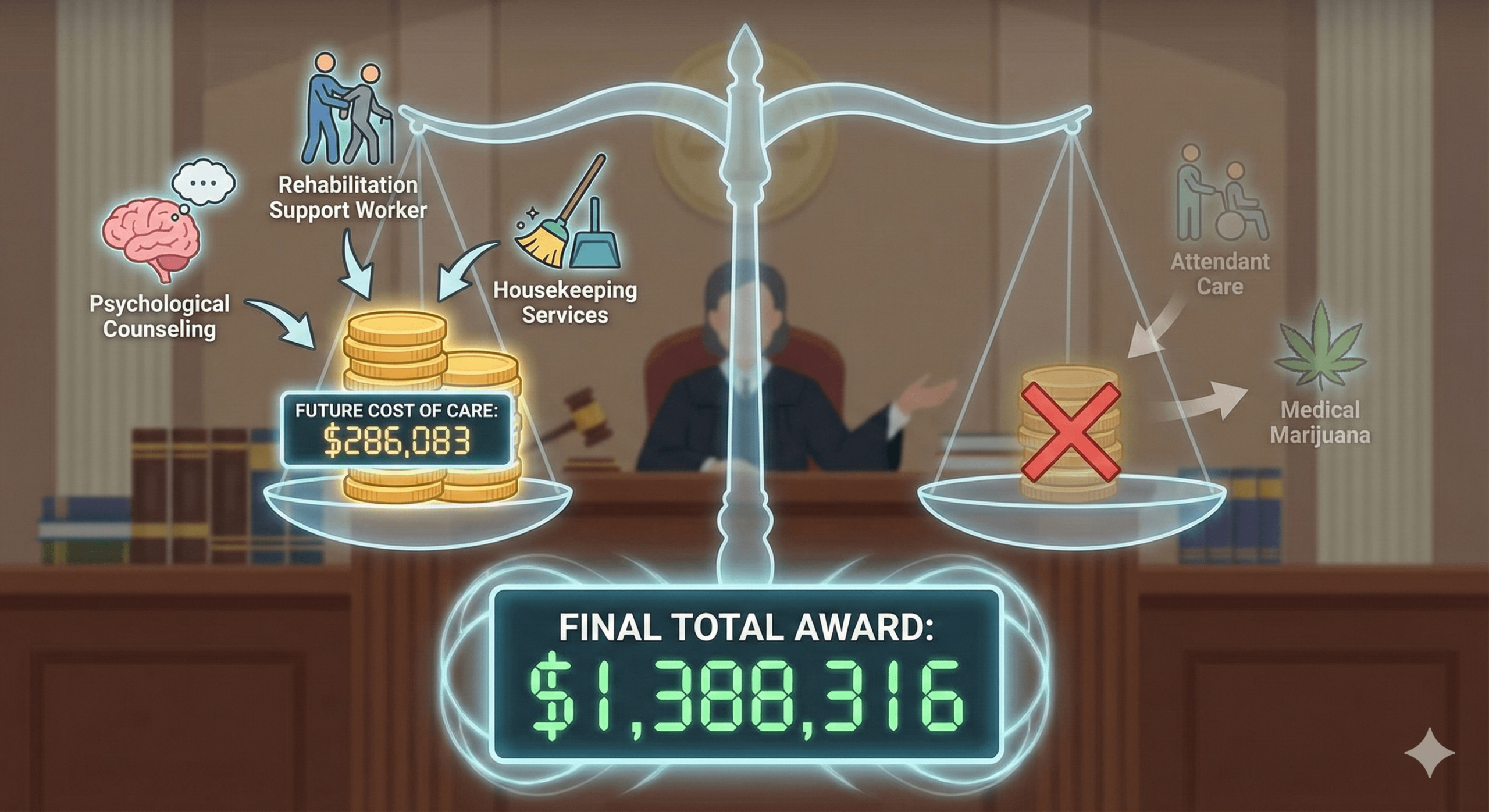
Future cost of care was another significant component of the judgment. The court awarded $286,083 to cover expenses such as psychological counseling, a rehabilitation support worker, and housekeeping services. While the plaintiff had sought a higher amount, including funding for attendant care and medical marijuana, the court narrowed the award to what was deemed reasonably necessary based on the medical evidence. The final total award, after accounting for out of pocket expenses and deductions for accident benefits already received, came to $1,388,316.
A final hurdle for the plaintiff was the statutory threshold under the Insurance Act. In Ontario, a plaintiff can only recover general damages if they have sustained a permanent and serious impairment of an important physical, mental, or psychological function. The defendants moved to have the claim dismissed on the basis that Mr. West did not meet this threshold, arguing his injuries were merely soft tissue in nature. Justice Fraser dismissed this motion, finding that the evidence clearly established that Mr. West’s impairments were both permanent and serious. The judge highlighted how the injuries substantially interfered with most of his usual activities of daily living and prevented him from pursuing the career training he had commenced before the incident.
The decision stands as a reminder of the profound impact a single moment can have on a person’s life trajectory. For Douglas West, a routine trip that ended in a rear end collision resulted in the loss of his career, his relationships, and his sense of self. The court’s ruling ensures that he will have the financial resources necessary to support his ongoing care and provide a degree of stability in a life that was fundamentally altered on a January afternoon in 2017.
Read more about more personal injury cases here.