The Ontario Physicians and Surgeons Discipline Tribunal has ordered the permanent revocation of Dr. Luis Garcia Pan’s certificate of registration following a determination that he sexually abused a patient during a medical appointment in 2010. In a decision1 released on December 15, 2025, the tribunal panel concluded that the severity of the misconduct, combined with a lack of mitigating evidence, necessitated the most serious penalty available under the provincial regulatory framework. The ruling marks the conclusion of a lengthy legal process that included a prior criminal proceeding and extensive arguments regarding the tribunal’s jurisdiction over the matter.
The case originated from a medical appointment that took place on December 21, 2010, at Dr. Garcia Pan’s office. During this half hour encounter, a patient identified as AE sought a routine doctor’s note to explain an absence from work. The tribunal previously found in a merits decision dated September 17, 2025, that Dr. Garcia Pan engaged in professional misconduct by committing twelve specific acts of sexual abuse against AE. These acts included both physical and verbal conduct that the tribunal described as an egregious breach of trust. According to the factual record, Dr. Garcia Pan kissed the patient on the cheeks and lips, made inappropriate sexual comments about her appearance, and touched her breast and buttocks. The tribunal also found that the physician exposed himself to the patient and requested that she engage in sexual acts with him, telling her that the encounter should remain their secret.
During the penalty phase of the proceedings, the tribunal considered the appropriate consequences for these findings. While Dr. Garcia Pan represented himself throughout the process, he did not testify at either the merits or the penalty hearings. He did, however, file a significant volume of written submissions and documents seeking to challenge the tribunal’s authority and the fairness of the proceedings. One of his primary arguments was that the tribunal lacked jurisdiction because his membership with the College of Physicians and Surgeons of Ontario had expired in September 2021, after he failed to renew it. He asserted that because he was no longer a member at the time of the hearing, he should not be subject to its disciplinary powers. The tribunal rejected this argument, citing established law which holds that the relevant date for jurisdiction is when the alleged misconduct occurred. Because Dr. Garcia Pan was a registered physician in 2010, the College retained the right to investigate and adjudicate the allegations regardless of his subsequent registration status.
Dr. Garcia Pan also renewed an objection based on an abuse of process, arguing that the discipline proceeding should not have continued because he had been acquitted of criminal charges related to the same incident in 2019. The tribunal dismissed this concern, noting that the standards of proof and the objectives of professional discipline differ significantly from those in the criminal justice system. A separate procedural challenge was raised regarding the composition of the tribunal panel. Dr. Garcia Pan argued that the panel could not proceed with only four members after one member was no longer able to complete the hearing. The tribunal determined that under the Statutory Powers Procedure Act, the remaining members were legally permitted to complete the hearing and render a decision.
The impact of the misconduct on the patient was a central factor in the tribunal’s deliberations. AE provided a victim impact statement which detailed the profound and long lasting emotional and physical consequences of the 2010 appointment. She described how the experience caused her significant economic harm and damaged her personal relationships. Most notably, the patient stated that she no longer trusts male physicians, a consequence the tribunal viewed as a direct result of Dr. Garcia Pan’s exploitation of the power imbalance between a doctor and a vulnerable patient. The tribunal noted that AE’s family had regarded Dr. Garcia Pan as a close friend and confidant, which added a layer of betrayal to the professional breach.
In determining the penalty, the tribunal had to navigate the evolution of Ontario’s medical regulations. At the time of the misconduct in 2010, revocation of a medical license was not a mandatory penalty for the specific acts committed by Dr. Garcia Pan. Mandatory revocation was only enacted in 2017 for sexual misconduct involving the touching of a patient’s breasts or buttocks. Consequently, the tribunal was required to apply the 2010 version of the Health Professions Procedural Code, which granted the panel discretion to choose between revocation, suspension, fines, or terms and conditions. Despite the lack of a mandatory requirement, the tribunal looked to contemporary legal principles and societal expectations to inform its decision.
The panel referenced several high profile legal precedents, including the Ontario Court of Appeal decision in the case of Peirovy and the Supreme Court of Canada decision in the case of Sheppard. These cases establish that while a penalty must reflect the context in which the misconduct occurred, sentencing and penalty ranges can evolve over time to reflect a modern understanding of the gravity of certain offences. The tribunal observed that society’s appreciation of the harm caused by the sexual abuse of patients has grown significantly since 2010. The panel concluded that even under the older legislative regime, revocation was a proportionate and necessary response to ensure public protection and maintain confidence in the medical profession’s ability to self regulate.
The tribunal highlighted a complete absence of mitigating factors in Dr. Garcia Pan’s case. There was no evidence that the physician had taken steps toward remediation or rehabilitation in the fifteen years since the incident occurred. Furthermore, the tribunal noted that Dr. Garcia Pan did not provide any evidence of remorse or an acknowledgment of the harm caused to the patient. While he suggested that his mental health should be considered as a factor, the tribunal found that he had failed to introduce any formal medical evidence or expert testimony that could be cross examined or evaluated. The only evidence accepted from the registrant during the penalty hearing was several years of tax assessments showing a low net annual income, which he used to argue against the imposition of high costs.
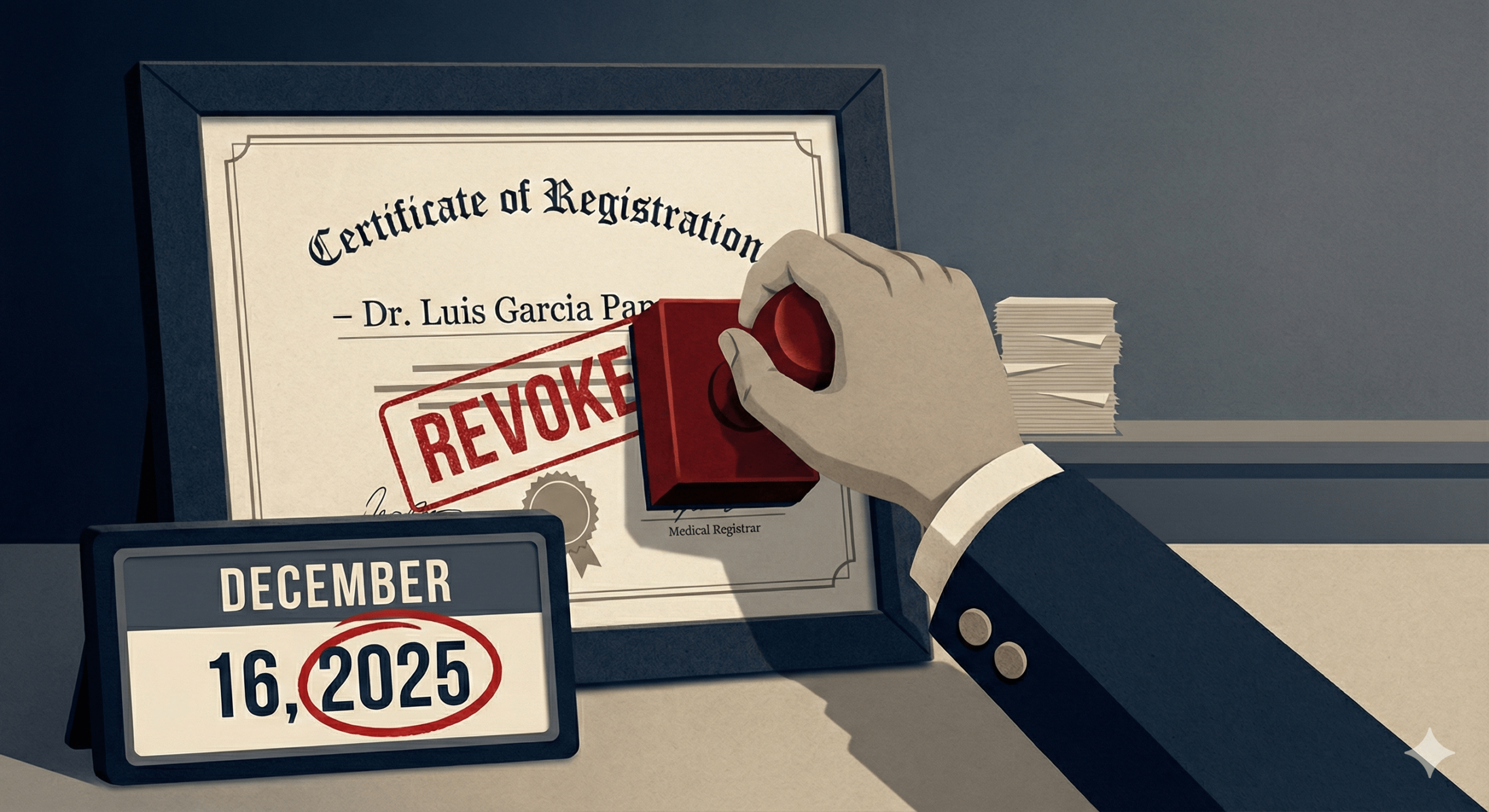
The final order issued by the tribunal includes several distinct components. First, the Registrar has been directed to revoke Dr. Garcia Pan’s certificate of registration effective December 16, 2025. This ensures that he can no longer practice medicine in Ontario. Second, Dr. Garcia Pan is required to appear before the tribunal panel to receive a formal reprimand, which serves as a public denunciation of his conduct. Third, he has been ordered to reimburse the College for the funding of therapy and counselling for AE. The tribunal required him to post security in the amount of $17,940 to guarantee this payment, noting that the patient’s impact statement clearly demonstrated her need for such support.
Finally, the tribunal addressed the issue of legal and hearing costs. The College of Physicians and Surgeons of Ontario requested $103,700 in costs, representing the expenses associated with a ten day hearing at the standard tariff rate. Dr. Garcia Pan argued that he did not have the financial means to pay such an amount, pointing to his tax returns. However, the tribunal found that he had not provided a complete picture of his assets, investments, or other sources of income available to him after a lengthy career as a physician. The tribunal ultimately granted the full request for costs, noting that the proceedings involved dozens of exchanges and extensive case management beyond the formal hearing days. Dr. Garcia Pan is required to pay the costs and post the therapy security by January 15, 2026. This decision underscores the tribunal’s commitment to prioritizing public safety and professional integrity when addressing historical cases of sexual abuse within the medical community.
Read more cases about proceedings in regulated professions here.