In a significant procedural ruling from the Ontario Superior Court of Justice, a local community group opposing a new transitional housing development in Peterborough has been ordered to pay $30,000 into court before their legal challenge can proceed1. The decision, delivered by Justice S.J. Woodley on November 20, 2025, centers on a dispute between Northcrest Neighbours for Fair Process Ltd. and the City of Peterborough regarding the use of “Strong Mayor Powers” to expedite the construction of a sober living facility. The ruling addresses the financial mechanisms of the court system and the requirement for fairness when a corporation with no assets initiates litigation against a municipality and a charitable organization.
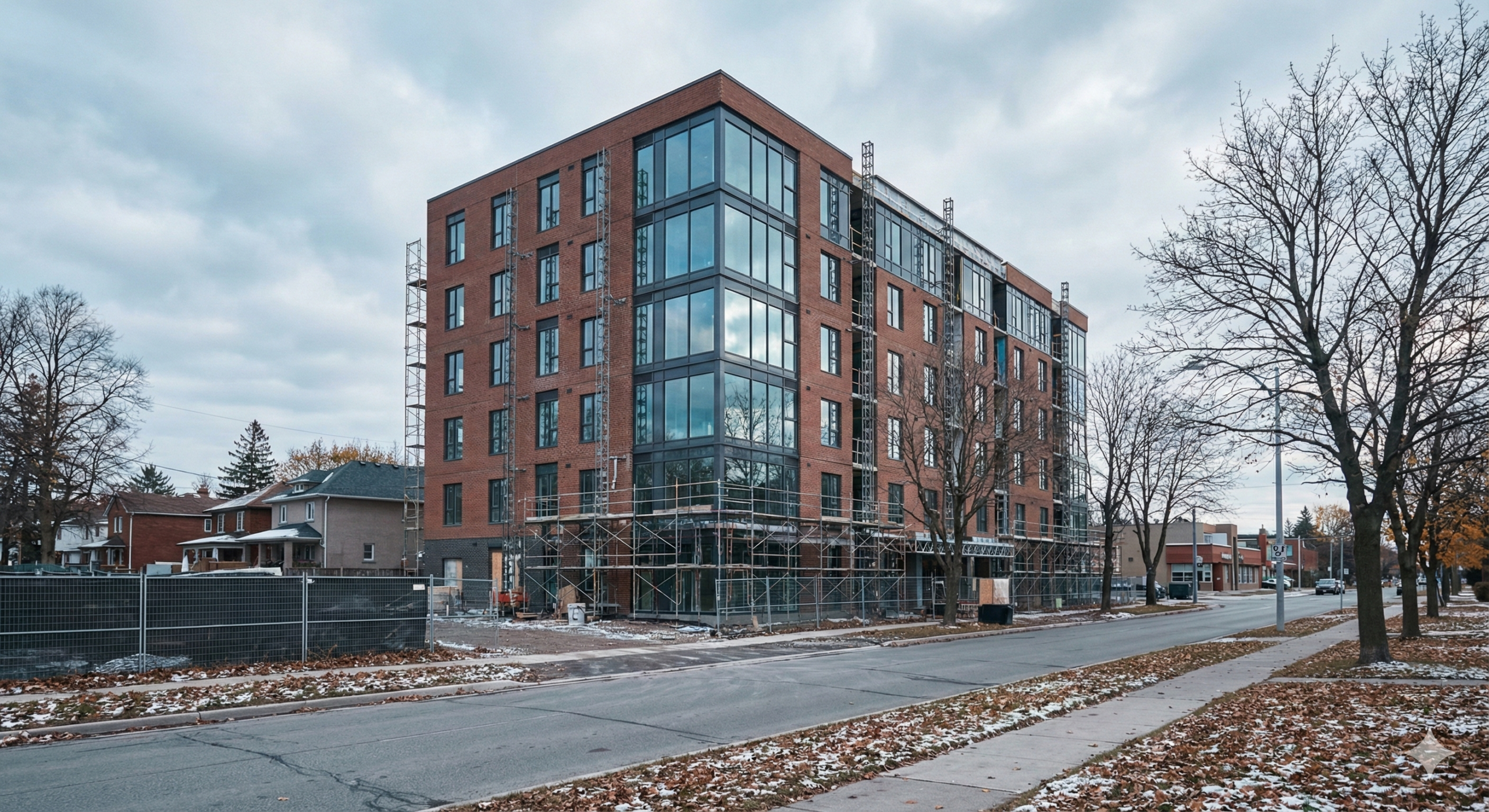
The conflict originated in early 2025 regarding a property located at 738 Chemong Road in Peterborough. The Brock Street Mission, a respondent in the case, owns the land and intends to construct a six-storey, 52-unit housing facility known as McNabb House. This facility is designed to operate as supportive housing to supplement the emergency shelter and semi-independent housing services already offered by the Mission at that location. While the initial plan involved a facility with constant care, the project evolved into a sober living facility aimed at individuals transitioning from emergency shelters or street living into independent housing. The model anticipates that rent will be geared to income and that the building will include security measures such as guest screening.
To facilitate this development, the City of Peterborough passed two specific municipal by-laws on February 24, 2025. One by-law amended the zoning of the property, while the other exempted the property from certain Site Plan Control requirements, such as those governing fire routes, parking, and buffering. These by-laws were enacted under Part VI.1 of the Municipal Act, 2001, a section of legislation commonly known as the “Strong Mayor Powers.” This legislation grants the head of a municipal council unique authority to advance bylaws that could potentially support prescribed provincial priorities, such as the construction of new housing units. Peterborough Mayor Jeff Leal utilized these powers to bring the by-laws to a vote, believing the project would advance the provincial goal of building 1.5 million new residential units. The by-laws subsequently passed with the support of more than one-third of the City Council, satisfying the statutory requirements.
Public opposition to the project emerged during the council’s discussions. Sarah McNeilly, a local resident, attended these meetings to make submissions regarding the by-laws. Following the passage of the by-laws, Ms. McNeilly’s legal counsel informed the City on April 1, 2025, that she intended to challenge their validity in court. The City responded by advising Ms. McNeilly that if she proceeded with litigation, the City would seek legal costs. Four days after this exchange, on April 5, 2025, Ms. McNeilly incorporated a new entity named Northcrest Neighbours for Fair Process Ltd. She appointed herself as the sole officer, director, and shareholder of this new corporation.
Northcrest Neighbours subsequently launched an application to quash the by-laws, arguing that they did not genuinely implicate a provincial priority and that the use of Strong Mayor Powers rendered them invalid. In response, the City of Peterborough and the Brock Street Mission brought a motion for security for costs. This is a legal mechanism designed to protect a defendant in the event they win the case but the plaintiff is unable to pay the resulting legal bill. The City argued that Northcrest was effectively a shell corporation with no assets, created specifically to insulate Ms. McNeilly from financial liability should the challenge fail.
The court had to determine whether there was good reason to believe Northcrest had insufficient assets to pay costs and, if so, whether ordering security would be unjust. The evidence presented to Justice Woodley confirmed that Northcrest indeed had no assets, no income, and no business dealings. Ms. McNeilly admitted during cross-examination that she incorporated the entity after learning the City would seek costs. She described the corporation as representing an unincorporated association of approximately eighty neighbours who contributed to a bank account for legal fees. However, neither Ms. McNeilly nor Northcrest provided any concrete evidence, such as bank statements, to verify the existence or balance of these funds.
Having established that the applicant had insufficient assets, the burden shifted to Northcrest to prove that an order for security for costs would be unjust. A corporate applicant can typically avoid such an order by proving impecuniosity, which means demonstrating that they are genuinely too poor to pay but have a case that deserves to be heard. To meet this threshold, a corporation must provide full financial disclosure, not just of its own accounts, but also of its shareholders and backers. The court found that Northcrest failed to provide this transparency. There was no detailed information regarding Ms. McNeilly’s personal ability to fund the litigation or the financial capacity of the eighty neighbours she claimed to represent. Without this evidence, the claim of impecuniosity could not be sustained.
The court then examined the merits of Northcrest’s case to determine if their chances of success were high enough to warrant allowing the case to proceed without security. Northcrest’s primary legal argument was that the McNabb House should be classified as an “institutional” facility rather than a “residential unit” because of the proposed security measures, such as video surveillance and visitor restrictions. If classified as institutional, the project might not fall under the provincial priority for “residential units,” which would mean the Mayor could not use Strong Mayor Powers to fast-track it.
Justice Woodley found this argument unconvincing. The decision noted that the security measures cited by Northcrest are common in many standard apartment and condominium complexes and do not transform a residence into an institution. The court emphasized that the facility is intended to provide separate rental units where occupants pay rent based on income, which aligns with the definition of residential housing. Furthermore, the Municipal Act contains an immunity clause stating that decisions made under Strong Mayor Powers cannot be quashed for unreasonableness, only for illegality or bad faith. Since the Mayor genuinely believed the bylaws advanced provincial housing priorities, and there was no evidence of bad faith, the court concluded that Northcrest’s application had a limited prospect of success.
In considering the broader interests of justice, the court addressed whether this litigation qualified as a public interest case. Public interest litigation often involves issues that affect the broader community or marginalized groups, and courts are sometimes lenient with costs in such matters. However, Justice Woodley determined that this application was not a matter of broad public interest but rather a local dispute driven by neighboring property owners concerned about the potential impact of the facility on their property values and lifestyles. The ruling stated that municipalities and non-profit organizations should not be exposed to financial risk by nominal corporate applicants in what amounts to a “Not In My Backyard” dispute.
The court ultimately decided that the interests of justice required Northcrest to post financial security. The judge noted that Ms. McNeilly or the other neighbours could have brought the application in their own names, accepting the financial risks inherent in litigation. Instead, they chose to create a corporation with no assets to shield themselves from potential cost awards. The court found that this strategy left the City and the Mission vulnerable to unrecoverable legal expenses if they successfully defended the by-laws.
Consequently, Justice Woodley ordered Northcrest Neighbours for Fair Process Ltd. to pay $30,000 into the court within thirty days. This money will be held as security for the costs of the respondents. The main application to challenge the by-laws and the request for an injunction cannot proceed until this payment is made. Additionally, the court granted leave for the respondents to seek further security if the litigation progresses and costs increase. As the successful parties on the motion, the City and the Mission are also entitled to have their legal costs for this specific hearing paid by the applicant.
This ruling imposes a significant financial hurdle for the community group. If Northcrest fails to pay the $30,000 into court within the stipulated timeframe, their legal challenge against the McNabb House development may be effectively stalled or dismissed. The decision underscores the court’s willingness to look behind the corporate veil when shell companies are used to litigate without financial accountability, particularly in cases involving municipal development and housing projects.
Read more Ontario legal news here.