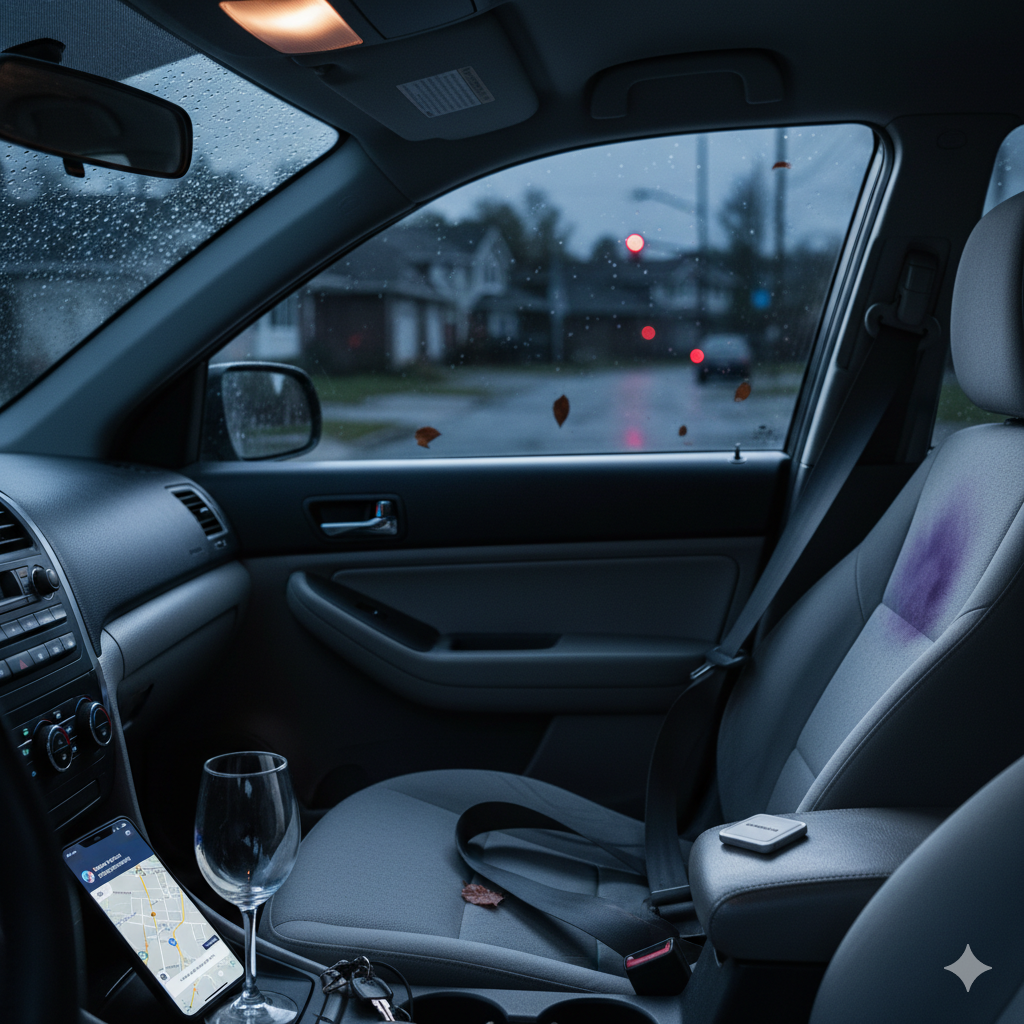
In a judgment released on November 5, 2025, the Ontario Court of Justice has found Mussadique Anwer guilty of assault and choking his wife following a dispute regarding her whereabouts and a disrupted subway commute1. Justice David Porter delivered the reasons for judgment after a trial that spanned several days in August and September, concluding that the Crown had proven beyond a reasonable doubt that Anwer assaulted Fatima Saghir and applied force to her neck during a violent altercation in his vehicle. The case highlighted issues of domestic control, including the use of tracking technology, and clarified legal standards regarding what constitutes strangulation under the Criminal Code.
The events in question took place in the early morning hours of August 2, 2023. The couple, who had entered into an arranged marriage in Pakistan when Saghir was 18 years old, had been residing together in Toronto. Saghir, now 25, moved to Canada in December 2021 and worked part time as a sales associate. By the summer of 2023, the relationship had deteriorated significantly. Both parties acknowledged in court that although they lived in the same house at 236 Albion Road, they were effectively living separate lives. Tensions reportedly stemmed from cultural differences and Anwer’s suspicions regarding his wife’s lifestyle, specifically her friendships with non Muslims and his belief that she was consuming alcohol, which was contrary to their conservative Muslim values.
On the evening of August 1, 2023, Saghir went out with friends in Toronto. Her plan was to take the subway north to York Mills station and have her husband pick her up there to return home. However, logistics became complicated when she arrived at Finch station around midnight only to discover that subway service between Finch and York Mills was suspended. She contacted Anwer via WhatsApp to update him on the change of plans, requesting that he pick her up at Finch station instead. This change in plans became the catalyst for the conflict that followed.
When Anwer arrived at the station to collect his wife, the interaction was immediately hostile. Saghir testified that upon entering the vehicle, Anwer accused her of lying about the subway service interruption. He also accused her of having been drinking alcohol. While Saghir denied lying and told him to check Google Maps to verify the subway closure, the argument escalated as they began their drive home. The situation turned physical shortly after they departed the station. Saghir told the court that while the car was stopped at a red traffic light, Anwer began screaming at her. From the driver’s seat, he suddenly struck her on the right side of her face with a backhanded motion.
The assault continued as Anwer punched her six or seven times with significant force. Saghir testified that she was turned towards him during the argument, which resulted in the blows landing primarily on the right side of her face. Fearing for her safety, she attempted to unbuckle her seatbelt and open the passenger door to escape while the car was stopped. She managed to open the door and yelled for help, but Anwer reached across the front seat to pull the door shut, preventing her exit. It was during this struggle that the choking incident occurred. Saghir testified that Anwer reached out with his left hand and grabbed her neck, squeezing it hard for approximately three or four seconds. Although she did not lose consciousness, she described the force as severe, noting that her head movement and the fact that he was driving prevented him from maintaining the grip longer.
Anwer then turned the vehicle onto a residential side street. According to Saghir’s testimony, he reached over with his right hand and forcibly pushed her head down onto the dashboard while she continued to cry and scream for him to stop. Once the car was parked, she managed to open the door and flee on foot. Anwer chased her down the street, caught her, and physically picked her up by her waist and legs to carry her back to the vehicle. He pushed her back inside, but she struggled free once more and ran toward a major road where she spotted a group of four men standing outside a house. She approached them for assistance, telling them her husband was hitting her and asking them to call 911. Anwer, having pursued her again, attempted to intervene by telling the bystanders that it was merely a “family matter” and that emergency services were not required. Despite his protests, the police were contacted, and officers attended the scene that night.
The prosecution presented photographic evidence to corroborate Saghir’s account of the violence. Seven photographs taken by Saghir in the early morning hours of August 2, along with an additional photo from later that afternoon, showed extensive injuries. The images depicted bruising and swelling on the right side of her face, scratches on her right eyelid, and swelling under her cheek and upper lip. Specific photos of her mouth revealed bruising inside the lip. Additionally, a medical note from her physician, dated August 3, 2023, was entered into evidence. The doctor recorded observations consistent with the photos, noting a bruise and swelling of the right upper lip, swelling of the right side of the face, and a small subconjunctival hemorrhage in her right eye.
During the trial, Anwer took the stand in his own defense and categorically denied assaulting his wife. He portrayed a different version of events, suggesting that Saghir was intoxicated and behaving irrationally. He admitted to being suspicious of her activities and revealed during his testimony that he had placed a Samsung AirTag tracking device on her keys without her knowledge to monitor her movements. He testified that on the night in question, he waited over an hour for her and, when she finally arrived, she smelled strongly of alcohol and was unsteady on her feet. He claimed that he found the smell repulsive and questioned her repeatedly about whether she had been drinking, which she denied.
Anwer’s defense regarding the physical injuries relied on a claim that Saghir had injured herself. He testified that during their argument, she opened the car door and ran away, screaming accusations that he was going to kill her. He claimed that as she ran, she tripped on a curb and fell to the ground. He stated that he only picked her up to help her back to the car because he wanted her to be safe and not “make a scene.” He denied striking her, choking her, or smashing her head against the dashboard. His counsel argued that Saghir’s version of events was implausible, suggesting it was unlikely he could have assaulted her across the center console while both were wearing seatbelts and the car was in motion.
A significant portion of the trial focused on the credibility of the two parties. The defense highlighted that Saghir had initially lied to her husband and the court about consuming alcohol that night. In re examination, Saghir admitted she had consumed one glass of wine but had denied it because she feared Anwer would expose her to her conservative parents and family, which would cause her significant embarrassment and shame. Justice Porter accepted this explanation, noting that her dishonesty on this specific point was rooted in cultural and familial fears rather than an attempt to deceive the court regarding the assault. The judge found her to be an impressive witness who answered questions directly, and he concluded that her admission of the lie did not undermine the reliability of her testimony regarding the violence she endured.
Conversely, Justice Porter found Anwer’s evidence to be incapable of belief. The judge noted that Anwer had no plausible explanation for the significant bruising and facial injuries documented in the photographs and medical notes, which were entirely consistent with the assault described by Saghir. The judge also pointed to Anwer’s admission that his wife fled from the car screaming “You are going to kill me” as an indication of her genuine terror, which contradicted his claim that they were simply having a verbal argument. Furthermore, the judge highlighted Anwer’s controlling behavior, specifically his use of a tracking device and his intense preoccupation with her whereabouts and alcohol consumption. Justice Porter concluded that Anwer lashed out in anger because he believed his wife was lying to him about the subway and her drinking, and that his denial of being angry was unbelievable given the circumstances.
Legal arguments were also raised regarding the second charge of choking, suffocating, or strangling under section 267(c) of the Criminal Code. The defense implied that because Saghir did not pass out and the grip lasted only a few seconds, the legal threshold for strangulation might not have been met. However, the Crown argued, and the judge agreed, that the offence does not require an interruption of breathing or airway constriction. Citing recent case law, Justice Porter affirmed that the offence is established if the accused intentionally places a hand on the victim’s neck and applies force capable of causing neck compression. The judge accepted Saghir’s testimony that the grip was “hard” and involved compression, finding Anwer guilty of the charge despite the brief duration of the act.
Justice Porter ultimately rejected the defense’s theory that Saghir’s injuries were the result of a trip and fall. He found the complainant’s emotional state immediately after the incident, where she sought help from strangers, to be strong confirmatory evidence of the assault. The judge noted that it defied common sense for a woman to flee a vehicle and frantically beg strangers to call 911 if she had merely tripped on a curb while her husband was trying to help her.
In his final ruling, Justice Porter stated that the evidence presented by the Crown proved beyond a reasonable doubt that Anwer had committed both offences. The court found that Anwer engaged in controlling behavior throughout the relationship, culminating in the violent outburst on August 2, 2023. Mussadique Anwer was found guilty of one count of assault and one count of choking, suffocating, or strangling. The decision serves as a judicial affirmation that domestic violence involving neck compression, regardless of whether it results in unconsciousness, falls squarely within the serious ambit of strangulation offences under the Criminal Code.
Read more crime stories here.