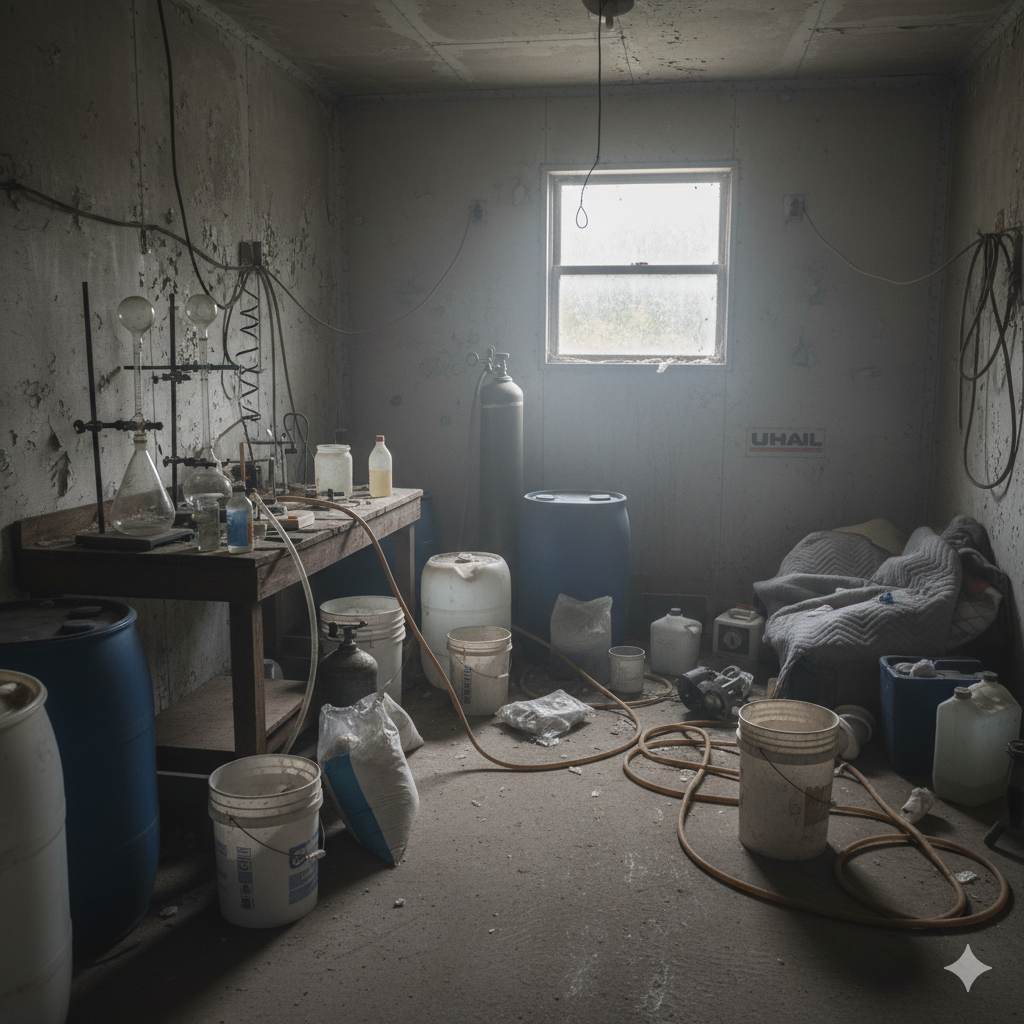
A Hamilton man with no prior criminal record has been sentenced to five years in jail for his participation in a clandestine methamphetamine laboratory uncovered during a major police operation known as Project Odeon1. Justice J.P.P. Fiorucci of the Ontario Court of Justice delivered the reasons for sentence on November 12, 2025, balancing the severe public danger of commercial drug production against the offender’s personal circumstances and a serious lapse in medical care he received while in pre-sentence custody.
Garry Moore, 47, entered a guilty plea to the offence of producing methamphetamine, a Schedule I substance, covering a period between April 1 and August 2, 2023. The charges stemmed from his involvement in a large-scale drug network operating across the Greater Toronto and Hamilton Area. The network was the target of Project Odeon, a joint forces investigation that ultimately dismantled multiple clandestine laboratories producing fentanyl and methamphetamine. The police operation culminated in search warrants executed at ten locations between late July and early August 2023, resulting in the seizure of approximately 18 kilograms of methamphetamine, 1.3 kilograms of fentanyl, precursor chemicals, and specialized laboratory equipment.
Mr. Moore’s involvement centred on a rural property located at 6800 Sixteen Road in Smithville. The property contained a residence and several outbuildings, one of which housed the methamphetamine laboratory. Investigators observed Mr. Moore living in one of the outbuildings and regularly moving between the structures carrying buckets, jugs, and gas canisters. Police noted that he would change his clothing before entering the outbuilding, a precaution investigators believed was intended for personal protection against the volatile chemicals used in the production process.
While Mr. Moore was not a directing mind of the operation, he played a functional role in the logistics of the laboratory. He worked under the direction of an associate and assisted in transporting chemicals and equipment. On one specific occasion in July 2023, surveillance observed him helping to load and unload laboratory equipment and chemicals from a U-Haul truck. This activity took place at both the Smithville property and another location on Bethesda Road in Whitchurch-Stouffville that was associated with fentanyl production. These items were essential for setting up and maintaining the clandestine laboratory.
The operation came to a halt for Mr. Moore on August 2, 2023, when investigators executed a search warrant at the Smithville property. Police located the active methamphetamine laboratory in one of the outbuildings, along with the necessary precursors and chemicals. Mr. Moore was arrested and admitted his participation in the production efforts.
During the sentencing hearing, the court received detailed information regarding Mr. Moore’s background. Raised in a stable household in Hamilton, he had maintained a crime-free life until this offence. He is a father of two, including a ten-year-old daughter with whom he has had no contact since his arrest. Prior to his involvement in the drug trade, Mr. Moore had built a solid employment history involving labour-intensive roles such as commercial contracting and automotive work. His most recent long-term employment was at Kubes Steel in Hamilton, where he worked for approximately two and a half years.
The court heard that Mr. Moore’s descent into criminal activity coincided with significant health and financial struggles. He suffers from symptoms consistent with Ménière’s disease, a disorder of the inner ear that causes severe vertigo and hearing loss. These symptoms became debilitating enough that he was forced to take a medical leave of absence from work, as it was unsafe for him to operate machinery. Unemployed, without prescribed medication, and under financial strain, Mr. Moore described himself as being in survival mode when he was recruited into the drug operation. He asserted that he was exploited by others due to his vulnerability, a characterization supported by collateral sources who described him as hardworking and eager to please.
A significant factor in the sentencing decision was a specific hardship Mr. Moore endured while in pre-sentence custody. Defence counsel provided medical records showing that Mr. Moore continued to suffer from nausea, dizziness, memory difficulties, and vertigo while incarcerated. He had been prescribed medication that effectively managed these symptoms, allowing him to participate in daily institutional activities. However, in January 2025, the detention centre failed to provide this medication for a period of ten days.
Mr. Moore addressed the court directly regarding this lapse in care, explaining that without the medication, he was bedridden for the entire ten-day period and was unable to eat or drink. Justice Fiorucci accepted this evidence, noting that the interruption in medication caused severe physical effects that made his time in custody significantly more difficult than usual. The judge determined that this constituted a collateral consequence of the sentence, a factor that legally permits a reduction in the final penalty to ensure proportionality.
The Crown had sought a penitentiary sentence of ten years, arguing that the production of methamphetamine is a grave offence that requires a strong message of denunciation and deterrence. Methamphetamine is recognized by the courts as a highly addictive and dangerous drug that causes staggering harm to individuals and communities. Furthermore, the production process itself poses risks of fire, explosion, and environmental damage from toxic waste. The Crown emphasized that Mr. Moore was part of a commercial enterprise that prioritized profit over public safety.
The defence, conversely, argued for a sentence in the range of four to five years. They highlighted Mr. Moore’s lack of a prior criminal record, his guilty plea, his remorse, and his supportive family. They also pointed to his efforts toward rehabilitation while in custody, which included obtaining his Ontario Secondary School Diploma in June 2024 and completing various rehabilitative courses.
In reaching his decision, Justice Fiorucci analyzed several legal precedents to determine the appropriate sentencing range. The judge considered the case of R. v. Ngo, where an offender received a seven-year sentence for a large-scale operation. In that case, the offender was seen in the lab for nine hours a day and was the last to leave at night. The judge also reviewed R. v. Nguyen, where a young offender received five years after his clandestine lab exploded, causing him severe burns and threatening the safety of the neighbourhood.
Justice Fiorucci noted that the sentencing range for methamphetamine production is broad, typically spanning from five to sixteen years, depending on the offender’s role and the scale of the operation. The judge distinguished Mr. Moore’s case from those requiring harsher penalties by noting his lower-to-middle level role in the hierarchy and his genuine remorse. Unlike offenders who deny responsibility or play a leadership role, Mr. Moore admitted his guilt, sparing the court a complex trial and reducing the burden on the judicial system.
The court concluded that while the involvement in a large-scale commercial drug network demanded a significant jail term to deter others, the mitigating circumstances justified a sentence at the lower end of the spectrum. The judge found that a five-year sentence properly prioritized the protection of society while acknowledging Mr. Moore’s potential for rehabilitation and the specific hardship he suffered due to the medication error in jail.
The final sentence imposed was five years in jail. However, Mr. Moore received substantial credit for the time he had already served. Having spent 834 days in custody prior to sentencing, he was credited with 1,251 days based on the standard enhancement rate of 1.5 days for every day served. This calculation left him with a remaining sentence of 574 days, or approximately 19 months.
Because the remaining time to be served is less than two years, Mr. Moore will serve his sentence in a provincial reformatory rather than a federal penitentiary. Following his release, he will be subject to a probation order for two years. The probation terms are intended to assist his reintegration into society and ensure he remains on a law-abiding path.
In addition to the custodial sentence and probation, Justice Fiorucci ordered Mr. Moore to provide a DNA sample for the national databank. The court also imposed a lifetime prohibition on possessing prohibited firearms and weapons, and a ten-year prohibition on possessing other firearms and ammunition. A forfeiture order for items seized during the investigation was also granted. The judge waived the victim surcharge, acknowledging that it would cause undue financial hardship given Mr. Moore’s circumstances.
Read more crime stories here.