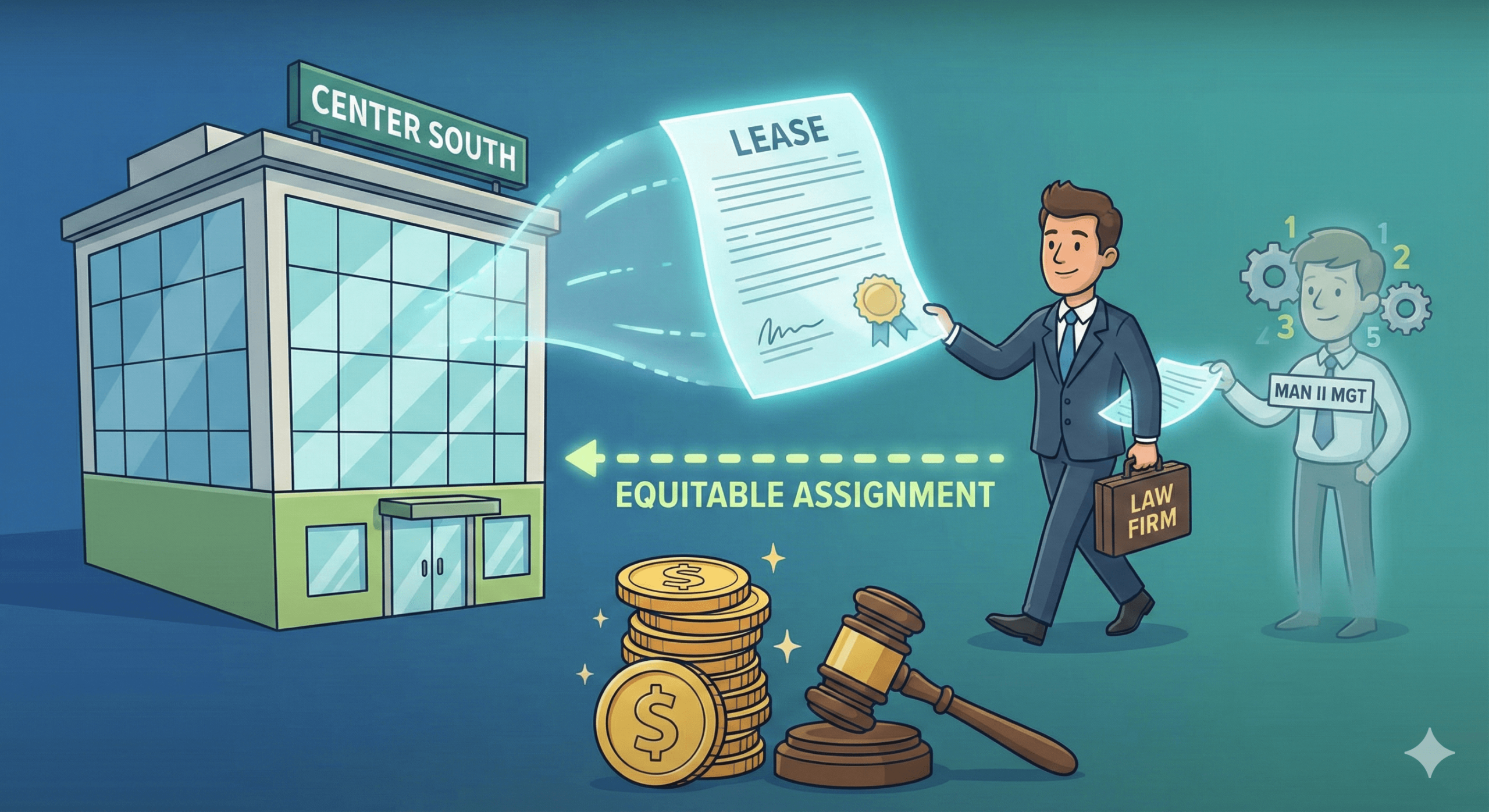
The Court of King’s Bench of Alberta has issued a ruling regarding the liability of commercial tenants, determining that a law firm remained responsible for unpaid rent even though the formal lease was signed by a separate management company1. The decision, rendered on January 6, 2026, by Justice D.A. Yungwirth, centers on the legal concept of equitable assignment, where the actions and intentions of parties can create a binding landlord-tenant relationship that exists outside the strict four corners of a written contract.
The dispute involved a commercial property located at 4528 – 99 Street in Edmonton, owned by 852819 Alberta Ltd., operating as Center South. The legal journey began in 2014 when David Sheckter, a lawyer with Masuch Albert LLP, approached the landlord’s representative, Jeff Dobrescu, to lease office space for the firm. While the initial offer to lease was made in the name of the law firm, Mr. Sheckter requested a change before the formal lease was signed. He asked that the tenant be listed as Man Management (Edmonton) Ltd., explaining that the change was intended to limit the law firm’s liability in case of future financial difficulties.
During these initial negotiations, Mr. Sheckter reportedly assured the landlord that as long as the law firm remained in business, it would be the entity actually paying the rent. Based on this assurance, the landlord agreed to the arrangement. Over the following years, the relationship appeared stable. The lease was amended in 2015 to increase the square footage and extend the term, and the law firm operated its practice out of the expanded premises. While the management company was the technical tenant, the law firm was the visible occupant of the space.
In late 2018, the parties entered into a second lease agreement to further increase the office space and extend the term until October 31, 2023. Again, at the request of Mr. Sheckter, the tenant’s name was updated to reflect a new entity, Man II Management (Edmonton) Ltd. By this time, the law firm had also changed its name to Masuch Law LLP. For the vast majority of this second lease term, the financial reality did not mirror the paperwork. After the first three months of the new term, all rent payments were made directly by Masuch Law LLP to the landlord via automatic deposit.
The situation changed abruptly in January 2023. Mr. Sheckter informed the landlord that Masuch Law LLP had merged with another firm, Ogilvie LLP. As part of this merger, the firm intended to vacate the Edmonton premises and move its operations to Ogilvie’s downtown offices. At the time of this announcement, ten months remained on the lease. According to court records, Mr. Sheckter assured the landlord that both Masuch Law and Ogilvie LLP would ensure the remaining rent was paid. He also asked for the landlord’s help in finding a replacement tenant to mitigate the firm’s ongoing financial obligations.
Following the move, Masuch Law continued to pay rent for January and February 2023, though the February payment was delayed. However, payments stopped thereafter. The landlord managed to mitigate some of the losses by leasing about one-third of the space to a lawyer who had not joined the merger, but a significant balance remained. The total unpaid rent for the final eight months of the term amounted to $106,736.64.
When the landlord sought to recover these funds through arbitration, a central legal question arose: was Masuch Law LLP actually a “tenant” liable for the debt, or was the liability confined to the numbered management company listed on the lease? Because the management company appeared to have no assets, the answer to this question determined whether the landlord could actually recover the lost rent.
The matter first went before an Applications Judge, who found that an equitable assignment had occurred. This meant that even though there was no formal document transferring the lease from the management company to the law firm, the conduct of the parties demonstrated that they had effectively treated each other as landlord and tenant. The law firm appealed this decision to the Court of King’s Bench, leading to the current ruling.
In her analysis, Justice Yungwirth emphasized that the existence of an equitable assignment is a question of fact. It depends on the intention of the parties, gathered from their words, their actions, and the surrounding circumstances. The court noted that no specific “magic words” are required to create such an assignment; rather, the court looks at whether the landlord and the purported assignee decided to treat each other as if a direct lease existed between them.
The evidence in this case pointed strongly toward a direct relationship between the landlord and the law firm. Justice Yungwirth observed that the landlord always understood the law firm to be the real tenant. This was evidenced by the fact that the landlord did not conduct financial scrutiny of the management companies or demand personal guarantees, as they trusted the firm’s professional standing and the verbal assurances provided by Mr. Sheckter.
Furthermore, the conduct of the law firm after vacating the premises was deemed highly relevant. Even after moving downtown, Masuch Law continued to pay utilities and security accounts for the Edmonton property until the very end of the lease term. The firm kept signage on the building to direct clients to their new location, continued to receive mail at the address, and retained keys to the premises. Perhaps most tellingly, the firm’s representatives continued to negotiate with the landlord about finding subtenants and “putting numbers together” for potential new rent arrangements.
Justice Yungwirth found that these actions were entirely inconsistent with the firm’s later argument that it was a mere stranger to the lease. The court pointed out that if the management company were truly the only tenant, there would have been no reason for the law firm to seek the landlord’s help in reducing “its” liability or to continue paying for utilities on a building it no longer occupied.
The firm had argued that Clause 16 of the lease, which governed formal assignments, should prevent a finding of liability. However, the court rejected this, noting that the landlord’s conduct showed he had effectively consented to the law firm acting as the tenant. Justice Yungwirth concluded that the parties had governed themselves as though Masuch Law was the tenant for years, and the law firm could not now retreat to the technicality of the numbered company to avoid its financial obligations.
The court dismissed the appeal, upholding the earlier finding that an equitable assignment had taken place. This decision effectively clears the way for the landlord to pursue the law firm for the $106,736.64 in unpaid rent through the pending arbitration proceedings. The ruling serves as a reminder to commercial parties that the daily reality of their business dealings and the assurances they provide can carry as much legal weight as the names printed on a formal contract.
Read about more real estate cases here.