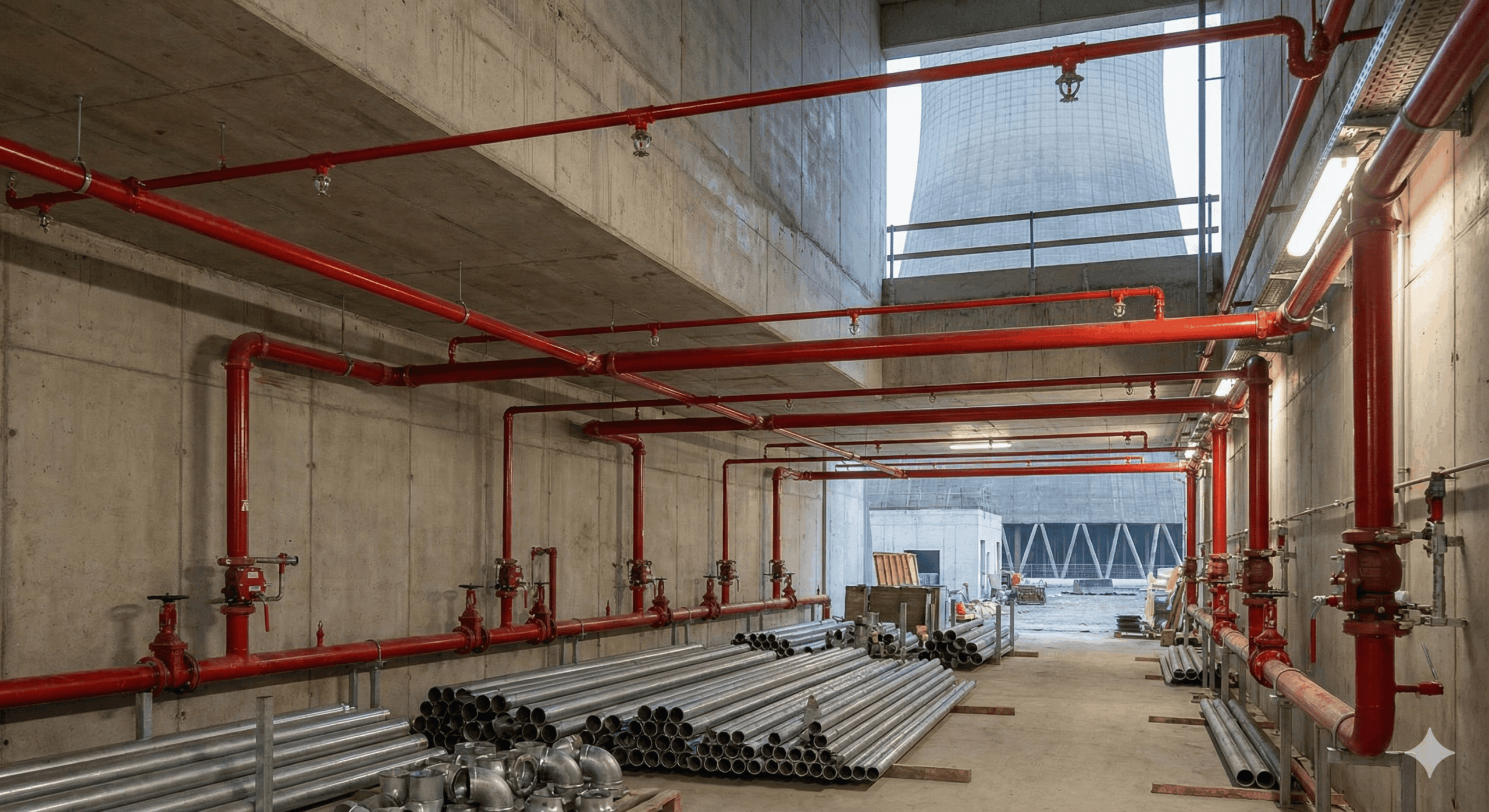
The Ontario Superior Court of Justice Divisional Court recently addressed a jurisdictional conflict between two major trade unions regarding work performed at the Bruce Nuclear Power Development1. This legal challenge arose from a dispute over which union had the right to install a new water-based fire suppression system at the Bruce A site. The United Association of Journeymen and Apprentices of the Plumbing and Pipefitting Industry of the United States and Canada, known as the UA, sought to overturn decisions made by the Ontario Labour Relations Board. The UA represented plumbers and pipefitters who believed the work fell within their exclusive professional domain. Opposing them was the Labourers International Union of North America, Local 1059, also known as LIUNA, which argued that its members were equally qualified and had a historical claim to such projects in the region.
The conflict began when E.S. Fox Limited was tasked with dismantling an old fire suppression system and installing a new one at the nuclear facility. E.S. Fox assigned the removal of the old plumbing to members of the UA. However, for the installation of the new system, the work was subcontracted to Troy Life & Fire Safety Ltd., which also assigned the project to the UA. LIUNA challenged this assignment by filing a jurisdictional dispute under the Labour Relations Act. The central question for the Ontario Labour Relations Board was whether the installation of water mains and fire suppression infrastructure belonged to the pipefitters or the labourers. In early 2025, the Board issued a decision that split the work. It allowed the UA to keep the removal portion of the project but reassigned the installation work to LIUNA.
The UA and Troy Life & Fire Safety Ltd. were dissatisfied with this outcome and requested a reconsideration, which the Board ultimately denied. This led the parties to the Divisional Court for a judicial review. The applicants argued that the Board had ignored a crucial piece of legislation known as the Building Opportunities in the Skilled Trades Act, 2021, often referred to as BOSTA. They contended that because the work involved the trade of a sprinkler fitter, which is a compulsory certified trade under Ontario law, only members of the UA possessed the legal qualifications to perform the tasks safely and lawfully. They argued that the Board’s failure to treat this statute as a primary factor made its decision unreasonable.
When the Ontario Labour Relations Board first looked at the dispute, it applied a long-standing framework consisting of six established factors to determine which union should perform the work. These factors include collective agreements, trade agreements between the unions, employer practice, area practice, safety and training, and economy and efficiency. The Board found that the collective agreements of both unions were broad enough to cover the work and that there were no specific trade agreements that settled the matter. Furthermore, the evidence regarding the specific practices of the employers involved was insufficient to tip the scales.
The turning point in the Board’s original analysis was the factor of area practice. LIUNA was able to provide substantial evidence showing that its members had historically performed this specific type of installation work within the geographic area of the Bruce Nuclear Power Development. In contrast, the UA could only point to a single project in its favour. The Board noted that in the construction industry, the history of who has traditionally performed the work in a specific region is often given the most weight. Because LIUNA had a much stronger track record of performing these installations in the local area, the Board concluded that the work should be assigned to them.
Regarding the safety, skills, and training factor, the UA had argued that BOSTA created a legal barrier for the labourers. They maintained that the installation of water-based fire protection systems is the core work of a sprinkler fitter. Under BOSTA, individuals must be certified or registered as apprentices to work in a compulsory trade. The UA suggested that by awarding the work to LIUNA, the Board was essentially encouraging a violation of provincial law. However, the Board found that members of both unions had demonstrated they possessed the necessary skills to do the work safely. The Board also observed that LIUNA members had been performing this work for years at the Bruce site without any safety incidents or interventions from the Ministry of Labour.
The Board’s refusal to let BOSTA dictate the outcome of a jurisdictional dispute was rooted in decades of its own legal precedents. In previous cases involving older versions of apprenticeship legislation, the Board had consistently held that such laws are intended to protect public safety by ensuring workers have certain skill sets, rather than to serve as a tool for dividing work between competing unions. The Board maintained that if the legislature had intended for apprenticeship laws to override the Labour Relations Act in jurisdictional matters, it would have stated so explicitly. Consequently, the Board treated the safety legislation as a background consideration rather than a deciding factor that could grant one union exclusive rights over a project.
In the Divisional Court, the UA and Troy Life & Fire Safety Ltd. argued that the legal landscape had changed with the introduction of BOSTA. They claimed the new Act was more rigorous and direct than its predecessors and that the Board’s reliance on old case law was a mistake. They further argued that the Board’s decision created a legally incoherent situation where a contractor might be forced to choose between following a Board order and complying with provincial trade certification requirements. The applicants asked the court to quash the Board’s decisions and send the matter back to be heard by a different official.
The court’s review was governed by the standard of reasonableness, a legal principle established by the Supreme Court of Canada in the Vavilov decision. This means the court does not decide the case again from scratch or determine what it would have done in the Board’s place. Instead, the court looks at whether the Board’s decision was transparent, intelligible, and justified based on the facts and the law. Justice Backhouse, writing for the Divisional Court, emphasized that labour relations boards are highly specialized tribunals. Courts generally show a high degree of deference to these boards, especially when they are dealing with the complex and industry-specific rules of the construction sector.
Justice Backhouse rejected the applicants’ argument that the court should first determine the relevance of BOSTA as an objective legal constraint before looking at the Board’s reasoning. The court clarified that a reasonableness review requires looking at the decision as a whole. The judges found that the Board had properly engaged with the arguments and provided a coherent explanation for why it followed its established practice. The court noted that even the UA had admitted during the initial proceedings that the factors the Board uses are not strictly governed by BOSTA regulations.
The court also addressed the concern regarding the potential for conflicting legal obligations. It noted that the Board had considered this point during the reconsideration phase. The Board had found that since LIUNA members had performed this work many times after BOSTA came into effect without any complaints or legal challenges, the alleged impossibility of compliance was not supported by the evidence. The court agreed that the primary purpose of BOSTA is public protection through skill regulation, not the adjudication of union territory.
Ultimately, the Divisional Court found that the Labour Relations Board had acted within its expertise. The Board’s decision to prioritize area practice (the history of which workers had actually done the work in that location) over the technical definitions in trade qualification legislation was deemed a reasonable exercise of its discretion. The court held that the Board’s reasons were logical and that there was a rational connection between the evidence provided and the final assignment of the work to LIUNA.
The application for judicial review was dismissed, leaving the Board’s original work assignment in place. The court also ordered the UA and Troy Life & Fire Safety Ltd. to pay legal costs to LIUNA, totaling ten thousand dollars. This ruling reinforces the principle that the Ontario Labour Relations Board maintains broad authority to resolve jurisdictional disputes using its traditional factors, even when those disputes involve trades that are subject to compulsory provincial certification. The decision underscores the difficulty of using general safety and qualification statutes to override the established customs and practices of the construction industry as interpreted by the Board.
Read more Ontario legal news here.