The Calgary Subdivision and Development Appeal Board has released a decision regarding a contentious townhouse project in the Wildwood community, ultimately allowing the development to proceed but with several specific modifications to the original plans1. The ruling, issued on December 31, 2025, follows a series of hearings held in late 2025 that pitted local residents against a developer seeking to build a four unit townhouse on a corner lot. While the Board upheld the fundamental approval of the project, it sided with the appellant on several technical inaccuracies within the application, requiring the developer to submit revised plans before construction can begin.
The legal journey for the property located at 46 Windermere Road SW began on August 21, 2025, when the City of Calgary Development Authority approved a permit for John Trinh & Associates to construct a new townhouse building and an accessory garage. The parcel is owned by 2433996 Alberta Ltd. and is designated as a Residential – Grade Oriented Infill district, known as R-CG. This specific zoning is intended to facilitate higher density in established neighborhoods through ground-oriented housing. However, because the proposed townhouse is considered a discretionary use under the local land use bylaw, the Development Authority had the power to approve it based on its merits, a decision that David Fraser, represented by Philip Handcock, promptly appealed.
The appeal centered on a wide range of concerns, from technical violations of the city’s bylaw to broader questions about neighborhood character and environmental impact. The hearing process was split into two sessions, starting in October 2025 and concluding in December, as the Board gathered evidence from city planners, the developer, and concerned neighbors. Throughout the proceedings, the appellant argued that the Development Authority had failed to exercise due diligence, pointing to several errors in the approved plans and alleging that the project did not comply with the strict requirements for grade oriented infill.
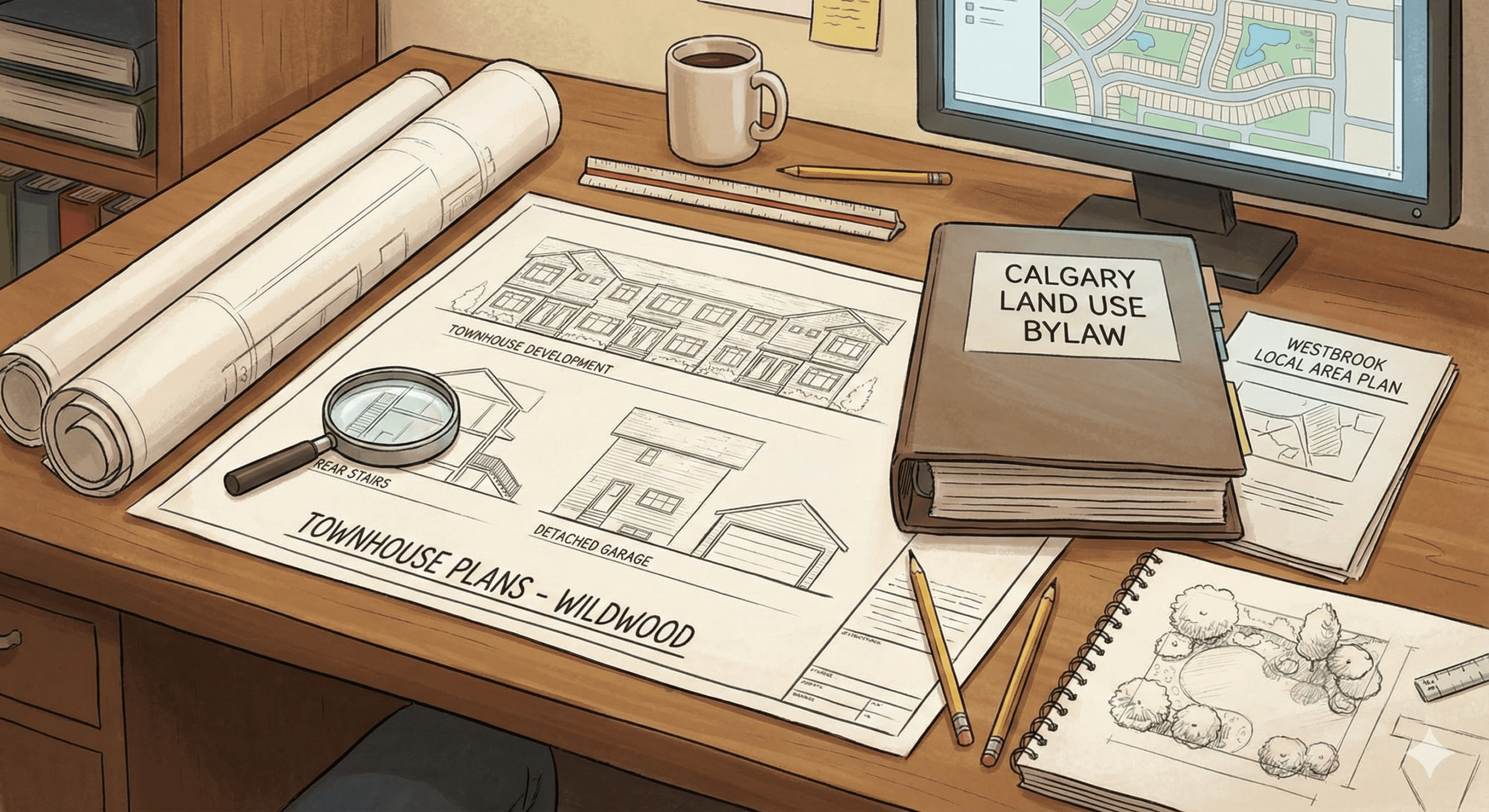
One of the primary points of contention involved the physical access to the units and the classification of outdoor spaces. The appellant argued that units three and four of the proposed development featured rear staircases that were nearly two meters high, which allegedly violated the requirement that all units provide individual, separate, and direct access to grade. The appellant contended that exiting a unit onto a high platform and descending ten risers did not constitute direct access. Furthermore, the appellant noted that these platforms were labeled as decks on the site plan. According to the city’s bylaw, a deck is intended for use as an outdoor amenity space and is subject to specific height restrictions that the proposed structures appeared to exceed.
In response to these arguments, the developer and the Development Authority maintained that the platforms were not decks but were instead circulation landings. They explained that because the platforms were less than 2.5 square meters in size, they did not qualify as amenity spaces under the bylaw. The developer also clarified that these rear entrances were secondary access points designed to meet building code requirements for fire safety and egress, while the primary entrances for the units were located at grade level on the sides of the building. The Board ultimately agreed with the city’s interpretation, finding that the bylaw does not require every entrance to be at grade, only that the unit itself has direct access to grade somewhere. However, the Board did find the labeling on the plans to be a legitimate error and ordered the developer to relabel the surfaces as landings in the revised documents.
The debate then shifted to the construction of the detached garage and the materials used for its exterior. The plans showed the garage sitting just 0.3 meters from the eastern property line. Under the Calgary Land Use Bylaw, a zero lot line setback is permissible only if the wall facing the property line is constructed of maintenance free materials. The appellant argued that the developer’s choice of Hardie board was a low maintenance material rather than a maintenance free one, citing manufacturer guidelines that suggest periodic cleaning or painting. The appellant also raised concerns that the narrow gap between the new garage and the neighbor’s existing garage would make it impossible to establish a proper maintenance easement.
The Board deliberated on the definition of maintenance free and ultimately sided with the Development Authority. The ruling clarified that materials like Hardie board are considered maintenance free in the context of the bylaw because they do not require the annual upkeep associated with traditional wood siding. The Board found that occasional washing did not disqualify the material from this classification. Regarding the setback, the Board ruled that the 0.3 meter distance actually exceeded the minimum requirement for a maintenance free wall, meaning no formal relaxation of the bylaw was necessary for the garage to proceed as planned.
Environmental concerns also played a significant role in the appeal. The appellant highlighted that nearly all the trees on the property, totaling approximately twenty, had already been removed or were scheduled for removal. The landscaping plan submitted by the developer was criticized for being inaccurate, as it incorrectly labeled a coniferous tree as a deciduous one and indicated that a tree would be retained when it had already been cut down. The appellant argued that the loss of mature trees was a setback to the city’s urban canopy goals and suggested that planting new trees near bedroom windows could create safety risks for emergency egress.
The developer defended the removal of the trees as an unavoidable part of modernizing the site and noted that the new landscaping plan would actually provide double the amount of soft landscaping and plantings required by the bylaw. The City’s Senior Planner, Nancy Sanborn, testified that while the errors in the tree table were regrettable, the overall project still met the requirements of the R-CG district. The Board concluded that while the preservation of mature trees is valuable, there is no specific bylaw protecting trees on private land in this context. Consequently, the Board allowed the tree removal to stand but mandated that the developer file a corrected landscaping plan that accurately reflects the current state of the vegetation and the correct species of the new plantings.
Broader planning policies, such as the Municipal Development Plan and the Westbrook Communities Local Area Plan, were also scrutinized during the hearing. The appellant argued that the massive scale of the townhouse and its modern design, which featured significant amounts of black Hardie board, did not sensitively integrate into the existing community of older bungalows. There were also concerns about privacy, specifically regarding large windows on the east elevation that might overlook the neighbor’s backyard and driveway. The appellant requested that these windows be frosted to protect the privacy of the adjacent residents.
The Board, however, found that the project aligned with the city’s long term growth strategies. The ruling noted that the Municipal Development Plan encourages a mix of housing types in established neighborhoods and that townhouses are an appropriate form of low density intensification. The Board determined that the building’s height, which is under eight meters, was lower than many typical two story infills and provided a respectful transition for the street. On the issue of privacy, the Board declined to require frosted glass, finding that the windows in question primarily overlooked a driveway or were positioned in a way that did not create an unreasonable intrusion into the neighbor’s private space.
The Board also addressed several procedural and practical issues, including the sufficiency of waste management and parking. The appellant had argued that the parking stalls were too small to be functional and that the increase in residents would lead to dangerous traffic conditions near a nearby stop sign. The City’s Mobility Engineering department reviewed the plans and confirmed that the parking stalls met the minimum dimensions and that the development actually provided more parking than required by the bylaw. The Board dismissed the traffic safety concerns as speculative, noting that the corner lot location was well suited for this type of development and that the private waste collection plan was adequate, provided the developer added a gate to the waste area to allow for easier access to the rear lane.
In its final analysis, the Board found that the development represented sound planning and was compatible with the objectives of the R-CG district. The decision acknowledged that while the Development Authority had made several typographical and labeling errors in its initial review, such as misidentifying the community as Glendale instead of Wildwood, these mistakes did not invalidate the core planning assessment. The Board emphasized its independence as a statutory tribunal, stating that it was not under pressure to approve developments but was instead bound to apply the law and the facts of each case.
The final order varied the Development Authority’s initial decision by adding four specific conditions that must be satisfied prior to the release of the development permit. The developer must file revised landscaping plans with a corrected tree table and labels. They are also required to update the plans to show a screened waste area with a gate that exits directly onto the rear lane. Additionally, the developer must relabel all rear circulation areas as landings rather than decks and provide accurate labeling for the building’s side elevations to correct a drafting error that showed them in reverse order. Once these corrections are made to the satisfaction of the Development Authority, the permit for the Wildwood townhouse will be officially issued.
Read about more real estate cases here.