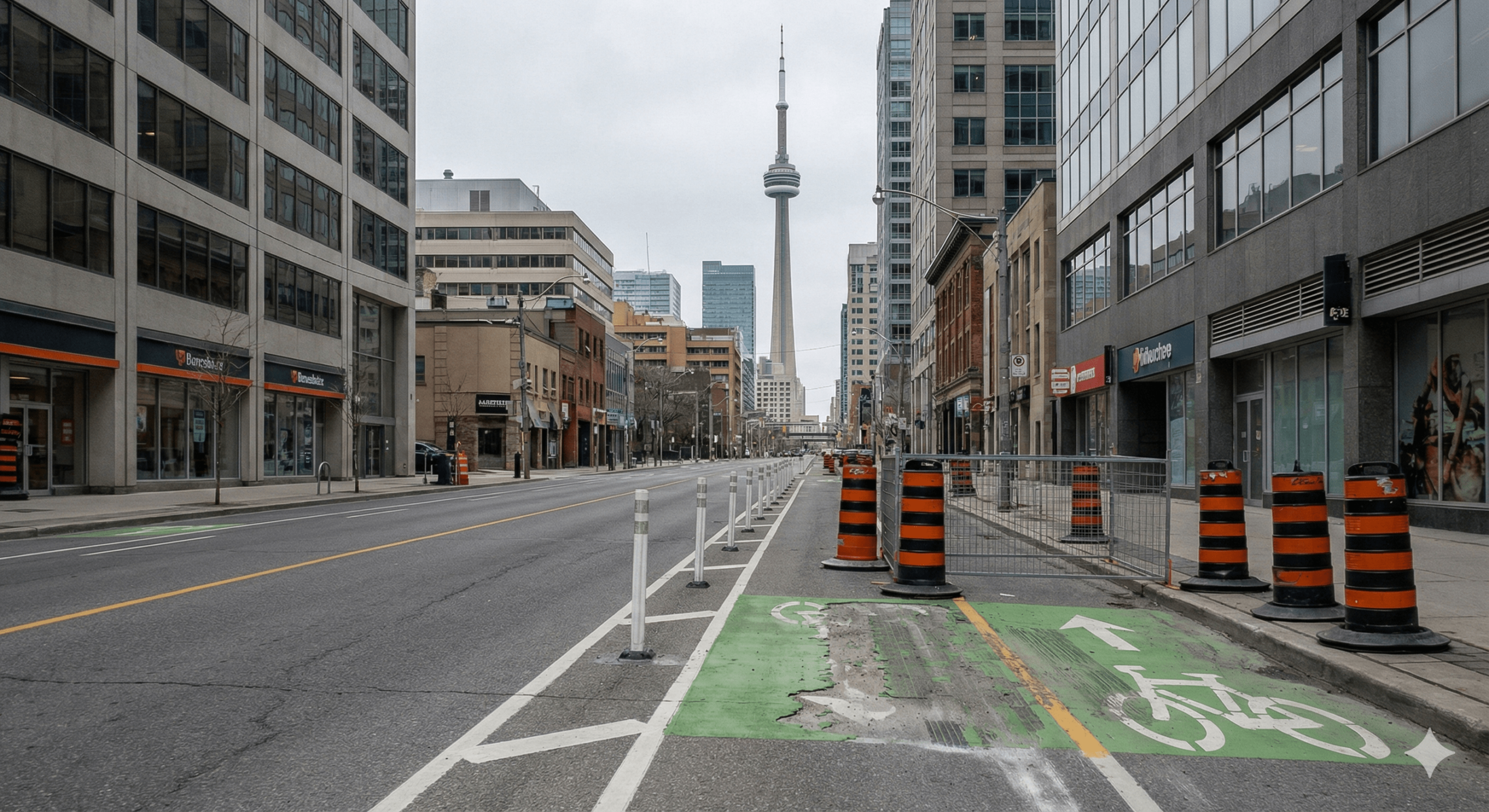
The Ontario Court of Appeal has moved a high profile legal battle over Toronto bicycle lanes into its next phase by allowing several advocacy groups to participate in an upcoming appeal1. In a decision released from the province’s highest court on December 31, 2025, Justice Benjamin Zarnett granted five different organizations the right to intervene as friends of the court. This means these groups will be allowed to provide written arguments and, in some cases, speak briefly during the hearing scheduled for late January 2026. The case centers on whether the provincial government has the legal authority to force the removal of existing bike lanes, or if doing so violates the constitutional rights of citizens who rely on them for safety.
The legal dispute began after the Ontario government introduced changes to the Highway Traffic Act in late 2024. These changes specifically required the removal of bicycle lanes on certain major streets in Toronto and mandated that those sections of the road be restored for motor vehicle use. While the government argued this was necessary to manage traffic congestion, critics and cycling advocates saw it as a move that would directly put lives at risk. A group consisting of Cycle Toronto and two individuals, Eva Stanger-Ross and Narada Kiondo, challenged the law in court. They argued that by removing separated bike lanes, the government was making the roads significantly more dangerous for cyclists.
In July 2025, Justice Schabas of the Superior Court of Justice ruled in favor of the cyclists. The judge issued two important declarations. First, he found that the specific provision requiring the removal of the lanes violated Section 7 of the Canadian Charter of Rights and Freedoms. This section of the Charter guarantees that everyone has the right to life, liberty, and security of the person. The judge decided that the government could not justify this violation under the Charter. Second, because the government had already repealed and replaced the original law with new wording, the judge declared that any future steps to remove physical barriers between cars and bikes on those streets would also violate the Charter.
The Attorney General of Ontario and the Minister of Transportation quickly appealed this ruling. They argued that the lower court judge made several significant legal mistakes. One of the primary arguments from the province is that Section 7 of the Charter does not create what they call a positive right to safety. In other words, the government believes the Charter prevents the state from directly hurting someone through things like imprisonment or physical force, but it does not force the government to provide specific safety measures like bike lanes. The province argues that the court’s decision creates a new and dangerous precedent that would require the state to maintain any safety measure it has ever built, even if policy priorities change.
As the case moved toward the Court of Appeal, five organizations asked for permission to join the proceedings. These groups include the Canadian Constitution Foundation, the David Asper Centre for Constitutional Rights, Greenpeace Canada, the Canadian Public Health Association, and For Our Kids Toronto. These groups are not parties to the original lawsuit, but they want to provide the court with specialized expertise or different perspectives on how the law should be interpreted. Under the rules for intervention, a judge must decide if these groups will actually help the court resolve the appeal without causing unfair delays or problems for the main parties involved.
The Canadian Constitution Foundation was granted permission to intervene because it plans to focus on the technical distinction between positive and negative rights. This is a central issue in the appeal. The foundation wants to suggest a specific way for the court to decide when the government is actively causing a deprivation of rights versus when it is simply failing to provide a benefit. Because this group often takes a different philosophical approach to the Charter than the other advocates, the court found their perspective would be useful. Neither the government nor the cyclists opposed their participation in the case.
The David Asper Centre for Constitutional Rights was also granted leave to intervene. This group intends to argue that the distinction between positive and negative rights is actually unhelpful and that the court should look at the situation differently. They also want to discuss a recent court decision called Drover versus Canada. In that case, the court held that Section 7 rights are not just limited to situations involving the justice system or criminal law. The government argues that Drover should be interpreted narrowly, while the Asper Centre believes it applies broadly to cases like the bike lane dispute where state action affects physical safety.
Greenpeace Canada will also be participating in the appeal. Their arguments will focus on the fact that the government has exclusive control over public roads. Because the state is the only entity allowed to regulate and design these roads, Greenpeace argues that any decision to remove safety features creates a direct link between the government’s actions and the harm suffered by citizens. They believe this makes it a case of the government actively causing a risk rather than just failing to provide a service. The court agreed that their focus on the government’s exclusive control over infrastructure provided a distinct viewpoint.
The Canadian Public Health Association and For Our Kids Toronto were granted more limited roles in the appeal. Both groups had already participated in the original hearing before the Superior Court. The Public Health Association wants to argue that equality principles should be used to interpret Section 7. They believe the court should consider how removing bike lanes disproportionately affects marginalized people who might not have cars or other ways to travel. The court allowed them to address this specific point but told them they cannot simply repeat the broad arguments they made in the lower court.
For Our Kids Toronto will focus its arguments on how the interests of children should be factored into the constitutional analysis. They point to international treaties like the United Nations Convention on the Rights of the Child to argue that the government must prioritize the safety of young people when making decisions about road infrastructure. While the court allowed them to speak on this legal issue, it denied their request to argue about the specific facts of the case. The judge noted that determining what the evidence showed is the job of the main parties, not the interveners.
In his decision, Justice Zarnett laid out strict rules for how these groups must behave during the appeal. Each group is limited to a written document of no more than ten pages. Furthermore, the time they are allowed to speak during the actual hearing is very short. Some groups were given ten minutes, while others were given only five. This is a common practice in the Court of Appeal to ensure that the hearing stays focused on the main arguments between the government and the cyclists while still benefiting from the specialized knowledge of the advocacy groups.
The outcome of this appeal will likely have major implications for how provincial and municipal governments manage public infrastructure in Ontario. If the original ruling stands, it could mean that once a government installs a safety feature that protects people’s lives or physical security, it becomes much harder to remove that feature without a very strong justification. On the other hand, if the government wins the appeal, it will reaffirm the province’s power to make broad policy decisions about road use without having to meet a high constitutional standard in court.
The hearing is set to take place on January 28, 2026. By then, all parties and the five intervening groups will have submitted their final written arguments. The court will then have to decide if the lower court judge was correct in using the Charter to stop the removal of bike lanes. This case is being watched closely by urban planners, legal scholars, and advocacy groups across the country, as it touches on the fundamental question of how much responsibility the government has for the day to day safety of people using public spaces.
Read more Ontario legal news here.