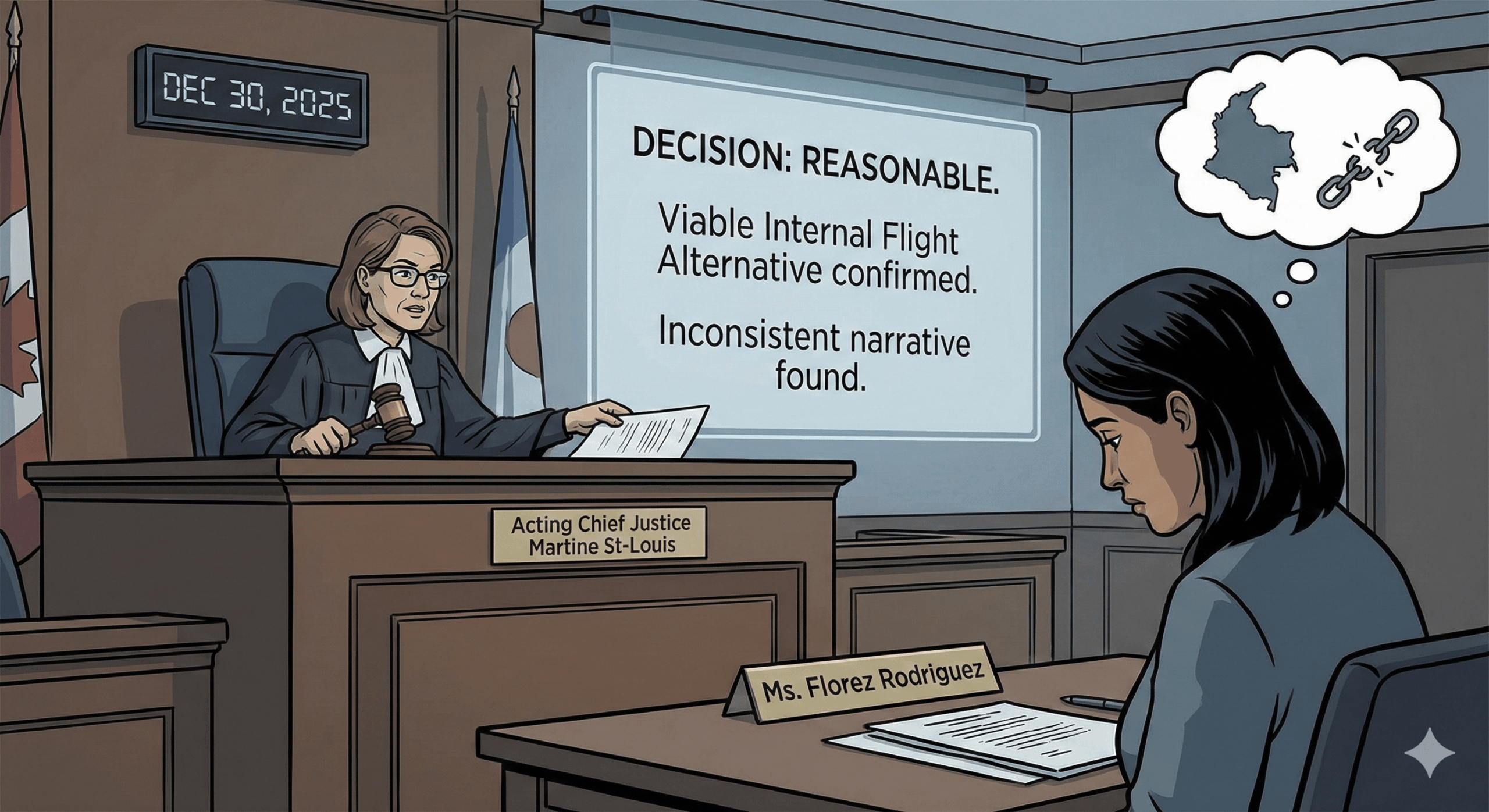
The Federal Court of Canada has dismissed an application for judicial review filed by Ahmad El Hajj, a citizen of Lebanon whose application for a work permit under the Temporary Foreign Worker Program was rejected by Immigration, Refugees and Citizenship Canada1. The decision, rendered by Madam Justice Ferron on December 30, 2025, concludes a multiyear legal process that centered on whether an immigration officer acted reasonably when questioning the applicant’s professional qualifications and his ability to communicate effectively in a Canadian kitchen environment. The ruling serves as a detailed examination of the standards applied to foreign workers seeking to fill specialized roles in the Canadian hospitality sector and the degree of scrutiny immigration officials may apply to supporting documentation.
Mr. El Hajj first applied for a work permit in October 2022, intending to work as a cook at a Lebanese restaurant located in Gatineau, Quebec. His initial application was rejected in February 2023, leading to a legal challenge that was eventually discontinued after both parties agreed the matter should be returned to a different officer for redetermination. This second assessment began in July 2023 and involved a rigorous review of the applicant’s background, education, and professional experience. The Labour Market Impact Assessment applicable to the position required the candidate to have a secondary school education and the ability to speak and write in either English or French. While the National Occupational Classification for cooks generally suggests a three year apprenticeship or several years of commercial experience, the specific assessment for this role focused primarily on education and language proficiency.
The process took a critical turn when an immigration officer conducted a verification phone call with Mr. El Hajj to assess his cooking knowledge and recruitment history. During this call, the officer noted significant concerns regarding the applicant’s ability to use professional terminology related to restaurant operations. According to the Global Case Management System notes, which form the official record of the decision, the applicant demonstrated a fundamental inability to describe the types of food he was capable of preparing. The officer expressed specific worries about health and safety, noting that a cook who cannot accurately name ingredients or communicate in English or French poses a high risk regarding food allergens and cross contamination. The officer observed that while Mr. El Hajj had some limited English abilities, they were not sufficient for the safe operation of a commercial kitchen.
In May 2024, the officer issued a procedural fairness letter to Mr. El Hajj, which is a formal mechanism used by immigration authorities to allow applicants to respond to specific concerns before a final decision is made. This letter explicitly invited the applicant to provide updated evidence of his culinary qualifications and language skills. The officer highlighted that under the Immigration and Refugee Protection Act, applicants have an obligation to answer questions truthfully and produce all relevant evidence required for their examination. At this stage, the officer had also begun verifying the applicant’s claimed work history. A phone call to a previous employer listed in Lebanon resulted in the business owner stating that they did not know Mr. El Hajj and had no record of his employment. This discrepancy created a significant hurdle for the applicant’s credibility regarding his professional background.
Mr. El Hajj responded to the fairness letter in June 2024 by submitting several documents, including a technical baccalaureate in hospitality, an updated curriculum vitae, and the results of an expired English language test. He also provided a link to an Instagram account containing approximately 250 photos and videos intended to showcase his culinary skills. However, the officer found these submissions to be insufficient. The officer noted that the technical baccalaureate documents were from an exam administered in Arabic and did not clearly indicate where the applicant had studied or the specific nature of his training. Furthermore, the exam results showed that Mr. El Hajj had failed the foreign language components of his studies. The officer also found that the Instagram account, while displaying food, featured no images of the applicant himself, making it impossible to verify that he was the person who had prepared the dishes.
The officer made several attempts to contact Mr. El Hajj for a second interview in October 2024 to further assess his language proficiency and allow him to address the concerns regarding his work history. The record indicates three attempts were made by telephone on a single day, but the officer was unable to reach the applicant. Shortly thereafter, the application was formally refused. The officer concluded that the applicant had failed to demonstrate an ability to perform the duties of a cook and had not provided enough evidence of his language abilities. Mr. El Hajj subsequently challenged this refusal in the Federal Court, arguing that the officer had ignored his evidence, shifted the requirements for his language skills, and reached an unreasonable conclusion given his fourteen years of claimed experience.
In the judicial review proceedings, counsel for Mr. El Hajj argued that the officer’s focus on the expired language test results was unfair, especially since the applicant only had fifteen days to respond to the fairness letter and could not retake the exam in that timeframe. The applicant further contended that the officer engaged in speculation regarding his knowledge of allergens and safety guidelines. He asserted that the officer’s investigation into his past employment was one sided and failed to account for the possibility that a business might have multiple locations or different signatories. Mr. El Hajj also pointed out that the officer’s attempts to call him for a final interview were conducted within a very narrow window of three hours on a single day, which he argued was an insufficient effort to provide him with a fair hearing.
Justice Ferron, in her analysis, applied the standard of reasonableness established by the Supreme Court of Canada. This standard requires the court to determine if the administrative decision is based on an internally coherent and rational chain of analysis and is justified in relation to the facts and the law. The court noted that while the duty to provide reasons in work permit cases is minimal, officers must still justify their decisions and meaningfully engage with the evidence. Justice Ferron found that the officer in this case had done exactly that. The court observed that the officer’s notes were written in a matter of fact tone and provided a clear explanation for why each piece of evidence was deemed insufficient.
Regarding the applicant’s language skills, the court found it was entirely reasonable for the officer to conclude that the applicant lacked the necessary proficiency. The judge noted that the task of a cook requires a certain level of communication to ensure customer safety and to follow workplace guidelines. The applicant’s poor performance during the initial interview, combined with his low scores in language subjects during his schooling, provided a rational basis for the officer’s doubts. The court also addressed the issue of the Instagram account, agreeing with the officer that without visual confirmation of the applicant preparing the food, the social media profile held little evidentiary value.
Justice Ferron also addressed the verification of the applicant’s past employment. The court found that the officer had followed a proper process by contacting the owner of the restaurant where Mr. El Hajj claimed to have worked. The owner’s denial of the applicant’s employment was a significant factor that the officer was entitled to rely upon. Although the applicant claimed to have ten years of experience at a different catering company, the court noted that the officer had reasonably questioned this experience because the applicant could not describe the food he allegedly cooked there during his interview. The judge emphasized that immigration officers are presumed to have considered all the evidence before them, and the thoroughness of the notes in this case supported the conclusion that the officer had performed a comprehensive review.
Finally, the court dealt with the officer’s unsuccessful attempts to schedule a final interview. While Justice Ferron agreed with the applicant that calling three times within a three hour window was not ideal and that an email might have been a more appropriate follow up, she determined that this did not constitute a fatal flaw in the decision making process. The court found that the applicant had already been given a fair opportunity to state his case through the initial interview and the procedural fairness letter. Because the existing record already provided a reasonable basis for the refusal, the failed attempts at a final phone call did not render the entire process unfair.
The application for judicial review was dismissed, and the court did not certify any questions of general importance. The ruling confirms that the burden remains on the applicant to provide clear and verifiable evidence of both their professional competency and their ability to meet the language requirements of a specific job in Canada. The decision reinforces the authority of immigration officers to look beyond an approved Labour Market Impact Assessment to ensure that an individual applicant is truly capable of performing the role they seek to fill.
Read about more immigration cases here.