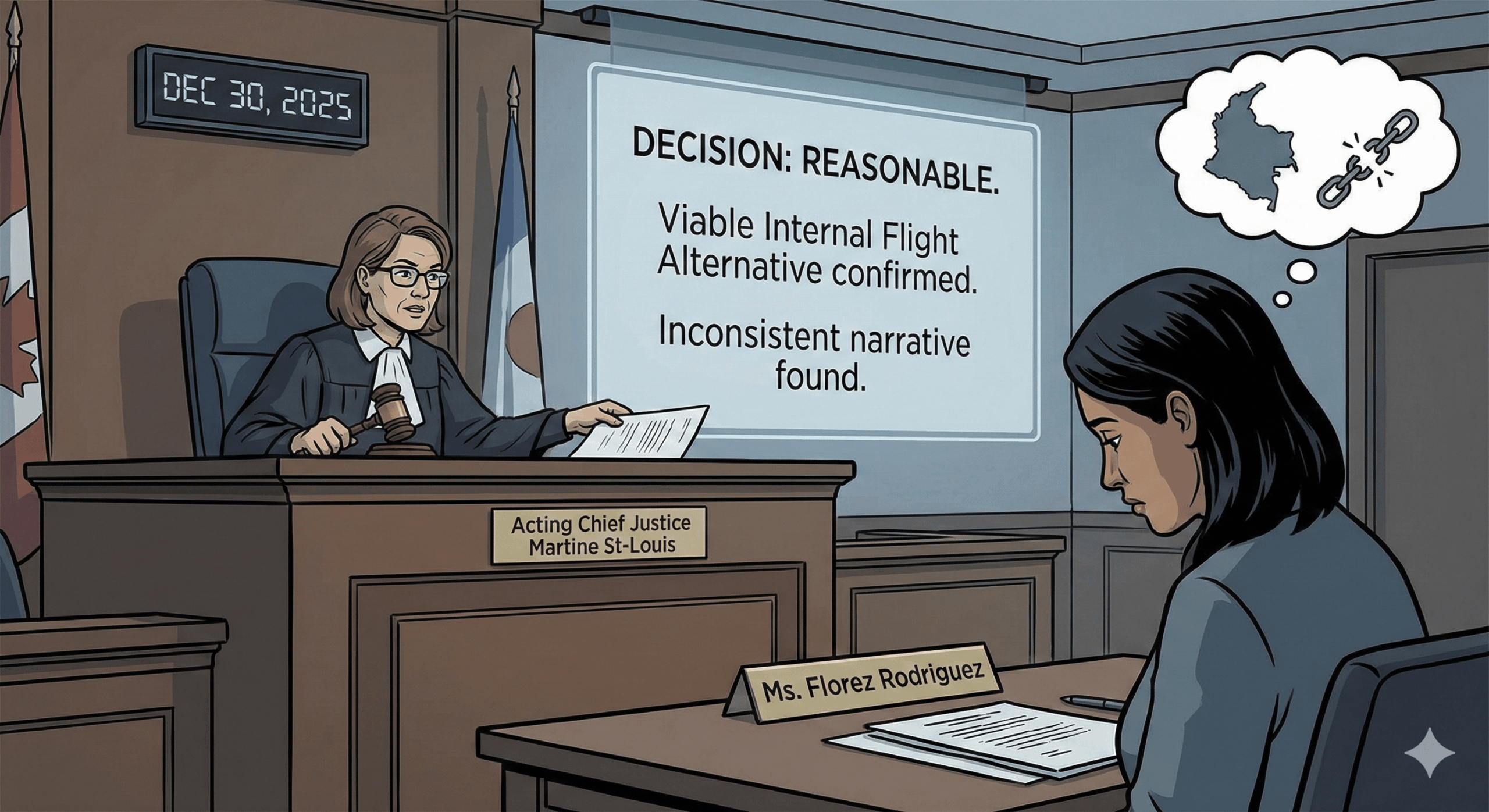
The Federal Court of Canada has dismissed an application for judicial review filed by Yuranny Florez Rodriguez, a Colombian citizen who sought refugee protection in Canada after alleging she was targeted by the Revolutionary Armed Forces of Colombia, known as the FARC1. In a decision rendered on December 30, 2025, Acting Chief Justice Martine St-Louis found that the Refugee Appeal Division acted reasonably when it concluded that Ms. Florez Rodriguez had a viable internal flight alternative within her home country and had failed to establish a consistent narrative regarding the threats she faced.
The legal journey for Ms. Florez Rodriguez began on April 24, 2022, when she arrived in Canada and promptly filed for asylum. In her initial Basis of Claim form, signed in June 2022, she provided a 17 page narrative detailing a harrowing experience in a mountainous region of Colombia. She alleged that while traveling and filming the area with a colleague, she was abducted and held captive by members of the FARC. According to her initial testimony, she feared that if she returned to Colombia, the militant group would kill her under the suspicion that she intended to become politically active in supporting peasant land restitution in regions under their control.
However, the nature of her claim shifted significantly nearly two years later. On January 6, 2024, Ms. Florez Rodriguez amended her application to include a new, critical piece of evidence: a threatening pamphlet she claimed to have found on the floor of her home in Colombia. This pamphlet allegedly contained an explicit death threat and accused her of being a community leader. When the Refugee Protection Division heard her case in May 2024, this late addition became a focal point of the tribunal’s scrutiny.
The Refugee Protection Division issued a split credibility finding. While the tribunal accepted that Ms. Florez Rodriguez was likely abducted by the FARC as she described, it did not believe her story regarding the threatening pamphlet. The tribunal noted several inconsistencies, primarily that such a significant event was entirely absent from her original 17 page narrative. Ms. Florez Rodriguez explained that she had destroyed the pamphlet to move past the trauma and had simply forgotten the incident when she first wrote her story. The tribunal rejected this explanation, finding it improbable that a person would forget a central death threat while simultaneously providing such a lengthy and detailed account of other events.
Furthermore, the Refugee Protection Division found that Ms. Florez Rodriguez did not fit the profile of a political activist or community leader likely to be hunted by the FARC. Her evidence showed that her only political involvement was a brief stint as an assistant to a candidate during a past campaign. During her own testimony, she admitted she was no longer involved in politics and had no desire to be in the future. Consequently, the tribunal concluded she was not targeted for her political opinions, but rather was detained because she was filming in a sensitive area.
A key factor in the denial of her claim was the concept of an Internal Flight Alternative. Canadian immigration law requires that a refugee claimant prove they are at risk of persecution throughout the entirety of their home country. If there is a safe location within their own nation where they can reasonably be expected to live, they do not qualify for refugee status in Canada. In this case, the tribunal identified the city of Barranquilla as a safe haven for Ms. Florez Rodriguez.
The Refugee Appeal Division subsequently upheld these findings, agreeing that Ms. Florez Rodriguez had not demonstrated that the FARC had the motive to track her down in a city as large and distant as Barranquilla. The appeal body noted that because the pamphlet was not found to be credible, and because the FARC had not contacted her or her family in the years following her abduction, there was no evidence of an ongoing pursuit. The division also found that relocating to Barranquilla would not be unreasonable, as there was no evidence she would face undue hardship in finding work or housing there.
Ms. Florez Rodriguez then turned to the Federal Court, seeking to overturn the appeal decision. Her legal counsel argued that the tribunal had erred by remaining silent on whether her claim fell under Section 96 or Section 97 of the Immigration and Refugee Protection Act. Section 96 deals with refugees who fear persecution based on race, religion, nationality, or political opinion, while Section 97 deals with individuals who face a personalized risk of torture or cruel and unusual treatment. Her lawyers contended that by failing to distinguish between these sections, the tribunal applied the wrong legal standard to her fear of persecution.
The Minister of Citizenship and Immigration defended the tribunal’s decision, arguing that the specific classification of the risk was secondary to the finding of an Internal Flight Alternative. The Minister’s position was that if a person is safe in one part of their country, it does not matter whether their underlying fear is based on political opinion or a general risk of harm; the result is the same: they do not require international protection.
In her analysis, Acting Chief Justice St-Louis agreed with the Minister. She emphasized that the concept of a viable internal flight alternative is a fundamental pillar of refugee law. To be a refugee, one must be a refugee from their country as a whole, not just a specific neighborhood or province. The Chief Justice cited existing case law which establishes that if a viable flight alternative exists, an asylum claim must be rejected regardless of the merits of other parts of the story. She found that the Refugee Appeal Division was not required to perform an exhaustive analysis of Section 96 or 97 once it determined that Barranquilla provided a safe and reasonable refuge.
The Court also addressed the credibility of the threatening pamphlet once again. Ms. Florez Rodriguez argued that the tribunal should have been more sensitive to cultural distinctions and given her the benefit of the doubt. She also pointed to documentation regarding corruption and criminal infiltration in Colombia to argue that the state could not protect her even in Barranquilla. However, the Chief Justice noted that the role of the Federal Court is not to re-evaluate evidence or second-guess the factual findings of the specialized tribunals, but rather to ensure the decision-making process was rational and logical.
Acting Chief Justice St-Louis concluded that the Refugee Appeal Division’s decision was coherent and based on the evidence provided. The Court highlighted that Ms. Florez Rodriguez herself testified that she was abducted because of her filming activities, not her politics, and that she intended to remain politically neutral. Given that no contact had been made by the FARC since the incident, the Court found it reasonable for the tribunal to conclude that the militant group lacked the motivation to find her in a different part of the country.
With the application for judicial review dismissed, the original decision to deny asylum stands. The Court did not certify any questions of general importance, which effectively brings the judicial review process to a close for this file. Ms. Florez Rodriguez was represented by Nancy Cristina Muñoz Ramirez of ROA Legal Services, while the Minister was represented by Nadine Saadé. No costs were awarded in the matter.
Read about more immigration cases here.