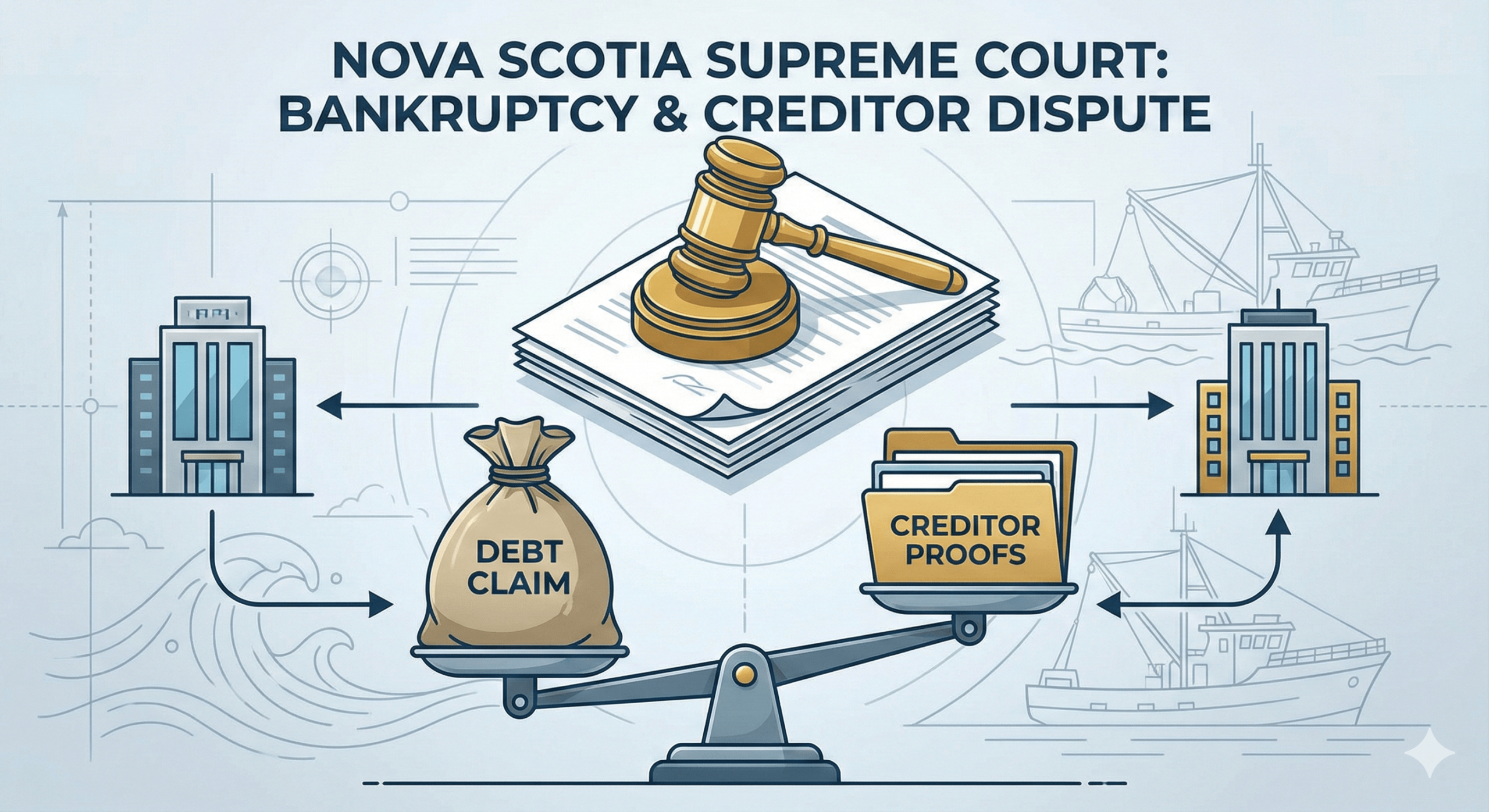
The biological defense mechanism of a sea cucumber involves the animal expelling its own internal organs to distract predators, a process of self-evisceration that is usually followed by a slow period of regeneration. In a decision from the Supreme Court of Nova Scotia, Registrar Raffi A. Balmanoukian observed that this visceral process serves as an apt metaphor for the ongoing legal battles surrounding Atlantic Sea Cucumber Limited1. The company is currently navigating the final, messy stages of bankruptcy, and the court was tasked with determining exactly how much the company owes to its primary backers and when, precisely, the bankruptcy legally began. The answers to these questions carry significant weight because the company is on the verge of a sale and investment solicitation process, often referred to in the industry as a SISP. With a bid deadline set for late January 2026, the competing creditors are positioned not just as claimants, but potentially as rival bidders who intend to use the debt they are owed as currency to buy the business.
The dispute at the heart of the case involves two primary entities. On one side is Atlantic Golden Age Holdings Limited, a company related to the bankrupt business that has provided significant funding over the years. On the other side is Weihai Taiwei Haiyang Aquatic Food Co. Ltd., a judgment creditor that has been locked in a long-standing conflict with the sea cucumber processor. The tension between these two groups has already spanned several years and multiple court applications. Earlier in the proceedings, the court issued what became known as the Security Decision. In that previous ruling, the court determined that the money advanced by Atlantic Golden Age Holdings was indeed a debt rather than an equity investment, but it also ruled that the debt was unsecured. This meant that Atlantic Golden Age Holdings would not have first dibs on the company’s assets and would instead have to share whatever remains in the estate with other unsecured creditors like Weihai Taiwei.
Because both parties are now classified as unsecured creditors, the size of their respective claims dictates their influence in the upcoming sale. If Atlantic Golden Age Holdings is found to be owed a larger amount, it receives a larger share of the eventual proceeds or can submit a more powerful credit bid to take over the company. The judgment creditor, Weihai Taiwei, argued that the claim should be limited to approximately 1.5 million dollars. This figure was based on earlier statements made by the principal of Atlantic Golden Age Holdings, Songwen Gao. Weihai Taiwei argued that it was unfair for the company to suddenly double its claim to nearly 3 million dollars by introducing evidence of a second, Canadian dollar bank account that had not been the primary focus of earlier affidavits. They characterized this late-stage evidence as a collateral attack on the court’s previous decisions and suggested that the timing of these new disclosures prevented them from properly challenging the nature of those specific advances.
Registrar Balmanoukian ultimately disagreed with the attempt to exclude the new evidence regarding the second bank account. The court noted that in bankruptcy proceedings, the goal is to determine the actual, factual state of indebtedness. Under the Bankruptcy and Insolvency Act, proofs of claim can be amended as new information comes to light. The court found that although the specific quantum of the debt had been a secondary issue while the parties were fighting over whether the money was debt or equity, the information had been available. The court pointed out that the creditor had the statutory right to examine the proofs of claim of other creditors but had seemingly failed to do so earlier in the process. Since the factual existence of the advances from the Canadian dollar account was not seriously questioned by the opposing side’s counsel, the court accepted that those funds were legitimate loans and should be included in the total claim.
However, the more complex legal hurdle involved the effective date of the bankruptcy. This date is not merely a clerical detail; it serves as the cutoff point for which debts can be claimed as part of the bankruptcy estate. Any money advanced after the bankruptcy date is generally treated differently than money advanced before. In this case, there was a significant gap between two possible dates. Weihai Taiwei argued that the bankruptcy began in July 2023, when Atlantic Sea Cucumber Limited failed to meet a deadline to file a formal proposal to its creditors. Atlantic Golden Age Holdings and the Trustee, msi Spergel Inc., argued that the bankruptcy did not officially start until March 28, 2024. This later date corresponded with a certificate issued by the Office of the Superintendent of Bankruptcy following a series of unsuccessful appeals by the company.
The confusion regarding the date stemmed from a series of high-stakes legal maneuvers in the summer of 2023. At that time, Atlantic Sea Cucumber Limited was attempting to move its insolvency proceedings out of the Bankruptcy and Insolvency Act and into the Companies’ Creditors Arrangement Act, which is often seen as a more flexible framework for restructuring large businesses. When a judge declined to abridge the time limits necessary to make that switch, the company missed its deadline to file a proposal under the bankruptcy rules. Under Section 50.4(8) of the Bankruptcy and Insolvency Act, when a debtor misses this deadline, they are deemed to have made an assignment into bankruptcy by operation of law. Essentially, the statute automatically triggers the bankruptcy even if the company is still fighting in court.
The Trustee had relied on a legal opinion suggesting that because the company was appealing those various decisions, the bankruptcy was stayed or put on hold. This opinion was based on a section of the law that pauses proceedings during an appeal. However, the court found that this legal opinion was fundamentally incorrect. Registrar Balmanoukian explained that the appeal in question involved the Companies’ Creditors Arrangement Act, not the Bankruptcy and Insolvency Act, and therefore did not trigger an automatic stay of the bankruptcy process. The court emphasized that a deemed assignment under the law is powerful and immediate. It operates regardless of whether the debtor is willing or whether the formal paperwork has been filed by the government offices. To hold otherwise would allow struggling companies to avoid the consequences of their insolvency indefinitely by simply refusing to file the necessary documents.
Consequently, the court ruled that the bankruptcy officially occurred on July 17, 2023. This ruling had a direct impact on the amount of money Atlantic Golden Age Holdings could claim. While the court allowed them to include the previously overlooked Canadian dollar account, it only allowed the balance that existed on the July 2023 date. Any money the related company poured into the business between July 2023 and March 2024 was effectively excluded from their provable claim in this context. This resulted in a total allowed claim of approximately 2.16 million dollars, a middle ground between the 1.5 million dollars sought by the judgment creditor and the 3 million dollars sought by the company’s backers.
The final portion of the decision addressed the conduct of the Trustee and the issue of legal costs. Weihai Taiwei had requested that the Trustee be ordered to pay 2,000 dollars in costs, arguing that the Trustee had consistently sided with the bankrupt company and its related backers throughout the litigation. They argued the Trustee was imprudent for relying on a flawed legal opinion regarding the bankruptcy date. The court, however, chose not to penalize the Trustee. Registrar Balmanoukian noted that Trustees are officers of the court and are typically not lawyers themselves. While the legal opinion they received turned out to be wrong, the court found that the Trustee acted reasonably by seeking professional legal advice rather than making an arbitrary decision. Because all parties had experienced a mix of success and failure in their various legal arguments, the court ordered that everyone would be responsible for their own legal bills for this specific application.
The ruling provides a clear path forward for the upcoming sale of Atlantic Sea Cucumber Limited. By settling the exact amount of the competing claims and clarifying the timeline of the insolvency, the court has stabilized the environment for potential bidders. The decision serves as a reminder of the rigid nature of bankruptcy deadlines and the fact that corporate "regeneration" often requires a clear and final accounting of the past. As the January 30 bid deadline approaches, the creditors now know exactly how much weight their claims will carry in the fight to take control of the company's remaining assets.
Read more about business cases in Canada here.