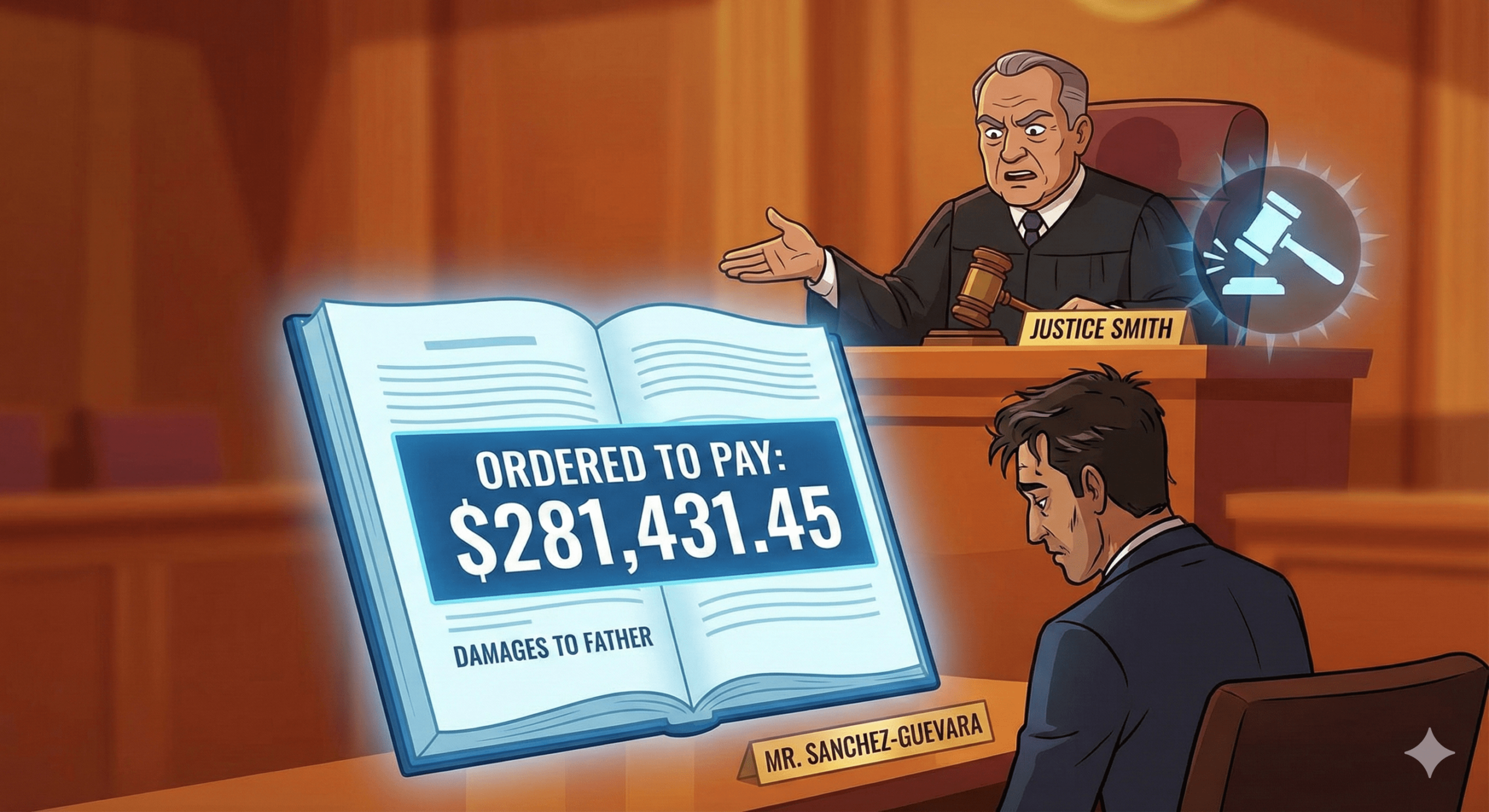
The Ontario Superior Court of Justice has issued a ruling in a case of elder financial abuse, ordering a son to repay more than $281,000 to his father1. The decision, released on December 17, 2025, follows a legal battle involving the Public Guardian and Trustee, acting on behalf of 81 year old Jose Mauricio Sanchez. The court found that the son, David Sanchez-Guevara, breached his fiduciary duties while acting as his father’s attorney for property, systematically depleting bank accounts that held the proceeds of a motor vehicle accident settlement.
The history of the case traces back to November 8, 2019, when the elder Mr. Sanchez was involved in a serious motor vehicle accident. The collision left him with significant cognitive and physical injuries, ultimately leading to a settlement with his insurer for statutory accident benefits. In March 2021, Mr. Sanchez received settlement proceeds totaling $309,534.40. Shortly thereafter, on April 1, 2021, Mr. Sanchez signed a Continuing Power of Attorney, appointing his son, David Sanchez-Guevara, to manage his financial affairs.
The court heard that by early July 2021, one of Mr. Sanchez’s primary bank accounts at Scotiabank held a balance of $271,432.29. However, within a span of less than four months, that balance was reduced to just 84 cents. Bank records examined during the proceedings revealed a consistent pattern of high volume transactions and personal spending that appeared unrelated to the needs of the elderly father. The evidence showed that funds were used for a variety of expenses, including food and dining, automotive fuel, home decor, retail shopping, gym memberships, and even expenditures at hotels and clubs.
In addition to the depletion of the main account, the court found that a separate account held by Mr. Sanchez was also targeted. On November 30, 2021, a $10,000 deposit was made into the second account, only to be withdrawn in its entirety on the same day. These financial movements occurred during the period when Mr. Sanchez-Guevara held full and unfettered access to his father’s accounts.
The elder Mr. Sanchez attempted to revoke the power of attorney in late November 2021, citing the removal of funds without his consent. By April 2022, the Public Guardian and Trustee stepped in to become the guardian of property for Mr. Sanchez, eventually initiating the legal application to recover the missing money.
Throughout the litigation, the procedural path faced several hurdles. When the matter first came before the court in September 2024, there were questions regarding whether the issues could be resolved through an application rather than a full trial. This led to adjournments and supplementary legal arguments. While Mr. Sanchez-Guevara attended some later hearings, including one where he requested more time to find a lawyer, he ultimately failed to file any formal evidence or a written response to the serious allegations made against him.
Justice Marc Smith, presiding over the matter, noted that Mr. Sanchez-Guevara’s failure to engage with the court process was significant. Because the son chose not to challenge the evidence or provide an explanation for the missing hundreds of thousands of dollars, the judge was permitted to draw an adverse inference. This legal principle allows a court to conclude that the silent party’s evidence would not have helped their case. Justice Smith found that the son had deliberately removed the funds for his own personal use, characterized the conduct as a clear breach of fiduciary duty and unjust enrichment.
The legal definition of a fiduciary duty in this context is strict. Under the Substitute Decisions Act, a guardian or attorney for property is required to act with honesty, integrity, and in good faith for the sole benefit of the person they represent. They are expected to manage the property with the same care a prudent person would use in managing their own affairs. Justice Smith determined that Mr. Sanchez-Guevara had placed his own interests above those of his father, failing to account for the transactions and leaving his father’s savings entirely depleted.
The court’s analysis focused on the documented loss. While the applicant had also alleged that Mr. Sanchez-Guevara had maxed out a $19,000 credit card, the judge found there was insufficient documentary evidence regarding the credit card statements to make a formal finding of misappropriation on that specific claim. However, the evidence regarding the two bank accounts was deemed conclusive.
In the final disposition, Justice Smith ordered Mr. Sanchez-Guevara to pay his father $281,431.45 in damages. To prevent further loss, the court also issued an injunction restraining the son from selling, transferring, or disposing of any property that originally belonged to his father or that could be traced back to the misappropriated funds. Furthermore, the son was ordered to “pass his accounts,” a formal legal process requiring him to provide a full, documented report of all financial dealings during the period he acted as attorney for property.
The financial consequences for Mr. Sanchez-Guevara extended beyond the repayment of the principal amount. Justice Smith expressed concern over the son’s conduct during the litigation, noting that his requests for adjournments only served to delay the resolution of the matter for his father. Consequently, the court awarded legal costs against the son on a “substantial indemnity” basis, which is a higher scale of costs often reserved for cases where a party’s conduct warrants the court’s disapproval. Mr. Sanchez-Guevara was ordered to personally pay an additional $18,370.17 to cover the legal fees and disbursements incurred by his father’s legal team.
The ruling serves as a stark reminder of the legal obligations placed upon those who hold power of attorney over the affairs of vulnerable family members. The court emphasized that the remedies for a breach of such duties are rooted in the principle of restitution, aiming to restore the victim to the position they would have been in had the misappropriation not occurred. For Jose Mauricio Sanchez, the order represents a formal legal recognition of the financial harm he suffered at the hands of a person entrusted with his care following a life altering accident.
The Public Guardian and Trustee will now be responsible for overseeing the enforcement of the judgment and the management of any recovered funds to ensure the ongoing care and support of the elderly Mr. Sanchez. The judgment was released and entered without the need for approval from Mr. Sanchez-Guevara, allowing the recovery process to begin immediately.
Read more Ontario legal news here.