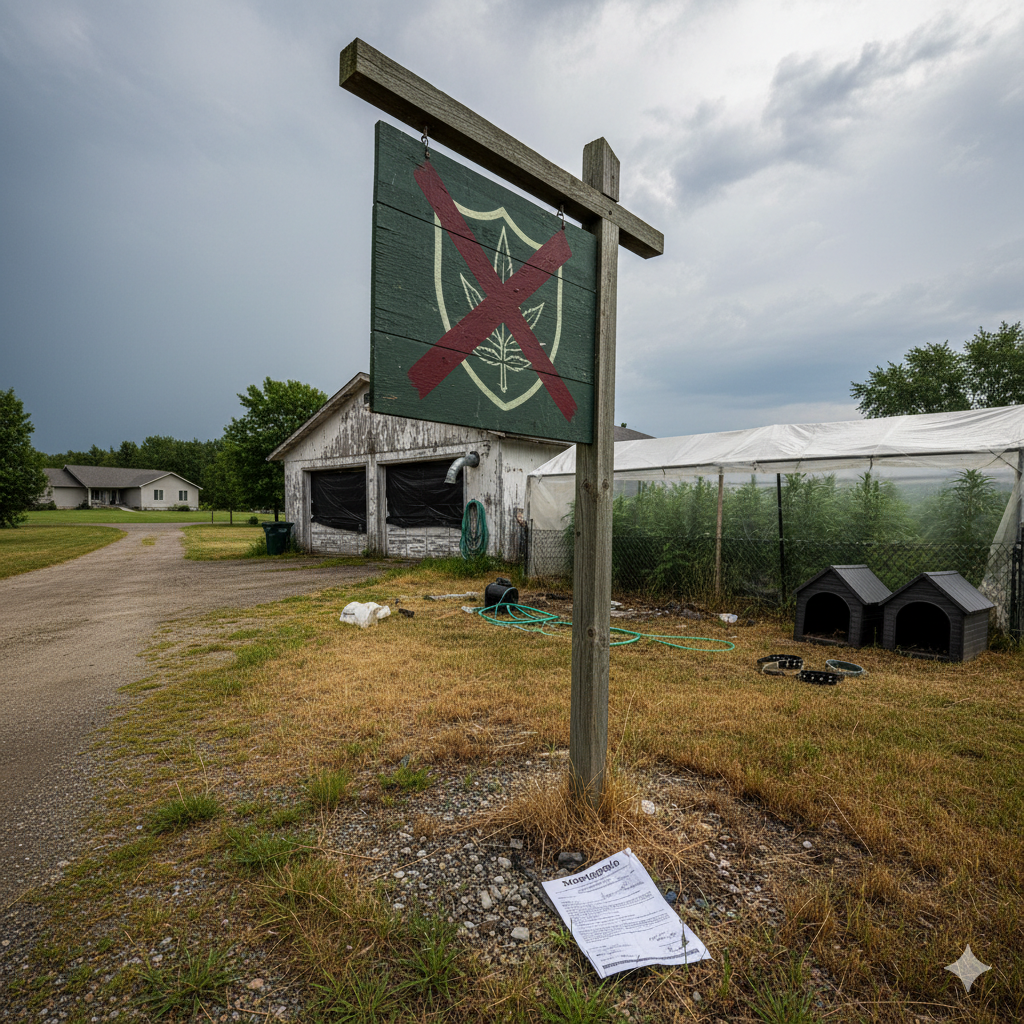
Image is a fictional dramatization that does not represent the actual property.
An Ontario Superior Court judge has granted an injunction to a Toronto police officer, ordering a man currently occupying a Kincardine, Ontario property to vacate within thirty days1. The decision, released on October 30, 2025, follows a heated dispute over the ownership of the property, which the occupant claimed was part of a partnership agreement to operate a legitimate marijuana grow operation. The plaintiff, Saad Keval, is the sole owner listed on the property’s title and sought the court order to remove the occupant, Hiep Nguyen, so the property could be sold.
Justice Lemay granted the injunction in favour of Keval, finding that the officer had presented a strong case for his ownership rights and would suffer irreparable harm if the order was not granted. The court found that the balance of convenience favoured removing Nguyen, particularly as any financial stake the occupant might have in the property would be protected by ordering the net proceeds from its future sale to be paid into court pending a full trial. The judge also found the original purpose of the alleged partnership was likely frustrated by criminal charges laid against Nguyen in 2024.
The background of the dispute, as outlined in court materials, dates back to November 2016, when the property at 1900 Bruce Road 15 was purchased for $205,000. At that time, the property was purchased by a third individual, David Ly, who was known to both Keval and Nguyen. The court heard evidence that four men contributed to the initial purchase: Keval, Nguyen, Ly, and a fourth man named Kirk Salvisburg. According to Keval’s affidavit, the arrangement was that Nguyen would be responsible for obtaining the necessary licenses to grow and sell marijuana for medical purposes and would then manage the operations at the property.
Despite this alleged plan, the only evidence of licenses presented to the court was for personal use, and none were for Nguyen. The court reviewed a license for David Ly, expiring in January 2018, which permitted 137 indoor plants. A second license for Ly, for personal use, allowed for 219 indoor plants and expired in April 2020. A third license, for Kirk Salvisburg, was also for personal use, permitting 329 indoor plants and expiring in September 2024. The court received no evidence that Nguyen himself had secured the commercial licenses central to the alleged agreement.
The ownership structure changed significantly in 2021. Keval paid $441,000 to David Ly to have the property’s title transferred exclusively into Keval’s name. Court records show that the majority of this funding, $434,720, came from a new mortgage Keval obtained from RBC. Keval provided documentation to the court proving that he has been the one making payments on this mortgage. Nguyen, who is self-represented, disputed the nature of this transaction. He provided evidence of a $40,000 transfer he made to Keval in November 2021, claiming it was to help Keval secure the financing and purchase the property. Keval, in reply, pointed to other money transfers between the parties, creating a complex financial picture that the judge ruled was a matter to be resolved at trial.
Further complicating the ownership claims was an affidavit from David Ly. Ly stated that he had requested a $30,000 buyout. His affidavit also claimed there was an agreement that upon the property’s eventual sale, he would receive $30,000, Keval would receive $130,000, and Nguyen would be entitled to $151,643.58. Justice Lemay noted that the court had no evidence that these payments were ever made or what the rationale for this specific split was.
The situation deteriorated in 2024. Keval deposed that between 2021 and 2024, he had received money from Salvisburg to help cover the mortgage costs. However, these payments stopped in January 2024. Keval stated he was unable to continue carrying the mortgage on his own, which prompted his legal action to sell the property. In May 2024, the situation became more complex when both Nguyen and Salvisburg were charged with several serious crimes, including possession of cocaine for the purposes of trafficking and illicit possession of cannabis for the purpose of selling it. Justice Lemay observed that while these charges do not prove guilt, they make it “more difficult” for Nguyen to obtain a marijuana cultivation license.
Nguyen’s subsequent bail conditions initially forbade him from living at the Kincardine property, although this condition was varied in January 2025 to permit him to live there. Critically, his bail conditions also prohibit him from possessing any drug paraphernalia. The judge noted this condition would make it “very difficult” for Nguyen to legally grow or possess marijuana, especially as one of his criminal charges was for illegal growing. Keval stated he had initially delayed taking civil action, hoping the criminal charges would be resolved, but proceeded when the criminal case did not move forward quickly.
Tensions escalated in June 2025 when Keval visited the property with a friend, Camaur Blake. Keval alleged that Nguyen intimidated him during the visit, made threats, and mentioned he had two pit bulls on the property. Keval claimed Nguyen stated he had lost a previous house to his ex-wife and “would not lose this house.” This encounter led Keval to fear for his family’s safety. Blake returned to the property alone in early July 2025 and provided a separate affidavit detailing his observations. Blake stated the front door was damaged, the house “reeked” of urine, and there were holes in the walls and damage to a bathroom door caused by the dogs.
Most importantly, Blake’s affidavit stated he observed marijuana plants at the back of the house and marijuana buds in the three-car garage, which he claimed had been “converted into a facility for growing marijuana.” This evidence of an active, illicit grow-op was a key factor in the judge’s decision.
Keval filed his statement of claim on July 16, 2025. After an initial adjournment on September 12 to allow the self-represented Nguyen to find a lawyer, the case proceeded. Nguyen missed the court-ordered deadline to file his materials, as did Keval with his reply, but Justice Lemay ultimately accepted the late filings. After a hearing on October 3, the judge scheduled a second hearing for October 29 to clarify the correct legal test for the injunction and to allow Nguyen to file additional documents he claimed to have. At this second hearing, Keval’s lawyer confirmed they were arguing for the high standard of a “strong prima facie case.”
In the legal analysis, Justice Lemay confirmed that the standard for an injunction is the three-part test from RJR Macdonald. However, the judge noted that because this injunction would permit the sale of the property, it would effectively amount to a final determination of the action. Therefore, Keval had to meet a higher threshold than just a “serious issue to be tried”; he had to demonstrate a “strong prima facie case.”
The court found Keval met this high standard. His claim was based on the tort of ejectment, and as the sole person on title, he has a strong legal argument for possession. The judge noted that even if Nguyen did prove an agreement at trial, Keval, as a co-owner, would still likely be entitled to force a sale under Ontario’s Partition Act. Furthermore, the judge found the alleged grow-op agreement “does not seem to be capable of being implemented” due to Nguyen’s criminal charges, weakening his defense.
On the second branch of the test, irreparable harm, the court found Keval met the standard in three ways. First, the simple loss of control over his own property constituted harm. Second, the “significant financial burden” of paying the mortgage alone without benefit from the property was also irreparable harm. Third, and most significantly, the evidence from Blake’s affidavit suggested illegal activity was taking place. The judge noted that under the federal Cannabis Act, possession of more than three plants without a permit is illegal, and Blake’s evidence suggested “numerous plants” were present. This illegal activity put the property at risk of forfeiture and seizure by the government, which the judge deemed “in and of itself, irreparable harm.”
Finally, the court assessed the balance of convenience. Justice Lemay weighed the harms to Keval (financial distress, risk of property seizure) against the harms to Nguyen (being removed from his home and losing his alleged agreement). The judge found that the harms to Nguyen could be managed. To address his displacement, the injunction forcing him to leave was delayed for thirty days to allow him time to find new accommodation. To protect his alleged 51% financial stake, the court ordered that all net proceeds from the sale, after the mortgage and closing costs are paid, must be paid into court. This money will be frozen until a trial judge determines the merits of the ownership dispute.
With these conditions in place, Justice Lemay found the balance of convenience “significantly” favored granting the injunction to Keval. The order was issued, with no-contact provisions taking effect immediately. On the matter of legal costs, the judge ruled that costs would be reserved for the trial judge, as “much is still unknown about this case,” and it is possible a trial judge could find in Nguyen’s favour regarding the existence of an agreement.
Read about other real estate related legal cases here.