In the case of R v Obey, 2025 SKKB 106 (CanLII), a Saskatchewan judge has designated 35-year-old Michael Riley Obey a dangerous offender and sentenced him to an indeterminate term in a federal penitentiary following a string of violent offences spanning several years, both in the community and while incarcerated.
In Canada, a dangerous offender designation is reserved for a small group of people convicted of very serious offences who are found to pose an ongoing threat to public safety. It allows the court to impose an indeterminate prison sentence, meaning there is no fixed release date.
Part XXIV of Canada’s Criminal Code contains the laws that govern dangerous and long-term offender proceedings, setting out the criteria, procedures, and sentencing options. The Crown’s application under this Part of the Criminal Code was based on seven predicate offences arising from three separate incidents. Predicate offences are the specific convictions the Crown relies on as the legal basis for applying to have someone declared a dangerous or long-term offender.
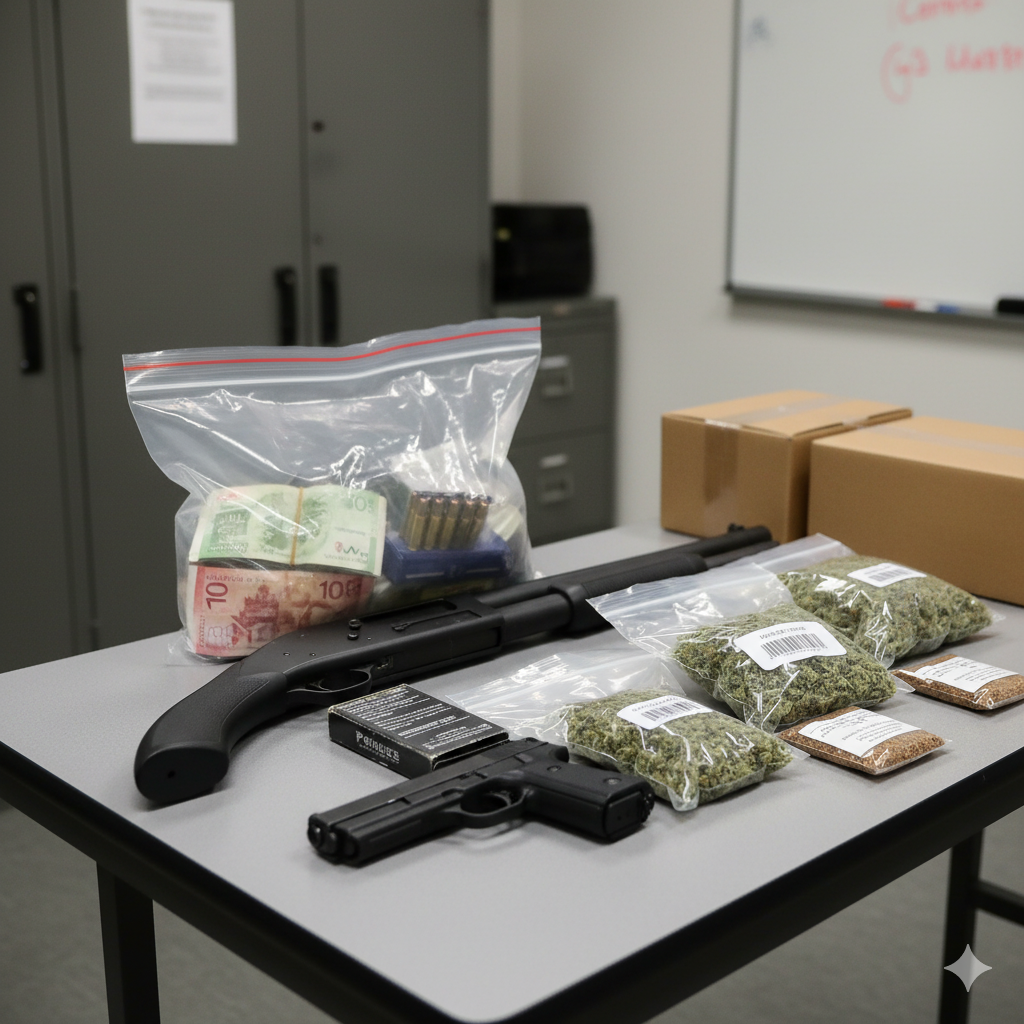
The first occurred on December 5–6, 2018, when police in Regina attempted to stop a stolen vehicle driven by Obey. During the encounter, he pointed a shotgun at a police officer, led police on a high-speed pursuit reaching 130 km/h, and at one point drove directly toward a police cruiser, forcing officers to leap from their vehicle to avoid being struck. Later that evening, he broke into a home on Pasqua First Nation, striking the occupant in the head with the shotgun, stealing his truck, and fleeing again. That vehicle eventually ran out of fuel, prompting Obey to try to enter a semi-truck before fleeing on foot. He was later cornered on a farmyard, where he used a running skid steer to menace approaching officers and swung a screwdriver at one before being subdued with pepper spray, a taser, and a police dog.
The second incident took place on March 10, 2021, while Obey was in custody at the Regina Provincial Correctional Centre. Transported to a medical clinic for treatment, he assaulted two correctional officers after his restraints were removed for an MRI, breaking one officer’s leg and knocking out part of another’s tooth. He escaped into the parking lot, entered a vehicle and ordered the driver to leave, but the driver fled on foot. Obey drove off, prompting police to attempt two spike belt deployments before ending the pursuit by ramming his vehicle into a ditch. The standoff lasted about an hour before he surrendered.
The third predicate offence occurred on June 30, 2021, at the Saskatoon Provincial Correctional Centre. Surveillance video captured Obey approaching another inmate without warning and stabbing him repeatedly with a metal shank, causing a collapsed lung and multiple stab wounds.
A Gladue report was prepared for sentencing. A Gladue report is a pre-sentencing or bail report that provides the court with information about an Indigenous offender’s background, including factors related to colonization and systemic discrimination, to help judges consider alternatives to imprisonment and assess moral culpability.
Obey’s Gladue report detailed an upbringing marked by intergenerational trauma, substance abuse from a young age, family instability, and diagnosed conditions including ADHD, fetal alcohol spectrum disorder, and PTSD. He had been involved in the criminal justice system since age 12, accumulating extensive youth and adult records dominated by violent offences, escapes, and breaches. His institutional history showed persistent infractions, fights, weapon-making, escape attempts, and what correctional staff described as an unrelenting risk to safety. Even after the Crown notified him in June 2022 that it was seeking a dangerous offender designation, his misconduct continued. Records show he was involved in a major disturbance later that year and in 19 separate incidents in 2023, including possessing weapons, brewing alcohol, and assaults.
Forensic psychiatrist Dr. Alberto Choy assessed Obey as having severe antisocial personality disorder and scoring in the 97th percentile for risk of violent reoffending, noting that only two percent of offenders score higher. Dr. Choy concluded there was little realistic prospect of sustained behavioural change, estimating that age-related reductions in risk would not be seen until Obey’s late 40s or 50s.
Chief Justice Tochor found all four statutory criteria for a dangerous offender designation proven beyond a reasonable doubt: the offences were serious personal injury offences; they formed part of a broader pattern of violence; there was a high likelihood of violent recidivism; and the conduct was intractable. The court acknowledged the Gladue factors, finding they reduced his moral culpability to an “intermediate extent” but concluded the severity, timing, and cumulative nature of the predicate offences outweighed that reduction. The judge stated there were no realistic treatment or supervision options that could adequately address his dynamic risk factors or protect the public.
The court considered but rejected a long-term offender designation or a determinate sentence, finding no lesser measure would adequately protect the public. Obey received an indeterminate sentence on each of the predicate offences, with lesser sentences for non-predicate offences to be served consecutively. He was also made subject to a lifetime firearms ban, DNA sampling, and other ancillary orders.
Read more crime stories here.