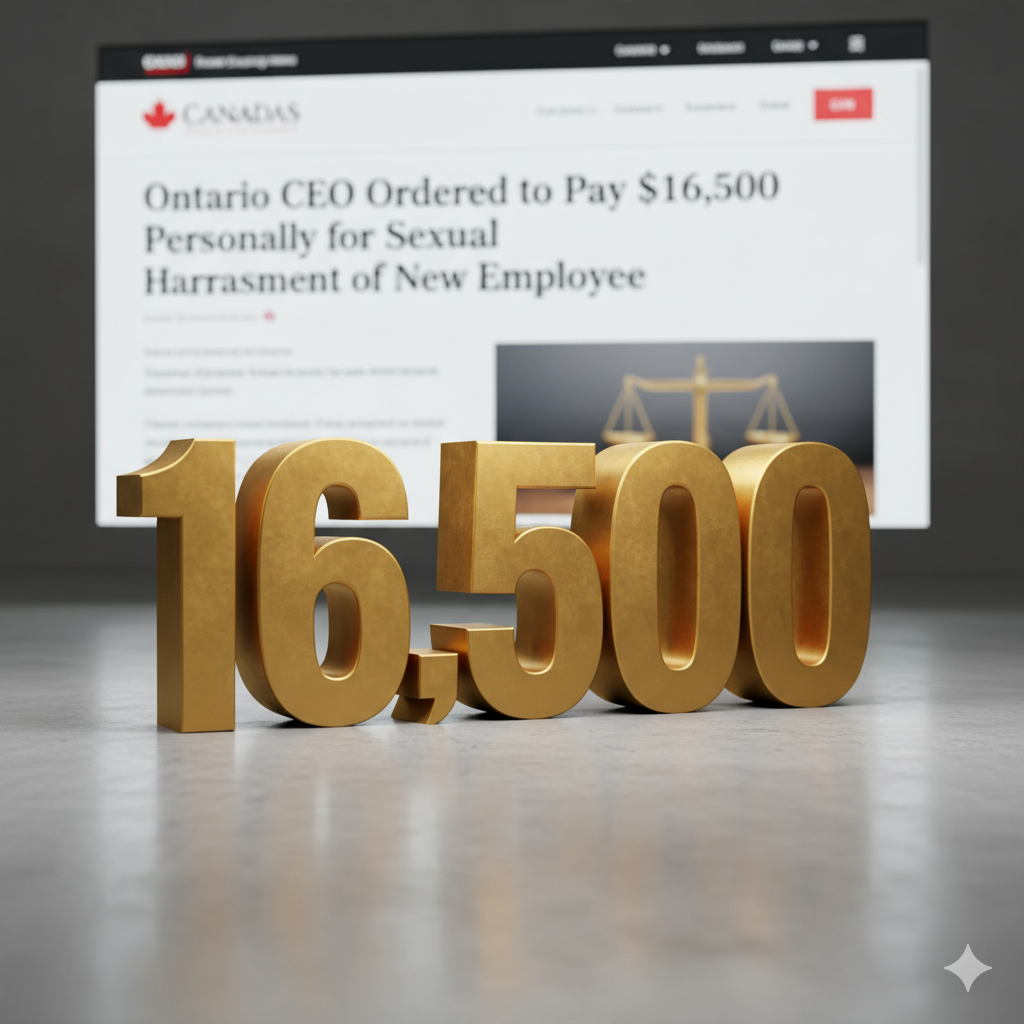
The Human Rights Tribunal of Ontario has ordered Abdel Mahmoud, the chief executive officer of a Mississauga shared workspace company, to personally pay $16,500 to a former employee for sexual harassment, sexual solicitation, and creating a poisoned work environment1. The decision, released on March 17, 2025, by Adjudicator Cyndee Todgham Cherniak, detailed a series of inappropriate actions that occurred over the employee's brief five-day tenure. In a significant procedural development, the application against the corporation itself was dismissed because the applicant had named a non-existent company, a mistake the Tribunal ruled was not a minor error.
The applicant, Brittany More, filed her application on January 19, 2021, alleging discrimination and sexual harassment. She initially named "Shared Workspace Incorporation" and Mr. Mahmoud as respondents. Neither Mr. Mahmoud nor the named corporation filed a response to the application. As a result, the Tribunal issued an interim decision in August 2022 noting them in default, which meant they were deemed to have accepted the allegations in the application and waived their right to participate further.
However, when the matter proceeded to a default merits hearing, Adjudicator Todgham Cherniak raised a critical issue. The Tribunal, in preparing for the hearing, reviewed Ms. More's own documents, including her employment contract and a corporate profile report. These documents clearly identified her employer as "Shared Work Space Inc.," a legally distinct entity from the "Shared Workspace Incorporation" she had named in her application. The applicant's counsel argued that this was a "slight error" and asked the Tribunal to simply substitute the correct name.
The Adjudicator disagreed, stating that an error in the legal name of a corporate respondent is not a "slight error" that could be fixed with "the stroke of a pen." She reasoned that the correctly named "Shared Work Space Inc." had never been properly served with the application and had not been noted in default. The Tribunal explained that it could not simply substitute one legal entity for another at the hearing stage.
The Tribunal presented Ms. More with two options: she could adjourn the hearing to formally amend her application and have the Tribunal deliver it to the correctly named "Shared Work Space Inc.," giving it an opportunity to respond. Alternatively, she could proceed with the hearing immediately but only against the personal respondent, Mr. Mahmoud. The Tribunal explicitly warned that proceeding only against Mr. Mahmoud would mean that certain remedies, such as lost wages, could not be awarded, as those are typically an employer's liability. Ms. More chose to proceed with the hearing solely against Mr. Mahmoud. Consequently, the application against the incorrectly named "Shared Workspace Incorporation" was formally dismissed because the entity does not exist.
The Tribunal then heard unopposed evidence from Ms. More regarding her employment, which began on September 25, 2020. Ms. More, who was 22 years old at the time, testified that during her job interview, Mr. Mahmoud warned her about a specific client who would "definitely try to fuck" her because she was "pretty." Despite this remark, she accepted the job as his executive assistant.
Her first day of work was September 28, 2020. Ms. More testified that Mr. Mahmoud took her to lunch and, during the meal, showed her sexually explicit photographs of her co-worker, whom he was planning to fire. He allegedly said the co-worker had been a "nude model." Upon returning to the office, Mr. Mahmoud tasked Ms. More with preparing that co-worker's termination letter. Before leaving, the co-worker passed Ms. More a handwritten note warning her to call if Mr. Mahmoud made sexual advances toward her.
Later that same day, Mr. Mahmoud took Ms. More to what he called a "Secondary Office Location." Ms. More described this location as a "chill spot with couches and a television set." She testified that they watched a movie, and Mr. Mahmoud sat directly beside her on the couch, commented that she was "uptight," and asked her for a hug, which she declined.
The following day, September 29, Mr. Mahmoud took Ms. More shopping for work clothes, stating they should "accentuate her body." He asked her to try the clothing on for him at the mall so he could "give his best opinion." Ms. More testified she tried on a few items at the mall, as she felt it was safer than being alone with him in his private office. Afterward, they returned to the secondary office, where Mr. Mahmoud allegedly asked her inappropriate personal questions, including whether she had a boyfriend and if she had ever been "raped."
On October 1, Mr. Mahmoud allegedly told Ms. More that he felt they could "relate" and that he believed they "should take our relationship further to a more personal level." The next day, October 2, Ms. More testified that Mr. Mahmoud asked her for a kiss on the cheek. She declined. She claimed that after this final rejection, he "punished" her by giving her no office work to do and asking her to move furniture in the warehouse. She left work that day and sent an email on October 14, 2020, resigning from her position, explicitly citing sexual harassment.
In assessing the evidence, the Adjudicator found Ms. More's testimony regarding the specific incidents set out in her application, which were supported by contemporaneous text messages to her mother, to be credible. However, the Adjudicator also found that Ms. More "embellished" her testimony at the hearing with new allegations that were not in her original application or text messages, and these new allegations were found to be not reliable.
Based on the credible evidence, the Tribunal found that Mr. Mahmoud had violated Ms. More's rights under the Human Rights Code. The Adjudicator concluded that the series of incidents, including showing the explicit photos, the inappropriate shopping trip, the deeply personal questions about rape, and the requests for a hug and a kiss, constituted sexual harassment and created a poisoned work environment. The requests for a hug, a kiss, and a "more personal level" were also found to be sexual solicitations made by a person in a position of power.
However, the Tribunal dismissed Ms. More's claim of reprisal. The Adjudicator was not convinced that being asked to move furniture or having no work to do was a "punishment" for rejecting the kiss. The Tribunal found it was "more likely" that Mr. Mahmoud simply "stopped the sexual harassment activities" (like shopping and watching movies) after being rejected and that there was not much administrative work for her to do in the small office.
In deciding on a remedy, the Tribunal ordered Mr. Abdel Mahmoud to pay Ms. More $16,500 for the injury to her dignity, feelings, and self-respect. The Adjudicator characterized Mr. Mahmoud's conduct as "blurring the lines between business and pleasure" but also noted that the harassment was "mostly passive in nature" and that he "accepted the applicant’s rejections" of his physical advances. The Tribunal placed the case on the "less serious end of the spectrum of sexual harassment."
No damages for lost wages were awarded. This was a direct consequence of Ms. More's choice to proceed only against Mr. Mahmoud personally and not to adjourn the hearing to correctly name her corporate employer, "Shared Work Space Inc." Any requests for public interest remedies, such as mandatory training policies, were also denied, as such orders would apply to the corporation, which was not a party to the hearing.